Quick Answer
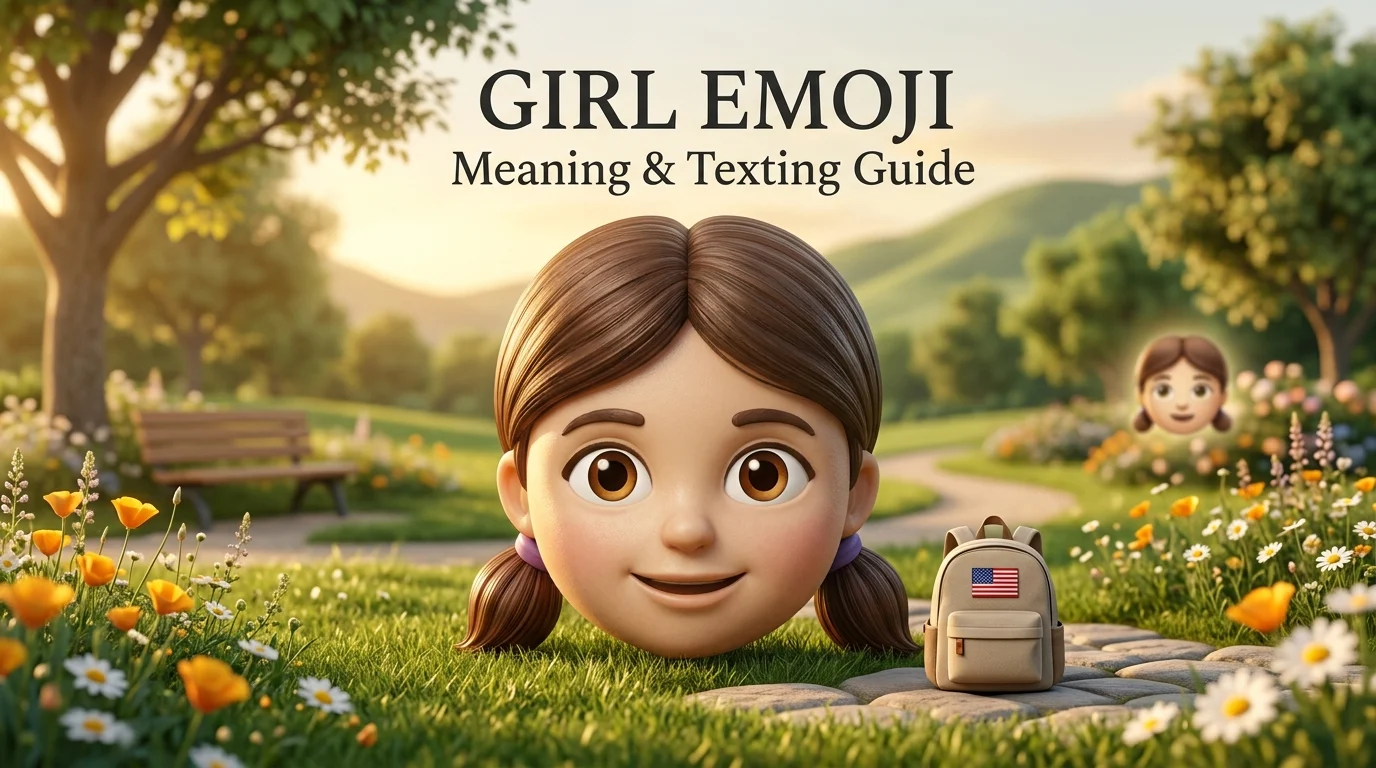
👧 usually means “girl” or “young female child.”
People use it to refer to:
- A girl or daughter
- A granddaughter or other young female family member
- Childhood or growing up
- A young girl mentioned in a conversation
- A cute or playful reference to a girl
Its tone is generally neutral, friendly, cute, or affectionate. Unlike some expressive face emojis, 👧 does not have a standard hidden romantic or emotional meaning.
The 👧 girl emoji represents a girl or young female child. It is commonly used when talking about a daughter, child, granddaughter, niece, childhood, or a young girl in general. Unicode lists 👧 as girl, with the code point U+1F467. Its meaning is usually literal rather than emotional, although context can make it feel cute, playful, or affectionate. It should not automatically be interpreted as referring to a teenage girl or adult woman because emoji meanings depend on context and the specific character being used.
What Does the Girl Emoji 👧 Mean?
The simplest meaning of 👧 is a girl.
For example:
“My daughter is starting school 👧”
Here, the emoji directly represents the girl being discussed.
It can also appear in messages about children, family, birthdays, school, childhood memories, or other situations involving a young girl.
Unicode places 👧 among human-form emoji and identifies it with the short name girl. Unicode also treats it as an explicitly gendered human-form emoji, in contrast with the gender-neutral 🧒 child.
👧 Meaning in Texting
In text messages, the girl emoji is usually straightforward.
Talking about a daughter
“My little girl had her first school performance 👧”
The emoji reinforces the reference to a girl or daughter.
Referring to a child
“There was a little girl at the park 👧”
Here, it has a literal meaning.
Talking about childhood
“I used to love dressing up when I was a kid 👧”
In this type of message, 👧 can visually reinforce the idea of being a young girl.
Adding a cute tone
“Look at this adorable little girl 👧”
The emoji can make the message feel warmer or more affectionate, but the exact feeling comes from the entire message rather than the emoji alone.
Does 👧 Mean “Girl” or “Woman”?
👧 specifically represents a girl, while 👩 represents a woman.
This distinction matters.
- 👧 = Girl
- 🧒 = Child
- 👩 = Woman
- 👦 = Boy
If you’re talking about an adult woman, 👩 is generally the more appropriate choice. If the person’s age is intentionally unspecified, 🧒 may be a better fit when referring to a child.
Unicode explicitly distinguishes 👧 girl from 👩 woman and 👦 boy from 👧 girl.
What Does 👧 Mean When Someone Sends It?
If someone sends 👧 in a conversation, start with the literal context.
For example:
“My niece is so funny 👧”
The emoji likely refers to the niece.
But if someone sends only:
“👧”
there is not enough information to determine exactly what they mean.
It could refer to:
- A girl
- A daughter
- A child
- Childhood
- A female character or person being discussed
- A playful reference to themselves or someone else
The Unicode Consortium notes that emoji do not have only one fixed meaning and that interpretation can vary with language, culture, and context.
Is the Girl Emoji 👧 Flirty?
No, 👧 is not inherently a flirty emoji.
It normally refers to a girl or young female child. If it appears in a personal conversation, the surrounding words and situation are much more useful for understanding the sender’s intention.
For example:
“My little sister is so funny 👧”
is clearly about a child.
A single 👧 emoji should not be treated as proof of flirting, attraction, or romantic interest.
Is 👧 Cute or Affectionate?
It can feel cute or affectionate when used in a warm message about a child.
For example:
“She looked so happy at her birthday party 👧🎂”
The combination creates a cheerful, affectionate tone.
However, the emoji itself does not officially mean “cute.” Its basic meaning is girl. The emotional tone comes from the surrounding message and situation.
👧 vs. 🧒: What’s the Difference?
The main difference is gender specificity.
👧 Girl specifically represents a girl.
🧒 Child represents a child without specifying gender.
Compare:
“The child is playing outside 🧒”
This leaves the child’s gender unspecified.
“The girl is playing outside 👧”
This identifies the child as a girl.
Unicode lists 🧒 as child and 👧 as girl, making them useful alternatives depending on whether gender is relevant to the message.
👧 vs. 👩: Girl or Woman?
This is another important distinction.
👧 Girl is generally used for a young female child.
👩 Woman represents an adult woman.
For example:
“My daughter is six 👧”
The girl emoji fits naturally.
But:
“My sister is a doctor 👩”
The woman emoji is generally more appropriate if referring to an adult.
The choice should reflect the person being described rather than being used as a general synonym for “female.”
Related People Emojis and Their Meanings
| Emoji | Official Name | Common Meaning | Tone | Where or When It Is Used |
|---|---|---|---|---|
| 👧 | Girl | Girl or young female child | Neutral, friendly, cute | Children, family, school, childhood |
| 👦 | Boy | Boy or young male child | Neutral, friendly | Children, family, school, childhood |
| 🧒 | Child | Child without specified gender | Neutral, gentle | General references to children |
| 👩 | Woman | Adult woman | Neutral, everyday | Adults, work, family, general references |
| 👨 | Man | Adult man | Neutral, everyday | Adults, work, family, general references |
| 👶 | Baby | Infant or very young baby | Cute, affectionate | Babies, birth, parenting |
| 👩👧 | Woman and Girl | Woman with a girl | Warm, family-focused | Parent-child or family contexts |
| 👨👧 | Man and Girl | Man with a girl | Warm, family-focused | Father-child or family contexts |
| 👧👧 | Girls | Two girls | Friendly, playful | Sisters, friends, groups of girls |
The easiest emojis to confuse with 👧 are 🧒 and 👩. Use 🧒 when the child’s gender does not matter, and 👩 when you’re referring to an adult woman. The family combinations such as 👩👧 and 👨👧 go further by showing a relationship between an adult and a girl. Unicode lists these as separate family or person combinations.
When Should You Use 👧?
The 👧 emoji works well when you want to:
- Refer to a girl or daughter
- Talk about childhood
- Mention a young female family member
- Discuss school or children’s activities
- Add a friendly visual reference to a girl
- Describe a group or family involving girls
If the person’s gender is unknown or irrelevant, 🧒 may be a better choice.
If the person is an adult woman, 👩 is more accurate.
Girl Emoji Examples in Text Messages
Example 1: Family
Message:
“My niece just started kindergarten 👧”
Likely meaning: The emoji represents the young girl mentioned in the message.
Example 2: Childhood
Message:
“I still remember my childhood photos 👧📸”
Likely meaning: The emoji refers to the speaker as a young girl in the context of childhood.
Example 3: School
Message:
“She had her first day at school today 👧🎒”
Likely meaning: It represents the girl going to school.
Example 4: Family relationship
Message:
“Mom and daughter day 👩👧”
Likely meaning: The combined emoji represents a woman and a girl in a family relationship.
These examples show possible uses rather than fixed meanings. The surrounding words provide the actual context.
Platform Appearance Can Vary
The design of 👧 can look slightly different across operating systems and platforms. Hair style, facial features, clothing, skin tone options, and other visual details may vary.
These design differences generally do not change its core meaning: girl.
Unicode also supports skin-tone modifier sequences for 👧, including light, medium-light, medium, medium-dark, and dark skin-tone variants.
Official Girl Emoji Details
- Emoji: 👧
- Unicode code point: U+1F467
- Unicode/CLDR short name: girl
- Category: People & Body
- Unicode version: Unicode 6.0
- Emoji version: Emoji 1.0
Emojipedia states that 👧 was approved as part of Unicode 6.0 in 2010 and added to Emoji 1.0 in 2015.
Unicode’s current emoji list identifies U+1F467 as girl and includes related keywords such as child, daughter, granddaughter, kid, young, and younger.
Common Misunderstandings About 👧
It does not automatically mean “daughter”
👧 can represent a daughter, but it can also simply mean girl or young female child.
It does not mean every female person
An adult woman is better represented by 👩 when age and gender are relevant.
It is not automatically romantic
The girl emoji has no standard romantic meaning. A personal conversation may give it a special context, but the emoji itself does not prove attraction or affection.
It does not always mean a specific real person
Someone may use 👧 symbolically for childhood, a fictional character, a general girl, or a visual reference.
It is not the same as 🧒
🧒 is gender-neutral, while 👧 specifically identifies a girl.
How to Respond to 👧
Your response depends on what the sender is talking about.
If they mention a child:
“Aww, she sounds adorable!”
If they are talking about childhood:
“Those memories are the best!”
If they simply send 👧 without context:
“What does the girl emoji mean here?”
A simple clarification is often better than trying to assign a hidden meaning to a single emoji.
Frequently Asked Questions
What does the 👧 emoji mean?
👧 means girl and usually represents a young female child. It can refer to a daughter, granddaughter, child, schoolgirl, or girl mentioned in a conversation.
What is the official name of 👧?
Unicode’s CLDR short name is girl, and its Unicode code point is U+1F467.
What does 👧 mean in texting?
It usually refers to a girl or young female child. Depending on context, it can also represent childhood, a daughter, or a cute reference to a girl.
What is the difference between 👧 and 🧒?
👧 specifically represents a girl, while 🧒 represents a child without specifying gender.
What is the difference between 👧 and 👩?
👧 represents a girl or young female child, while 👩 represents an adult woman.
Does 👧 mean a daughter?
It can. The emoji is often suitable when talking about a daughter, but it can also simply mean a girl or young female child.
Is 👧 a flirty emoji?
Not by itself. 👧 is primarily a literal people emoji and does not have a standard flirty meaning.
Can 👧 represent childhood?
Yes. Someone may use 👧 when talking about themselves or someone else as a young girl, especially in childhood memories or stories.
Conclusion
The 👧 girl emoji is a straightforward people emoji that represents a girl or young female child. It can refer to a daughter, family member, schoolgirl, childhood memory, or a girl mentioned in conversation. Its tone may feel cute or affectionate in some messages, but those feelings come from context rather than a fixed definition.
When choosing between 👧, 🧒, and 👩, the key difference is you want to identify a girl, an unspecified child, or an adult woman.








5 thoughts on “Girl Emoji Meaning 👧: What Does It Mean in Text?”