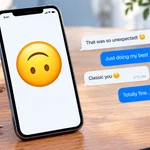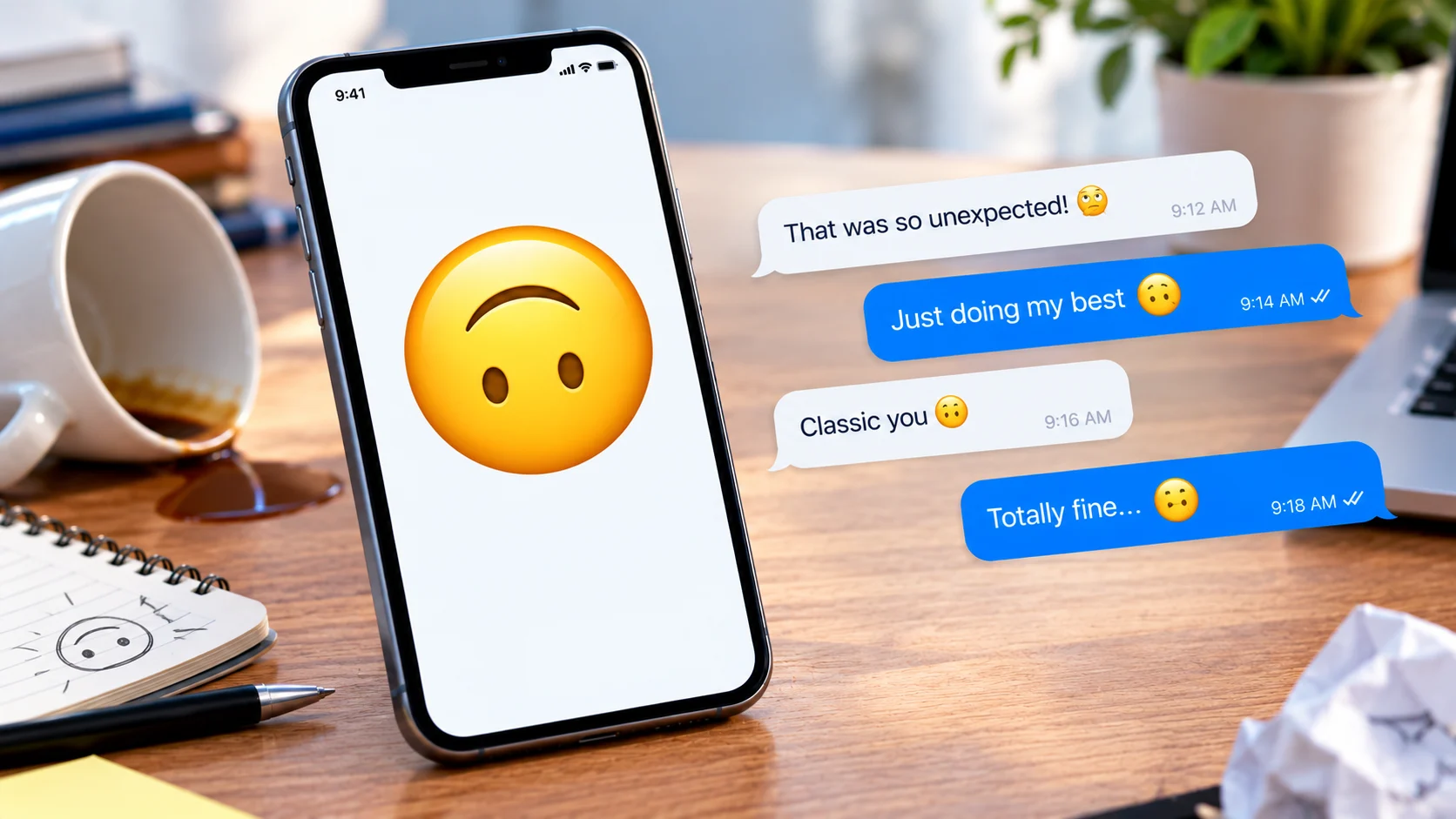
🙃 usually means sarcasm, irony, silliness, awkwardness, or a playful “oh well” reaction. In texts, it can also show mild frustration or emotional discomfort while keeping the message humorous rather than completely serious.
The upside down emoji 🙃, officially called Upside-Down Face, is commonly used to express sarcasm, irony, silliness, joking, awkwardness, or mild frustration. Its meaning can shift depending on the message around it.
Unlike a normal smiling emoji, 🙃 often suggests that something is not quite as cheerful as the smile makes it look. It can communicate a playful “well, this is awkward,” a sarcastic “sure,” or an exaggerated “everything is fine” feeling.
What Does the Upside Down Emoji 🙃 Mean?
The official Unicode name for 🙃 is Upside-Down Face. It shows a classic smiling face turned upside down and is represented by the code point U+1F643. Unicode lists it among its face emojis.
In everyday messaging, its meaning is less literal. People commonly use it when their words have a layer of irony, humor, or awkwardness.
For example:
“I absolutely love getting stuck in traffic for an hour. 🙃”
The smile does not mean the person genuinely enjoys traffic. The upside-down expression signals that the statement is sarcastic.
Upside Down Emoji Meaning in Text
The meaning of 🙃 can change depending on what comes before it.
Sarcasm
One of the clearest uses is sarcastic humor.
“Great, my phone died right before the meeting. 🙃”
Here, 🙃 suggests the opposite of genuine happiness. The sender is frustrated but presenting the situation with humor.
Irony
🙃 can point out a situation where reality feels ridiculous or contradictory.
“I finally cleaned my room, and now I can’t find anything. 🙃”
The emoji adds an ironic “of course this happened” feeling.
Awkwardness
It can also soften an uncomfortable or embarrassing situation.
“I just waved back at someone who wasn’t waving at me. 🙃”
The emoji makes the embarrassment feel more playful.
Mild Frustration
Sometimes 🙃 communicates annoyance without making the message sound openly angry.
“They changed the deadline again. 🙃”
The sender may be irritated, but the emoji gives the complaint a lighter, resigned tone.
Silliness
🙃 can simply make a message feel goofy or intentionally absurd.
“I have absolutely no idea what I’m doing 🙃”
In this context, it can mean something like “I’m being silly about this.”
Emojipedia describes the emoji as commonly expressing irony, sarcasm, joking, goofiness, or silliness, while also noting its use for awkwardness and bemused resignation.
Why Does 🙃 Feel Different From 🙂?
The two emojis look closely related, but their conversational effect can be very different.
🙂 Slightly Smiling Face generally presents a straightforward mild smile.
🙃 Upside-Down Face takes that smile and turns it into something more ambiguous. It can suggest that the apparent happiness is not completely genuine.
Compare:
“Sure, I can do that 🙂”
This can sound calm and friendly.
“Sure, I can do that 🙃”
Depending on context, this may suggest resignation, irony, or “I guess I have to.”
The surrounding words are what determine the exact tone.
Is 🙃 a Sarcastic Emoji?
Yes, 🙃 is commonly used for sarcasm, but sarcasm is not its only meaning.
For example:
“Love when the Wi-Fi stops working during an important call 🙃”
The statement sounds positive on the surface, but the emoji helps signal that the sender means the opposite.
Still, you should not assume every 🙃 is sarcastic. Someone may use it simply because something is awkward, silly, frustrating, or absurd.
Is the Upside Down Emoji Passive-Aggressive?
It can sometimes feel passive-aggressive, particularly when attached to a short or seemingly polite statement.
For example:
“No worries, take your time 🙃”
Depending on the previous conversation, this could mean:
- genuine patience
- mild annoyance
- sarcasm
- resignation
The emoji alone does not prove that the sender is being passive-aggressive. The conversation history and wording matter.
What Does 🙃 Mean From Someone?
When someone sends 🙃 to you, look at the entire message rather than treating the emoji as a fixed code.
For example:
“Well, that went exactly as planned 🙃”
This probably signals irony or frustration.
But:
“I accidentally wore two different socks today 🙃”
is more likely playful or self-deprecating.
The same emoji can therefore carry very different emotional weight.
Is 🙃 Flirty?
🙃 does not have a fixed romantic or flirty meaning.
Someone might use it during playful flirting, especially when a message is teasing or intentionally awkward, but the emoji itself does not establish romantic interest.
For example:
“Okay, maybe I was hoping you’d text me first 🙃”
could have a playful or flirty tone because of the words surrounding it.
By contrast:
“I forgot my umbrella again 🙃”
has no obvious romantic meaning.
Context matters more than the emoji by itself.
What Does 🙃 Mean From a Girl or Guy?
The meaning of 🙃 does not depend on the sender is a girl or a guy.
A person of any gender can use it to express sarcasm, awkwardness, humor, resignation, or irony. The better clues are the actual words, previous conversation, timing, relationship, and the sender’s normal communication style.
Upside Down Emoji vs. Similar Emojis
| Emoji | Official Name | Common Meaning | Tone | Where or When It Is Used |
|---|---|---|---|---|
| 🙃 | Upside-Down Face | Sarcasm, irony, awkwardness, silliness | Playful or ironic | Sarcastic texts, awkward moments, jokes |
| 🙂 | Slightly Smiling Face | Mild happiness or friendliness | Calm and friendly | Casual replies and positive messages |
| 🫠 | Melting Face | Embarrassment, overwhelm, awkwardness | Vulnerable or humorous | Awkward situations, heat, emotional overload |
| 😅 | Grinning Face with Sweat | Nervous relief, awkward humor | Nervous or relieved | Close calls, mistakes, uncomfortable moments |
| 😬 | Grimacing Face | Awkwardness, tension, discomfort | Uncomfortable | Cringe moments and difficult situations |
| 😏 | Smirking Face | Smugness, teasing, suggestiveness | Confident or teasing | Teasing, jokes, suggestive contexts |
| 🤭 | Face with Hand Over Mouth | Amusement, embarrassment, surprise | Playful or coy | Laughing, gossip, awkward reactions |
| 🤷 | Person Shrugging | Uncertainty, indifference, “I don’t know” | Casual or resigned | Unclear situations and “oh well” reactions |
The most commonly confused pair is 🙃 and 🙂. 🙂 usually presents a straightforward smile, while 🙃 often adds irony or an unusual emotional twist.
🙃 and 🫠 can both appear in awkward situations, but 🫠 tends to suggest feeling overwhelmed, embarrassed, or emotionally melted, while 🙃 more often creates an ironic or sarcastic tone.
🙃 and 😏 can both appear in teasing conversations, but 😏 has a more clearly smug or suggestive expression. 🙃 is usually more absurd, ironic, or awkward.
Upside Down Emoji Examples
“My alarm didn’t go off, so I woke up five minutes before work 🙃”
This suggests frustration mixed with humor.
“I definitely didn’t spend three hours watching random videos 🙃”
The emoji adds a joking, self-aware tone.
“Sure, I’ll fix it for the fifth time 🙃”
Here, the emoji can communicate resignation or mild annoyance.
“I just called my teacher ‘Mom’ 🙃”
This is a playful way to acknowledge an embarrassing mistake.
“Everything is completely under control 🙃”
Depending on the situation, this can strongly suggest irony because the reality is probably the opposite.
Can 🙃 Be Rude?
🙃 is not inherently rude, but it can sound dismissive, sarcastic, or annoyed in some messages.
For example:
“Yeah, that’s exactly what I wanted 🙃”
If someone has just made an unwanted decision for you, this could sound clearly sarcastic.
But:
“I forgot my keys again 🙃”
is simply self-directed humor.
If you’re unsure how the sender intended it, don’t treat the emoji alone as evidence of hostility.
How to Respond to 🙃
Your response should match the context.
If they’re joking:
“😂 What happened?”
If they’re frustrated:
“That sounds rough. What went wrong?”
If they’re being sarcastic:
“Okay, I can tell that was definitely not the plan 😂”
If you’re unsure:
“Wait, is that a happy 🙃 or an ‘everything is falling apart’ 🙃?”
That last response can work well in casual conversations because the emoji is deliberately ambiguous.
Upside Down Emoji Copy and Paste
🙃 Upside-Down Face
Copy it here:
🙃
The official Unicode code point is U+1F643. It was approved in Unicode 8.0 in 2015 and added to Emoji 1.0 the same year.
Official Upside Down Emoji Name and Details
- Emoji: 🙃
- Official Unicode name: Upside-Down Face
- Code point: U+1F643
- Unicode version: 8.0
- Emoji version: Emoji 1.0
- Common associations: irony, sarcasm, joking, silliness, awkwardness
Unicode’s current Emoji 18.0 chart lists 🙃 as upside-down face with keywords including “hehe,” “smile,” and “upside-down.”
Emojipedia notes that the emoji is implemented as a flipped version of 🙂 Slightly Smiling Face on most platforms, although designs can vary between vendors.
FAQs
What does the upside down emoji 🙃 mean?
🙃 usually expresses sarcasm, irony, silliness, awkwardness, or mild frustration. The exact meaning depends on the words and situation surrounding it.
Is 🙃 a sarcastic emoji?
Yes, 🙃 is commonly used to signal sarcasm or irony. It can also express joking, awkwardness, resignation, or a playful “oh well” feeling.
What does 🙃 mean from a girl?
It has no special meaning based on the sender’s gender. It can mean sarcasm, awkwardness, humor, frustration, or irony depending on the conversation.
Is 🙃 a flirty emoji?
Not by itself. It can appear in a playful or flirty conversation, but the surrounding words and relationship provide the actual romantic context.
What is the difference between 🙃 and 🙂?
🙂 usually communicates a straightforward mild smile, while 🙃 often adds irony, sarcasm, awkwardness, or a sense that the situation is not quite as cheerful as it appears.
What is the difference between 🙃 and 🫠?
🙃 is commonly used for irony and sarcasm, while 🫠 more often conveys feeling overwhelmed, embarrassed, awkward, or emotionally “melted.”
Conclusion
The upside down emoji 🙃 is much more than a smiley turned upside down. It is commonly used to add irony, sarcasm, silliness, awkwardness, or mild frustration to a message.
Its biggest clue is the contrast between the smile and the situation. When someone says something that sounds positive but adds 🙃, they may be signaling that the reality is anything but straightforward.
See Also More:
- Announcement Emoji Meaning | What Does It Mean In 2026
- Lock Emoji Meaning | What It Means in Text & Messages in 2026
- Bowing Emoji Meaning | What It Means in Text & How to Use It In 2026