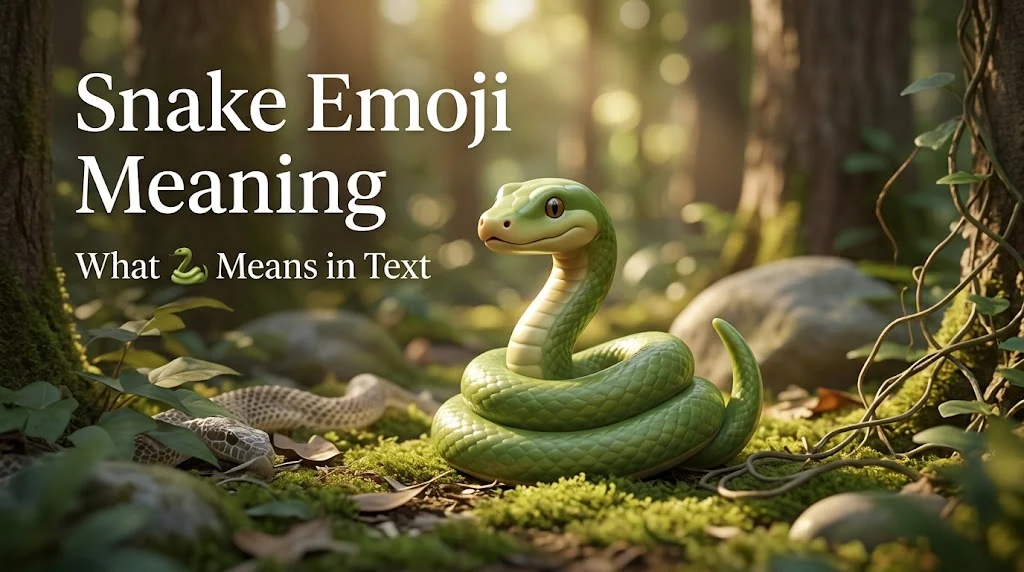
The 🐍 snake emoji usually represents a snake, but in texts it can also suggest someone is being sneaky, deceptive, or untrustworthy. Its meaning can shift from playful to negative depending on the conversation and context.
The 🐍 snake emoji usually represents an actual snake, but in messages it can also suggest someone is being sneaky, deceptive, manipulative, or untrustworthy. The meaning depends heavily on the words around it. In a harmless conversation, 🐍 may simply refer to snakes, reptiles, wildlife, the Chinese zodiac, or even the Python programming language. In a teasing or critical message, however, it can carry a much sharper tone.
What Does the 🐍 Snake Emoji Mean?
The 🐍 snake emoji commonly means:
- A real snake or reptile
- Something sneaky, suspicious, or deceptive
- A playful warning or teasing reaction
- The Chinese zodiac sign of the Snake
- Ophiuchus or other snake-related symbolism
- Python programming in technical conversations
Its tone can range from neutral and literal to playful, sarcastic, or negative. The surrounding message matters more than the emoji alone.
What Is the Official Name of 🐍?
The official Unicode name is SNAKE, and its code point is U+1F40D. Unicode places it in the animal/reptile category. The emoji was approved in Unicode 6.0 in 2010 and later included in Emoji 1.0 in 2015.
The character is generally shown as a snake with a long body and a visible tongue, although its exact artwork can vary between platforms and operating systems. The Unicode name identifies the character; it does not assign every informal meaning people give it.
Snake Emoji Meaning in Text
In texting, 🐍 can have several meanings.
1. A Literal Snake
The simplest use is simply talking about a snake.
“We saw a snake on the hiking trail 🐍”
Here, there is no hidden message. The emoji adds a visual reference to the animal.
2. Someone Is Being Sneaky
A common figurative use is to describe behavior that seems secretive, dishonest, or untrustworthy.
“You really made plans without telling me 🐍”
Depending on the relationship and tone, the emoji may suggest, “That was sneaky.”
3. Calling Someone Two-Faced or Untrustworthy
In a disagreement, 🐍 can become more negative.
“Now I know who I can trust 🐍”
In this context, the snake may symbolize betrayal or a person the sender considers untrustworthy.
That does not mean 🐍 automatically accuses someone of lying. The surrounding words and conversation history are what give it that interpretation.
4. Playful Teasing
Friends can also use the emoji without serious hostility.
“You took the last slice again 🐍😂”
Here, the snake can make the complaint feel exaggerated and humorous rather than genuinely angry.
Is the Snake Emoji Negative?
It can be, but it is not always negative.
A literal wildlife conversation may use 🐍 with no emotional meaning at all. A joking conversation may use it as playful teasing. In an argument, the same emoji can sound much harsher.
A useful way to read it is:
Literal context → neutral
Friendly teasing → playful
Accusation or conflict → potentially negative
This is why interpreting the emoji by itself can lead to misunderstandings.
Can 🐍 Mean Sneaky or Manipulative?
Yes. This is one of the most common figurative interpretations of the snake emoji. Emojipedia notes that it is often used metaphorically for sneaky or manipulative behavior and to describe someone as untrustworthy.
For example:
“He changed the story again 🐍”
The emoji reinforces the idea that the person’s behavior seems suspicious.
Still, it is better to treat this as a contextual interpretation, not a guaranteed definition.
Snake Emoji in a Relationship or Friendship
When someone sends 🐍 during a friendship or relationship conversation, the meaning depends on what happened before it.
It might suggest:
- “That was sneaky.”
- “You caught me.”
- “You’re acting suspicious.”
- “I’m teasing you.”
- “I don’t trust what you just did.”
It does not automatically mean the sender is ending the friendship, accusing someone of cheating, or expressing hatred.
If the message is serious, the surrounding words usually make that clear.
Is 🐍 Flirty?
The snake emoji is not inherently a flirting emoji.
Someone could use it in playful banter, but that does not prove romantic interest. If it appears alongside clearly affectionate or playful language, it may contribute to that tone. Without that context, 🐍 is more naturally understood as literal, symbolic, teasing, or suspicious.
Snake Emoji Symbolism
Snakes have many meanings across cultures and contexts, so 🐍 can take on different symbolic roles.
It may be connected with:
- Snakes and reptiles
- Danger or caution
- Sneakiness or deception
- Transformation and renewal in some symbolic traditions
- The Chinese zodiac
- Ophiuchus or the Serpent-Bearer
- Fantasy, mythology, and storytelling
Unicode specifically identifies 🐍 as the sixth sign of the Asian zodiac in its character documentation.
The emoji itself does not guarantee any particular cultural or spiritual interpretation. The surrounding topic determines which meaning is most relevant.
🐍 Snake Emoji in the Chinese Zodiac
The snake is one of the animals in the Chinese zodiac cycle. Unicode’s documentation identifies 🐍 as the sixth of the Asian zodiac signs.
Someone discussing a zodiac year, Chinese New Year, or astrology may therefore use 🐍 in a completely neutral or celebratory way.
For example:
“It’s the Year of the Snake 🐍”
In that sentence, the emoji has nothing to do with deception or suspicious behavior.
🐍 and Ophiuchus
The snake can also appear in discussions involving Ophiuchus, the Serpent-Bearer. Unicode lists “Ophiuchus” and “serpent” among associated keywords for 🐍.
This can make the emoji useful in conversations about astrology, constellations, mythology, or related symbolism.
🐍 in Coding and Technology
The snake emoji may also appear in programming discussions because Python is a programming language and the snake is commonly associated with it.
For example:
“I’m learning Python this week 🐍”
Here, 🐍 is simply a visual reference to Python programming rather than an insult or warning.
Related Emojis: 🐍 Compared With Similar Emojis
| Emoji | Official Name | Common Meaning | Tone | Where or When It Is Used |
|---|---|---|---|---|
| 🐍 | Snake | Snake, sneakiness, deception, zodiac | Neutral, playful, or negative | Wildlife, jokes, criticism, zodiac, coding |
| 🦎 | Lizard | Lizard or reptile | Neutral | Nature, reptiles, animals |
| 🐊 | Crocodile | Crocodile or alligator-like reptile | Neutral, sometimes playful | Wildlife, jokes, nature |
| 🐉 | Dragon | Mythical dragon, fantasy, power | Playful or dramatic | Fantasy, games, stories, celebrations |
| 🐲 | Dragon Face | Dragon character or mythical creature | Playful, fantastical | Games, fantasy, mythology |
| 🐢 | Turtle | Turtle, slowness, patience | Friendly or playful | Animals, nature, jokes |
| 🦕 | Sauropod | Long-necked dinosaur | Playful | Dinosaurs, children’s topics, jokes |
| 🦖 | T-Rex | Tyrannosaurus or dinosaur | Playful, energetic | Dinosaurs, humor, games |
The biggest difference is that 🐍 has a stronger figurative meaning than most of these animal emojis. 🦎 usually just identifies a lizard, while 🐉 and 🦖 often point to fantasy or dinosaurs. 🐍 can describe an actual animal, but in the right context it can also characterize someone’s behavior.
Snake Emoji Message Examples
Example 1: Literal Meaning
“There was a snake near the campsite 🐍”
Likely meaning: A real snake was seen.
The surrounding words make the literal interpretation obvious.
Example 2: Sneaky Behavior
“You already knew about the surprise? 🐍”
Likely meaning: The sender is teasing the person for keeping something secret.
The emoji adds a playful accusation rather than necessarily making the message hostile.
Example 3: Serious Suspicion
“I found out what really happened 🐍”
Likely meaning: The sender may be accusing someone of dishonest or suspicious behavior.
Here, the surrounding conversation matters a lot because the same emoji could sound joking between close friends.
Example 4: Python Programming
“Finally finished my Python project 🐍”
Likely meaning: Python programming.
Nothing negative is implied.
Common Misunderstandings About 🐍
One of the easiest mistakes is assuming that every snake emoji is an insult.
For example:
“My favorite animal is the snake 🐍”
This is clearly literal.
Likewise:
“Chinese zodiac: Snake 🐍”
is a zodiac reference.
Another mistake is assuming 🐍 always means “liar.” It can suggest deception or untrustworthiness in certain contexts, but the sender may simply be joking or talking about an actual snake.
How to Respond to the Snake Emoji
Your response should depend on the message surrounding it.
If it is clearly playful:
“Okay, okay, you caught me 😂”
If someone seems suspicious:
“Wait, what did I do? 😅”
If it is about a real snake:
“No way! Was it close? 🐍”
If you’re unsure:
“Wait, what do you mean by the snake? 😂”
Asking for clarification is often better than assuming the sender intended an insult.
Copy and Paste Snake Emoji
Here is the emoji by itself:
🐍
You can copy it for messages about snakes, reptiles, wildlife, zodiac topics, playful teasing, or other contexts where it fits.
FAQs
What does the 🐍 snake emoji mean?
The 🐍 snake emoji can literally represent a snake, but it may also suggest sneakiness, deception, suspicious behavior, or someone being untrustworthy. In other contexts, it can refer to the Chinese zodiac, Ophiuchus, mythology, or Python programming.
Does 🐍 mean someone is a liar?
Not necessarily. It can be used to suggest that someone is deceptive or untrustworthy, but context determines the emoji is serious, playful, literal, or symbolic.
Is the snake emoji rude?
It can feel rude when it is directed at someone during an argument or accusation. Between friends, it may simply be teasing. The surrounding message is more important than the emoji alone.
Is 🐍 a flirting emoji?
Not by itself. The snake emoji does not have an official romantic meaning. If it appears in playful conversation, it may contribute to a flirty tone, but you should look at the complete conversation before interpreting it that way.
What does 🐍 mean from someone in a text?
It could mean “snake,” “sneaky,” “suspicious,” or “you got caught,” depending on the conversation. A literal message about wildlife may have no hidden meaning at all.
What is the official name of 🐍?
Its official Unicode name is SNAKE, with the code point U+1F40D.
When was the snake emoji added?
🐍 was approved as part of Unicode 6.0 in 2010 and added to Emoji 1.0 in 2015.
What is the difference between 🐍 and 🦎?
🐍 represents a snake, while 🦎 represents a lizard. The snake emoji also has a stronger figurative association with sneakiness or deception, while 🦎 is generally more literal.
Conclusion
The 🐍 snake emoji can be much more than a picture of a reptile. It may represent an actual snake, a zodiac sign, Python programming, playful teasing, or suspicious and deceptive behavior. The safest way to understand it is to read the emoji together with the words, relationship, and tone of the conversation rather than assigning it one fixed meaning.
See Also More:
- Bird Emoji Meaning | From Simple Bird to Playful Texting Symbol In 2026
- Santa Emoji Meaning | Christmas Cheer, Gifts & Holiday Spirit In 2026
- Clapping Emoji Meaning | Applause, Praise & More In 2026









11 thoughts on “🐍 Snake Emoji Meaning | What It Really Says in Text & Conversation In 2026”