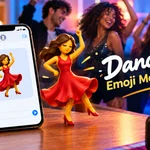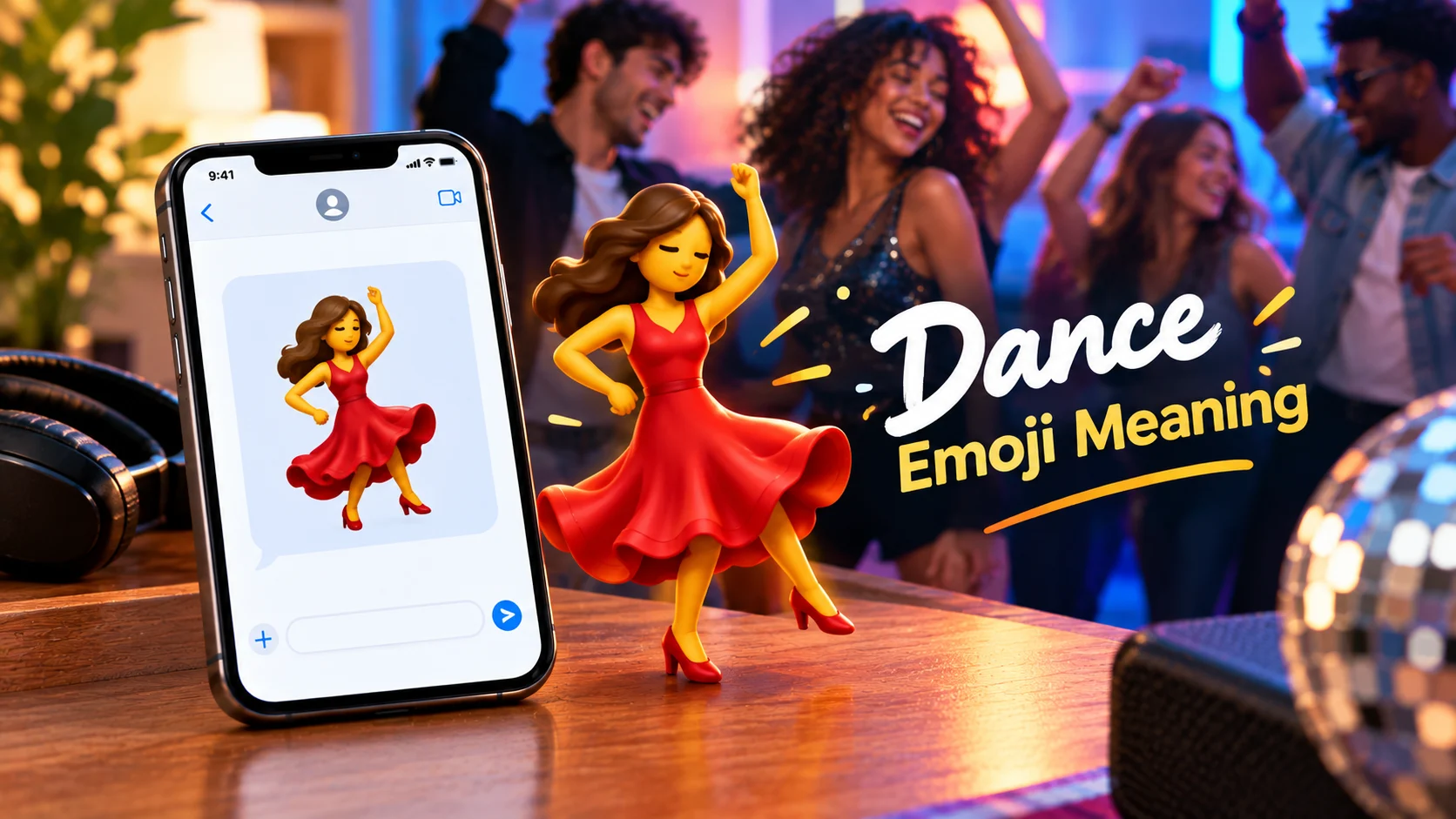
💃 Dance emoji meaning: dancing, celebration, confidence, fun, excitement, or a happy reaction. It can be literal such as talking about a dance class or figurative, such as adding 💃 after good news. It is generally positive and playful, but it does not automatically mean flirting or romantic interest.
The dance emoji 💃 usually expresses dancing, fun, celebration, excitement, or a positive reaction. It can be used literally when someone is talking about dancing, but in texts it often works more like a cheerful reaction: “Great!” “I’m excited!” or “Let’s celebrate!”
The official Unicode/CLDR name is Woman Dancing, although the emoji was originally introduced under the name Dancer. Its exact meaning depends on the surrounding message, the relationship between the people texting, and the sender’s usual style.
What Does the Dance Emoji 💃 Mean?
The 💃 emoji represents a person dancing, commonly shown with one arm raised and wearing a red dress. Unicode currently lists its CLDR short name as woman dancing. It has the Unicode code point U+1F483.
In everyday messaging, 💃 can communicate several closely related ideas:
- Dancing: “I’m going dancing tonight 💃”
- Celebration: “We passed the exam 💃”
- Excitement: “The weekend is finally here 💃”
- Fun: “That sounds like a good time 💃”
- Positive approval: “Yes, exactly 💃”
- Confidence or playful energy: “I’m feeling good today 💃”
The emoji is often less about actual dance movements and more about the feeling of being happy, energetic, or ready to celebrate.
The emotional tone of 💃
The dance emoji usually has a positive, upbeat, playful, and celebratory tone.
It can make an otherwise simple message feel more energetic:
“We got tickets 💃”
Without the emoji, the sentence is simply information. With 💃, it feels more like a small celebration.
The same effect can work with short reactions:
“Finally! 💃”
Here, the emoji helps show excitement or relief rather than describing literal dancing.
💃 Meaning in Text Messages
In texting, the dance emoji is often used as a reaction emoji rather than a literal description of dancing.
For example:
“I finished all my homework 💃”
Likely meaning: The sender is happy to be finished and is celebrating.
“Friday is tomorrow 💃”
Likely meaning: The sender is excited about the weekend.
“We’re going to the concert tonight 💃”
Likely meaning: The sender is excited and may literally be expecting to dance or have fun.
The words around 💃 usually provide the best clue. Unicode itself notes that emoji meanings can change depending on language, culture, and context.
Can 💃 Mean “Yay” or “I’m Happy”?
Yes. 💃 can function as a visual version of “yay,” “woohoo,” or “let’s go.”
Someone might send:
“I got the job 💃”
The emoji does not necessarily mean the person is physically dancing. It adds a celebratory reaction to the good news.
This use is especially common when the sender wants a message to feel lively without writing a longer reaction.
Is the Dance Emoji 💃 Flirty?
It can appear in a playful or flirty conversation, but 💃 is not inherently a flirting emoji.
The emoji itself mainly communicates dancing, fun, celebration, or positive energy. A message feels flirty depends much more on the surrounding words and the existing relationship.
Compare:
“Let’s celebrate tonight 💃”
This could simply be friendly excitement.
“You looked amazing tonight 💃”
The words may give the message a more personal or flirtatious tone.
The emoji alone is not enough to prove romantic interest. It is better to interpret the entire message instead of assigning a relationship meaning to 💃 automatically.
Can 💃 Be Sarcastic?
Yes, although sarcasm usually comes from the message and context, not from the emoji itself.
For example:
“Another meeting at 7 a.m. tomorrow 💃”
The dance emoji clashes with the complaint, which can create a joking or sarcastic effect.
The sender may actually be unhappy about the early meeting while using 💃 to make the complaint humorous.
This is one reason emoji interpretation should not rely on a single fixed definition.
Does 💃 Mean Confidence?
Sometimes.
The dancing pose can give a message a confident, energetic, or carefree feeling. Someone might write:
“New outfit, new mood 💃”
Here, 💃 can reinforce a sense of confidence and fun.
However, confidence is a contextual interpretation, not the emoji’s official definition.
What Does 💃 Mean From Someone?
When someone sends you 💃, first look at what they are responding to.
If you tell them:
“I finally finished my project!”
and they reply:
“💃”
they are probably celebrating your good news with you.
If they send:
“Going out tonight 💃”
they may simply be expressing excitement about their plans.
If the emoji appears alongside a compliment or playful message, the overall conversation may feel more personal or flirtatious. Still, 💃 by itself does not establish romantic intent.
Dance Emoji Examples and Context
| Message | Likely Meaning | Why Context Matters |
|---|---|---|
| “We’re officially on vacation 💃” | Celebration and excitement | The vacation announcement gives the emoji a festive meaning. |
| “Dance class tonight 💃” | Literal dancing | The surrounding words directly refer to dancing. |
| “I finally submitted it 💃” | Relief and happiness | The emoji celebrates completing a task. |
| “Friday is here 💃” | Excitement | It acts as a cheerful reaction to the weekend. |
| “Another Monday morning 💃” | Possible sarcasm | The upbeat emoji may contrast with the unpleasant situation. |
| “You’re coming with us? 💃” | Excitement | It can make the invitation feel more energetic and playful. |
These are hypothetical examples showing how context can change the interpretation.
Related Emojis to Know
Several emojis can communicate dancing, celebration, excitement, or playful energy. They are not interchangeable, though.
| Emoji | Official Name | Common Meaning | Tone | Where or When It Is Used |
|---|---|---|---|---|
| 💃 | Woman Dancing | Dancing, fun, celebration | Playful, energetic | Celebrations, reactions, dance-related messages |
| 🕺 | Man Dancing | Dancing, partying, celebration | Playful, energetic | Dance, parties, upbeat reactions |
| 🧑🩰 | Ballet Dancer | Ballet or dance performance | Artistic, graceful | Dance-related conversations and performances |
| 🪩 | Mirror Ball | Disco, dancing, party atmosphere | Festive, playful | Parties, music, nightlife themes |
| 🕺🏻 | Man Dancing: Light Skin Tone | Dancing with a specified skin tone | Energetic, playful | Dance and celebration messages |
| 🥳 | Partying Face | Celebration, excitement, congratulations | Very festive | Birthdays, achievements, good news |
| 🎉 | Party Popper | Celebration or congratulations | Festive | Announcements, achievements, parties |
| 🎊 | Confetti Ball | Celebration and festive excitement | Cheerful, celebratory | Parties, milestones, congratulations |
The closest direct counterpart to 💃 is 🕺 Man Dancing. Unicode lists both as distinct gendered dancing emojis: 💃 is U+1F483 and 🕺 is U+1F57A.
The newer 🧑🩰 Ballet Dancer is different because it specifically represents a person performing ballet and provides a gender-neutral ballet-dancer option. It was approved in Emoji 17.0 in 2025.
For general celebration, 🥳 or 🎉 may be a better choice than 💃. If you want to emphasize dancing or energetic fun, 💃 is more specific.
💃 vs. 🕺: What’s the Difference?
The basic difference is the depicted gender.
- 💃 Woman Dancing represents a woman dancing.
- 🕺 Man Dancing represents a man dancing.
Both can express dancing, celebration, partying, or upbeat energy. The 🕺 emoji was added in 2016 as a gender counterpart to the existing dancer emoji.
So if the gender of the person is not relevant, the choice can simply come down to the appearance or style the sender prefers.
💃 vs. 🥳
These emojis can both communicate excitement, but they do it differently.
💃 focuses on dancing, energy, fun, or a celebratory reaction.
🥳 focuses more directly on partying, celebration, and festive excitement.
For example:
“I got concert tickets 💃”
feels energetic and playful.
“I got concert tickets 🥳”
feels more like a straightforward celebration.
💃 vs. 🎉
🎉 Party Popper is a general celebration symbol. It works well for birthdays, achievements, announcements, and congratulations.
💃 adds a more personal, energetic, human reaction.
You might use:
“Congratulations! 🎉”
for a simple celebration.
Or:
“We did it! 💃”
for a more expressive, playful reaction.
How to Respond to 💃
Your response should match the conversation rather than assuming what the sender meant.
If they’re celebrating
“Yesss! 🎉”
If they’re excited about plans
“That sounds fun!”
If they’re talking about dancing
“Have a great time 💃”
If you’re unsure what they mean
“Haha, what are we celebrating? 😄”
A simple response is usually better than trying to decode a single emoji too deeply.
Common Misunderstandings About 💃
It doesn’t always mean actual dancing
Someone can use 💃 while sitting at a desk, celebrating good news, or reacting to a funny situation.
It doesn’t automatically mean flirting
A playful conversation can contain 💃 without any romantic meaning.
It doesn’t prove confidence
The emoji can create a confident or energetic feeling, but that interpretation depends on the message.
It doesn’t have one universal meaning
Unicode explains that emoji meanings can vary according to context, culture, and language.
Its appearance can differ across platforms
Emoji artwork is created by individual platform vendors, so the exact appearance of 💃 may vary between devices and services. Emojipedia notes that the emoji has had different designs across platforms over time.
Official Dance Emoji Details
For the emoji most commonly called the dance emoji, the relevant Unicode character is:
- Emoji: 💃
- Current CLDR short name: Woman Dancing
- Unicode code point: U+1F483
- Original Unicode name: DANCER
- Unicode version: 6.0
- Emoji version: Emoji 1.0
Unicode’s current emoji list identifies U+1F483 as woman dancing, while historical Unicode documentation records its original name as DANCER.
The distinction matters because people often search for this character using informal terms such as dance emoji, dancer emoji, or dancing woman emoji, while the current official CLDR name is Woman Dancing.
Copy and Paste the Dance Emoji
💃
You can copy and paste it into a text, caption, comment, or message.
Skin-tone versions are also supported, including 💃🏻, 💃🏼, 💃🏽, 💃🏾, and 💃🏿. Unicode lists these as skin-tone modifier sequences for Woman Dancing.
FAQs
What does the 💃 emoji mean?
💃 usually represents dancing, fun, celebration, excitement, or a positive reaction. Its exact meaning depends on the surrounding message.
What does 💃 mean in texting?
In texting, 💃 often works as an energetic reaction. It can mean “yay,” “I’m excited,” “let’s celebrate,” or simply indicate that someone is dancing.
Is 💃 a flirting emoji?
Not by itself. 💃 can appear in a flirtatious conversation, but it more generally expresses fun, dancing, excitement, or celebration.
What is the official name of 💃?
The current CLDR short name is Woman Dancing. The Unicode code point is U+1F483, and its original Unicode name was DANCER.
What is the difference between 💃 and 🕺?
💃 is Woman Dancing, while 🕺 is Man Dancing. Both can express dancing, partying, celebration, and upbeat energy.
Can 💃 be sarcastic?
Yes. A sender may use the cheerful dancing emoji after an unpleasant statement to create a joking or sarcastic contrast. The surrounding words are what make the sarcasm clear.
What emoji is similar to 💃?
🕺 is the closest direct counterpart. 🪩, 🥳, and 🎉 can also fit celebratory or party-related messages, while 🧑🩰 is more specifically associated with ballet.
Conclusion
The dance emoji 💃 is mainly a cheerful symbol for dancing, fun, celebration, excitement, and positive energy. In text messages, it often works as an expressive reaction rather than a literal description of dancing. It can make a message feel more playful or festive, but its presence does not automatically signal flirting, confidence, or romantic interest. The surrounding words and conversation are the best guide to what the sender actually means.
See Also More:
- Bird Emoji Meaning | From Simple Bird to Playful Texting Symbol In 2026
- Santa Emoji Meaning | Christmas Cheer, Gifts & Holiday Spirit In 2026
- Clapping Emoji Meaning | Applause, Praise & More In 2026