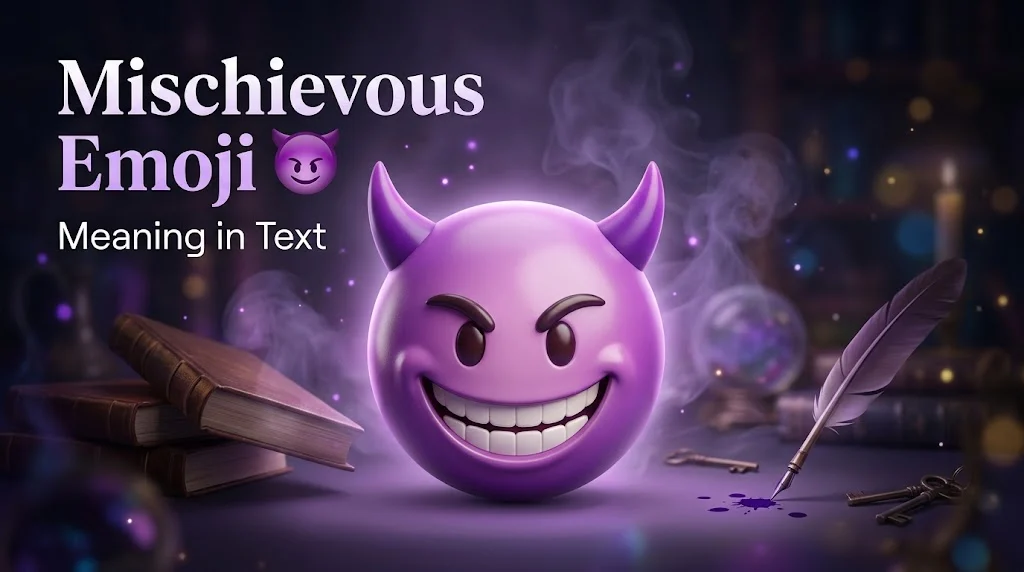
😈 usually means “I’m being mischievous,” “I’m feeling naughty,” or “I’m up to something.” It can add a playful or devilish tone to a message.
The 😈 mischievous emoji usually refers to 😈 Smiling Face with Horns, a playful, devilish expression used to show mischief, naughtiness, excitement, or a joking “I know what I’m doing” attitude. Unicode’s official name is Smiling Face with Horns, not “Mischievous Face.” The mischievous meaning comes from its devilish design and common informal use.
Depending on the message around it, 😈 can make a comment feel playful, teasing, cheeky, dramatic, or slightly suggestive. It does not automatically mean something romantic or negative.
For example:
“I ate the last slice 😈”
Here, 😈 makes the statement sound cheeky rather than serious.
The same emoji can also appear in jokes, Halloween posts, playful teasing, or messages where someone is excited about doing something a little rebellious.
What Is the Mischievous Emoji?
The emoji commonly called the mischievous emoji is 😈 Smiling Face with Horns.
Unicode lists it as U+1F608, with the official name “Smiling Face with Horns.” It was approved in Unicode 6.0 in 2010 and later included in Emoji 1.0.
Visually, it is usually shown as a purple face with devil horns, a broad smile, and narrowed eyes. Its appearance can vary somewhat between platforms, but the central idea remains a smiling, devilish character.
The word “mischievous” fits especially well because the emoji often suggests playful trouble rather than genuine harm.
What Does 😈 Mean in Text?
In texting, 😈 often adds a cheeky or mischievous tone to words that could otherwise sound ordinary.
It can suggest:
- “I’m being a little naughty.”
- “I have a plan.”
- “I know this is mischievous.”
- “That was fun.”
- “I’m teasing you.”
- “I’m feeling rebellious.”
- “This is going to be interesting.”
The surrounding words matter. Compare:
“I finished the project 😈”
This could jokingly suggest that the person did something unexpected or feels pleased with what they pulled off.
But:
“I’m going to prank him 😈”
makes the mischievous meaning much clearer.
The emoji adds tone; it does not create a single fixed meaning for the sentence.
Is 😈 a Bad or Evil Emoji?
Not necessarily.
Because 😈 has devil horns, it can represent devilish behavior, a devil, evil, or something wicked. But in everyday messages, it is often much lighter and more playful than the imagery suggests. Emojipedia describes it as commonly expressing mischief, naughtiness, excitement, or “wicked” in slang.
Someone might use it after admitting to a harmless prank, joking about breaking a small rule, or celebrating a cheeky win.
So the emoji should not automatically be read as “evil.” The conversation determines the tone is playful, dramatic, or genuinely negative.
When Does 😈 Feel Playful?
😈 feels playful when the surrounding message is clearly a joke, tease, prank, or harmless confession.
For example:
“I changed the group chat name again 😈”
The emoji makes the message sound knowingly cheeky.
Another example:
“Guess who got the last cookie 😈”
Here, the emoji signals playful teasing rather than hostility.
In these situations, 😈 works almost like a written grin that says, “Yes, I did that—and I know you noticed.”
Can 😈 Be Flirty or Suggestive?
It can sometimes have a suggestive or flirty tone, but the emoji alone does not prove romantic interest.
The same 😈 can be used between friends, in jokes, during playful teasing, or in other situations where someone wants to sound cheeky. Emojipedia specifically notes that 😈 can be more playful and suggestive than 👿, but context still determines what the sender intended.
If the surrounding conversation is already playful, 😈 may simply intensify that tone.
If the conversation has romantic or suggestive context, the same emoji may take on a more suggestive meaning.
The safest interpretation is to look at the whole message and the relationship between the people, rather than treating 😈 as proof of attraction.
What Does 😈 Mean From Someone?
When someone sends 😈 to you, they may be saying that they are:
- joking around
- teasing you
- feeling mischievous
- proud of something cheeky
- planning something playful
- exaggerating a “bad” or rebellious attitude
- adding a devilish tone to a statement
For example:
“You better watch out 😈”
This could be friendly teasing, especially if the conversation is already humorous.
On the other hand:
“I finally beat your score 😈”
is more clearly a playful celebration.
There is no universal hidden message behind the emoji. The sender’s wording and normal communication style are more useful clues.
😈 in Friendship and Everyday Conversations
Among friends, the mischievous emoji can make a message sound more humorous or teasing.
It works well after:
- harmless jokes
- playful challenges
- funny confessions
- surprise plans
- small pranks
- joking complaints
- playful bragging
For example:
“I told everyone your embarrassing nickname 😈”
The emoji signals that the statement is being delivered with a cheeky attitude.
Still, the exact tone depends on the friendship. A message that feels funny between close friends could feel rude or annoying in a different relationship.
😈 vs. 😏: What’s the Difference?
These two emojis are easy to confuse because both can suggest a sly or cheeky attitude.
😈 Smiling Face with Horns is more openly devilish, mischievous, naughty, or playful. 😏 Smirking Face has a sideways-looking expression and is more associated with smugness, slyness, flirtation, or suggestive undertones. Emojipedia distinguishes 😈 from 👿 by its more playful expression and describes 😏 as sly, smug, mischievous, or suggestive.
A simple way to remember them:
- 😈 = “I’m being a little devil.”
- 😏 = “I know something, and I’m giving you a knowing look.”
Neither one has a guaranteed romantic meaning.
Related Emojis Similar to 😈
| Emoji | Official Name | Common Meaning | Tone | Where or When It Is Used |
|---|---|---|---|---|
| 😈 | Smiling Face with Horns | Mischief, naughtiness, devilish fun | Playful, cheeky | Jokes, teasing, playful confessions |
| 👿 | Angry Face with Horns | Anger, devilish behavior, evil | Angry, menacing | Strong frustration, dramatic jokes, Halloween |
| 😏 | Smirking Face | Slyness, smugness, knowing humor | Sly, suggestive | Teasing, jokes, confident remarks |
| 😉 | Winking Face | A joke, playful hint, or light teasing | Playful, friendly | Casual texts, jokes, teasing |
| 😜 | Winking Face with Tongue | Silly joking or playful teasing | Goofy, playful | Jokes, banter, humorous comments |
| 😇 | Smiling Face with Halo | Innocence or pretending to be innocent | Sweet, playful | “I did nothing” jokes or innocent humor |
| 🤭 | Face with Hand Over Mouth | Surprise, embarrassment, or suppressed laughter | Playful, shy | Funny reactions, awkward moments |
| 😼 | Cat with Wry Smile | Sly or mischievous attitude | Cheeky, sly | Playful cat-themed reactions and teasing |
The biggest distinction is between 😈 and 👿. Both have horns, but 😈 is smiling and generally feels more playful, while 👿 has an angry expression and can feel much more hostile or menacing.
The other common confusion is 😈 vs. 😏. 😈 gives off a more obvious “devilish” or naughty vibe, while 😏 tends to communicate a knowing, smug, or sly expression.
Mischievous Emoji Examples in Text
Example 1
“I took the last piece of pizza 😈”
Likely meaning: A playful admission that the sender did something cheeky.
Example 2
“Wait until you see what I planned 😈”
Likely meaning: The sender is teasing you about a surprise or playful plan.
Example 3
“I totally won that argument 😈”
Likely meaning: Playful confidence or teasing rather than serious hostility.
Example 4
“No spoilers… I already watched it 😈”
Likely meaning: A cheeky confession.
Example 5
“Halloween is coming 😈🎃”
Likely meaning: Devilish or spooky fun. The Halloween context makes the horns especially relevant.
These examples are illustrations, not universal rules. A different conversation could give the same emoji a different tone.
How to Respond to 😈
Your response should match the tone of the message rather than assuming what the sender means.
If they are joking:
“Haha, I knew you were up to something 😂”
If they are teasing you:
“Oh, so that’s how it is? 😏”
If you are unsure:
“Wait, what are you planning? 😂”
If the message seems playful:
“Okay, troublemaker 😄”
A neutral response is also fine if you are not sure the emoji is meant seriously or as a joke.
When Should You Use 😈?
😈 works best when you want your message to feel intentionally cheeky, playful, or devilish.
Good situations include:
- joking about a harmless prank
- admitting to something cheeky
- playful teasing
- celebrating a mischievous moment
- joking about being “bad”
- adding a devilish mood to Halloween content
- making a playful statement sound less serious
It may be less suitable when you are discussing something serious, apologizing for real harm, or communicating with someone who may misunderstand playful sarcasm.
Why Context Matters So Much
An emoji does not work like a dictionary definition in every message. Its meaning comes from the combination of the emoji, words, situation, and relationship.
For example:
“I have a surprise for you 😈”
could be playful and harmless.
But:
“I’m really angry about this 😈”
creates a mixed signal because the words suggest anger while the smiling devil suggests a different emotional tone.
That is why it is better to read 😈 as a tone marker rather than a fixed statement.
Does 😈 Always Mean Flirting?
No.
😈 can be used in flirting or suggestive conversations, but it can also mean simple mischief, humor, teasing, excitement, or devilish fun.
If someone sends 😈 by itself, there is not enough information to confidently conclude that they are flirting.
Look at the surrounding conversation instead.
Is 😈 Rude?
Usually, 😈 is not inherently rude. Its tone can become rude if it is attached to an insulting, threatening, or deliberately mean statement.
For example, using 😈 after a harmless joke is very different from using it after an offensive comment.
The emoji can make a message feel more provocative, so the relationship and situation still matter.
😈 Emoji on Different Platforms
Emoji designs can vary between platforms. The Unicode character stays the same, but the artwork used to display it can differ.
For example, Emojipedia notes differences in the appearance of 😈 across vendors, including changes in color, horns, and facial details in earlier designs.
These visual differences usually do not change the core meaning, but they can slightly affect how playful, cute, or intense the emoji feels.
Official Details About 😈
- Emoji: 😈
- Official Unicode name: Smiling Face with Horns
- Code point: U+1F608
- Unicode approval: Unicode 6.0
- Emoji 1.0: 2015
- Common informal descriptions: mischievous emoji, devil emoji, naughty emoji, smiling devil
- Typical tone: playful, mischievous, cheeky, devilish
Unicode lists 😈 as Smiling Face with Horns, while “mischievous emoji” is an informal description based on common usage.
FAQs
What is the official name of the mischievous emoji?
The official Unicode name is Smiling Face with Horns (😈). “Mischievous emoji” is a common descriptive term, not the official Unicode name.
What does 😈 mean from a friend?
From a friend, 😈 often suggests joking, teasing, mischief, or a playful confession. The exact meaning depends on what was said around it.
Does 😈 mean naughty?
It can. 😈 is commonly used to suggest naughtiness or a playful “bad” attitude, but it does not automatically imply anything serious or inappropriate.
Is 😈 a flirting emoji?
It can be used in a flirty or suggestive context, but 😈 is not exclusively a flirting emoji. It is also widely used for jokes, mischief, teasing, and devilish humor.
What is the difference between 😈 and 👿?
😈 has a smile and generally feels more playful or mischievous. 👿 has an angry expression and can communicate anger, frustration, or a more menacing devilish mood.
What is the difference between 😈 and 😏?
😈 has a clear devilish and mischievous character, while 😏 is a smirking expression that can suggest slyness, smugness, or a knowing attitude. 😏 can also have a suggestive meaning depending on context.
Conclusion
The 😈 mischievous emoji is best understood as a playful devilish expression. Its most common uses involve mischief, naughtiness, teasing, excitement, or a joking sense of being “bad.”
Its meaning can shift with the message around it. Sometimes it is simply funny; sometimes it adds a sly or suggestive edge. The key is not to treat 😈 as proof of a particular emotion or relationship signal. Read the emoji together with the sender’s words, situation, and usual communication style.
See Also More:
- Bird Emoji Meaning | From Simple Bird to Playful Texting Symbol In 2026
- Santa Emoji Meaning | Christmas Cheer, Gifts & Holiday Spirit In 2026
- Clapping Emoji Meaning | Applause, Praise & More In 2026



6 thoughts on “😈 Mischievous Emoji Meaning | The Playful Devil Behind the Grin In 2026”