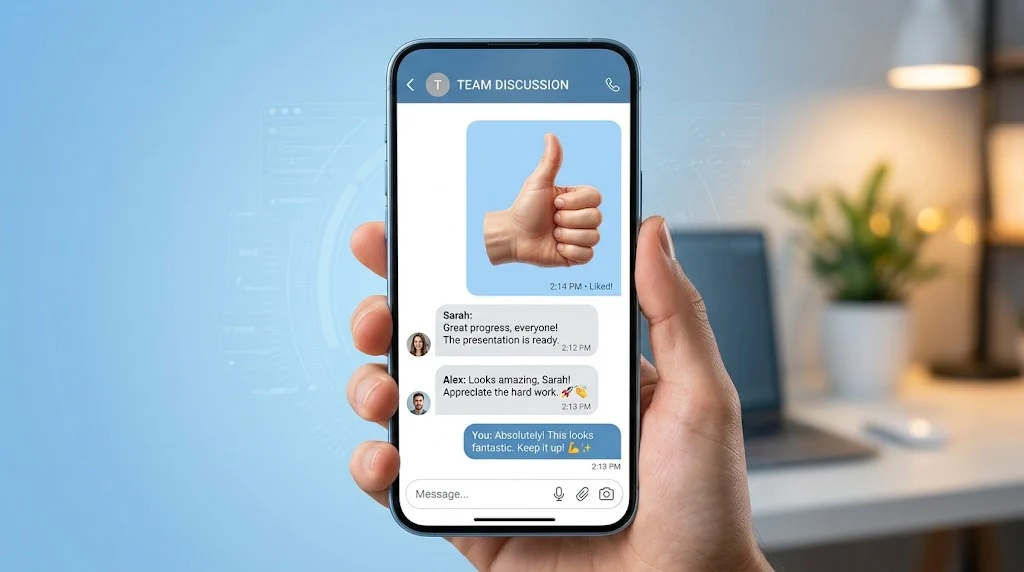
The 👍 thumb up emoji usually expresses approval, agreement, acceptance, or a simple “good.” It can mean “yes,” “sounds good,” “I agree,” “nice,” or “okay,” depending on the conversation. In some situations, especially when it appears by itself after a serious or emotional message, it can also feel brief, cold, dismissive, or sarcastic. The surrounding words and the relationship between the people matter more than the emoji alone.
👍 usually means approval or agreement. Someone may send it to say:
- “Yes.”
- “Okay.”
- “I agree.”
- “Sounds good.”
- “Nice!”
- “Got it.”
- “Thanks, I understand.”
It is generally a positive or neutral reaction, but a one-character reply can feel different depending on what came before it.
What Does the 👍 Thumb Up Emoji Mean?
The 👍 emoji shows a hand with the thumb raised. Unicode lists its CLDR short name as “thumbs up” and gives it the code point U+1F44D. Unicode also lists keywords such as “+1,” “good,” “like,” and “yes.”
In everyday messaging, the emoji works much like a verbal thumbs-up gesture. It can show that someone:
- Approves of an idea
- Agrees with a statement
- Accepts a plan
- Likes something
- Understands information
- Supports someone
- Wants to give a quick positive reaction
For example:
“I’ll meet you at 6 👍”
This normally means “That works” or “Sounds good.”
The emoji does not have one universal emotional meaning. A 👍 after good news can feel enthusiastic enough, while the same emoji after a long emotional message may feel much more detached.
👍 Meaning in Text Messages
In texting, the thumb up emoji is often used as a quick acknowledgment.
For example:
“Don’t forget to bring your notes tomorrow 👍”
Here, the likely meaning is:
“Got it.”
Another example:
“Want to grab pizza after school? 👍”
Here, it can mean:
“Yes, I’m in.”
It can also replace short replies such as “okay,” “sure,” or “agreed.”
Because it takes almost no effort to send, a standalone 👍 can sometimes sound less expressive than words. That does not automatically mean the sender is annoyed. Some people simply use the emoji as their normal way of acknowledging a message.
Is 👍 Positive, Neutral, or Negative?
Most of the time, 👍 is positive or neutral.
Its tone can range from warm approval to simple acknowledgment.
Positive
“That presentation was really good 👍”
Here, the emoji reinforces approval.
Neutral
“I’ll send the file tonight 👍”
This is mostly an acknowledgment.
Potentially cold or dismissive
“I’m really upset about what happened.”
“👍”
In this context, the same emoji could feel too short or emotionally distant. The interpretation comes from the message and situation, not from the emoji itself.
Emojipedia similarly notes that the thumbs-up can express sincere approval while also being interpreted as passive-aggressive or sarcastic in certain contexts.
What Does 👍 Mean When Someone Sends It to You?
When someone sends 👍, the safest interpretation is usually agreement, acknowledgment, or approval.
For example:
You: “I finished the assignment.”
Them: “👍”
They may simply mean:
“Okay, got it.”
Or:
You: “I can pick you up at 5.”
Them: “👍”
This most likely means:
“Sounds good.”
You should not automatically assume that the person is angry, flirting, bored, or trying to end the conversation. Look at the surrounding messages and their usual communication style.
Does 👍 Mean “Okay”?
Yes. In many conversations, 👍 can function as a quick “okay” or “got it.”
For example:
“Please text me when you get home 👍”
The sender may be acknowledging the instruction without adding another sentence.
Likewise:
“Meet outside at 4?”
“👍”
This generally means “Okay” or “Deal.”
Can 👍 Mean “I Agree”?
Yes. Agreement is one of its clearest uses.
“I think we should leave early.”
“👍”
The reply can be understood as:
“I agree.”
It can also show agreement with an opinion:
“That was the best part of the movie.”
“👍”
In this case, the emoji works almost like a visual “yes.”
Is 👍 Flirty?
Not by itself.
A thumbs-up emoji is usually too general to prove romantic or flirty interest. It can appear in a friendly, casual, family, school, or relationship conversation.
For example:
“Good luck on your test tomorrow 👍”
That is naturally supportive, but it does not automatically indicate flirting.
If a conversation contains clear romantic language, other emojis, or an established romantic context, the overall message may feel different. Even then, 👍 alone does not establish romantic interest.
Can 👍 Be Sarcastic?
Yes, but context is essential.
For example:
“Wow, thanks for ignoring my message all day 👍”
Here, the emoji may be used sarcastically because the words already communicate frustration.
Another example:
“Great job breaking the only working charger 👍”
The emoji may emphasize irony rather than genuine approval.
The important point is that the thumbs-up emoji itself does not automatically mean sarcasm. The surrounding language creates that interpretation.
Can 👍 Be Rude?
It can feel rude or dismissive in some situations, particularly when someone expects an emotional or detailed response.
Imagine someone sends:
“I’m sorry. I really wanted to explain what happened.”
A reply consisting only of:
“👍”
could feel cold because it gives little emotional acknowledgment.
However, that does not prove the sender intended to be rude. They might simply use 👍 as a quick acknowledgment.
If the meaning matters, consider the full conversation instead of interpreting the emoji in isolation.
How the Same 👍 Changes With Context
The words around an emoji can completely change how it feels.
| Message | Likely Meaning | Tone |
|---|---|---|
| “Sounds good 👍” | Agreement | Friendly |
| “Got it 👍” | Acknowledgment | Neutral |
| “Nice work 👍” | Approval | Positive |
| “Thanks 👍” | Appreciation or acknowledgment | Neutral-positive |
| “Great job breaking it 👍” | Possible irony | Sarcastic |
| “I’m really sorry.” → “👍” | Acknowledgment that may feel emotionally distant | Potentially cold |
These are examples, not fixed rules. The same person may use 👍 differently from one conversation to another.
👍 in Friendships and Everyday Conversations
Among friends, 👍 can be a simple way to keep a conversation moving without writing a full response.
It can mean:
- “Sure.”
- “I’m good with that.”
- “Okay.”
- “Nice.”
- “I understand.”
- “See you then.”
It is especially useful when the response does not need a long explanation.
For example:
Friend: “I’ll bring the snacks.”
You: “👍”
That is simply an easy way to say “Sounds good.”
👍 in More Serious Conversations
The emoji deserves a little more caution when the conversation involves serious emotions.
If someone tells you:
“I’m having a really difficult day.”
Replying only with 👍 may not communicate the support you intended.
A warmer response could be:
“I’m sorry you’re having a rough day. I hope things get better.”
The point is not that 👍 is always inappropriate. It is that a simple acknowledgment may not carry enough emotional detail for a serious message.
Related Hand and Reaction Emojis
| Emoji | Official Name | Common Meaning | Tone | Where or When It Is Used |
|---|---|---|---|---|
| 👍 | Thumbs Up | Approval, agreement, okay | Positive or neutral | Quick replies, agreement, acknowledgment |
| 👎 | Thumbs Down | Disapproval or disagreement | Negative | Rejecting an idea or showing dislike |
| 👌 | OK Hand | Okay, all good, satisfactory | Positive or neutral | Reassurance, confirmation, casual replies |
| 🙌 | Raising Hands | Celebration, excitement, praise | Cheerful | Good news, achievements, celebration |
| 👏 | Clapping Hands | Applause, praise, approval | Supportive | Compliments, achievements, encouragement |
| ✌️ | Victory Hand | Victory, peace, positive attitude | Playful or positive | Casual messages, celebrations, photos |
| 🤝 | Handshake | Agreement, cooperation, partnership | Friendly or professional | Deals, teamwork, mutual agreement |
| ❤️ | Red Heart | Love, care, affection | Warm and emotional | Support, affection, appreciation |
The closest comparison is usually 👎, because it is the opposite hand gesture. 👌 can also overlap with “okay,” but it has a different visual gesture. 👏 and 🙌 are more expressive and celebratory, while 👍 is usually simpler and more restrained.
🤝 is better when the idea is mutual cooperation or agreement between people. ❤️ carries much more emotional weight and should not be treated as interchangeable with 👍.
👍 vs. 👌: What Is the Difference?
Both can communicate that something is okay, but they are not identical.
👍 usually focuses on approval, agreement, or acknowledgment.
👌 more often communicates “okay,” “all good,” or “perfect.”
For example:
“Want to meet at 5?” → 👍
This naturally reads as agreement.
“Everything is ready.” → 👌
This can suggest that everything is fine or in order.
The exact feeling depends on the conversation.
👍 vs. 👎: The Clearest Contrast
These two emojis are direct opposites in many everyday contexts.
- 👍 = approval, yes, agreement, good
- 👎 = disapproval, no, disagreement, bad
If someone asks:
“Do you like this idea?”
A 👍 generally means yes or approval.
A 👎 generally means no or disapproval.
How to Respond to 👍
Your response depends on what the person is acknowledging.
If they send 👍 after making a plan, you may not need to respond at all.
If you want to keep the conversation going, natural replies include:
- “Perfect!”
- “Sounds good.”
- “Thanks!”
- “Awesome.”
- “See you then.”
- “Glad that works.”
If you are unsure the person meant “okay,” “yes,” or something more dismissive, you can simply clarify:
“Just checking are we still good for 6?”
That is usually more reliable than trying to decode one emoji.
Copy and Paste 👍
Here is the standard thumbs-up emoji:
👍
Unicode also supports skin-tone variations, including 👍🏻, 👍🏼, 👍🏽, 👍🏾, and 👍🏿. Unicode lists these as modifier sequences for the thumbs-up emoji.
The basic 👍 is the easiest choice when you simply want to express approval or acknowledgment without adding a specific skin tone.
Official Name and Unicode Details
Unicode’s current emoji charts list 👍 with the CLDR short name “thumbs up” and code point U+1F44D.
The emoji was approved in Unicode 6.0 in 2010 and later included in Emoji 1.0 in 2015, according to Emojipedia.
The technical name is useful for identifying the character, but everyday users generally know it simply as the thumbs-up emoji or thumb up emoji.
Does the 👍 Emoji Mean the Conversation Is Over?
Sometimes it can signal that a person has nothing more to add, especially when it is sent as a standalone reaction.
For example:
“Okay, I’ll see you tomorrow.”
“👍”
The reply may naturally close the exchange.
But this is not guaranteed. Some people use 👍 as a normal acknowledgment and may continue chatting afterward.
Avoid assuming that a standalone 👍 always means “I don’t want to talk anymore.”
Common Misunderstandings About 👍
One of the biggest mistakes is treating the emoji as a fixed emotional code.
A 👍 does not automatically mean:
- The sender is angry
- The sender is flirting
- The sender is being sarcastic
- The sender wants to end the friendship
- The sender is annoyed
- The sender is romantically interested
Instead, look at the words, timing, topic, and communication habits around it.
A short “👍” after “Want to meet at 7?” is very different from a short “👍” after a serious apology.
FAQs
What does the 👍 emoji mean in texting?
The 👍 emoji usually means “okay,” “yes,” “I agree,” “sounds good,” or “got it.” Its exact tone depends on the surrounding conversation.
Is 👍 a positive emoji?
Usually, yes. It commonly expresses approval, agreement, or acknowledgment. In some contexts, however, it can feel neutral, cold, or sarcastic.
Does 👍 mean yes?
It can. When someone sends 👍 in response to a question or plan, it often means yes or agreement.
Does 👍 mean okay?
Yes. “Okay,” “got it,” and “sounds good” are common interpretations when the emoji is used as a short reply.
Does 👍 mean someone is flirting?
Not by itself. A thumbs-up emoji is generally too broad to establish romantic or flirtatious interest.
Can 👍 be sarcastic?
Yes. Sarcasm can be created by the surrounding words and situation. For example, a thumbs-up after a clearly negative or ironic statement may be read sarcastically.
Why can 👍 sometimes feel rude?
A standalone emoji may feel too brief when someone expects an emotional or detailed response. It is rude depends on the conversation and the sender’s normal communication style.
What is the difference between 👍 and 👌?
Both can communicate something positive or acceptable, but 👍 more directly suggests approval or agreement, while 👌 often conveys “okay,” “all good,” or “perfect.”
What is the difference between 👍 and 👎?
👍 generally expresses approval or agreement, while 👎 generally expresses disapproval or disagreement.
What is the official name of 👍?
Unicode’s current CLDR short name is “thumbs up.” Its code point is U+1F44D.
Conclusion
The 👍 thumb up emoji is one of the simplest ways to communicate approval, agreement, acknowledgment, or “okay.” Its meaning is usually positive or neutral, but the tone can change when it appears alone, follows a serious message, or is paired with sarcastic wording.
The best way to understand 👍 is to read it together with the words, situation, and relationship between the people. A single emoji rarely tells the whole story.
See Also More:
- Bird Emoji Meaning | From Simple Bird to Playful Texting Symbol In 2026
- Santa Emoji Meaning | Christmas Cheer, Gifts & Holiday Spirit In 2026
- Clapping Emoji Meaning | Applause, Praise & More In 2026



1 thought on “👍 Thumb Up Emoji Meaning | The Simple Signal Behind “Yes,” “Good,” & More In 2026”