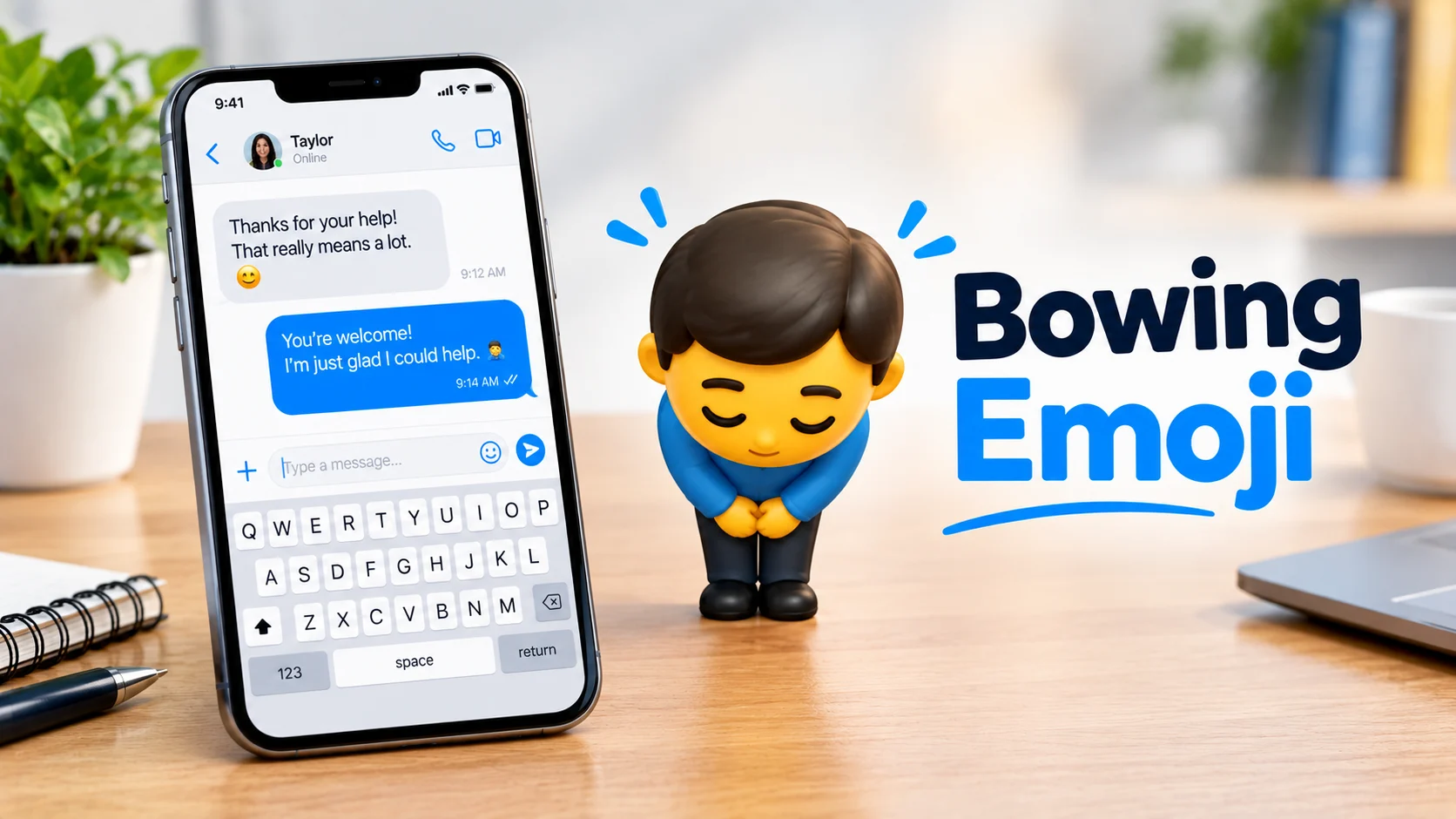
🙇 Person Bowing commonly means “I’m sorry,” “I respectfully ask,” “thank you,” or “I’m showing respect.” It can also make a request sound more humble or dramatic. In joking conversations, it may exaggerate embarrassment or submission rather than communicate a serious apology.
The bowing emoji 🙇 usually expresses a sincere apology, respect, humility, or a strong request. It can also be used playfully to show embarrassment, gratitude, or exhaustion, depending on the conversation. The official Unicode name is Person Bowing, while Unicode’s character data identifies it as PERSON BOWING DEEPLY.
Because the gesture can carry different meanings across cultures and situations, the words around 🙇 matter. A message like “I’m really sorry 🙇” is clearly apologetic, while “Thank you so much 🙇” can make the same emoji feel more respectful or humble.
What Does the Bowing Emoji 🙇 Mean?
The bowing emoji depicts a person bent forward in a deep bow. Unicode lists 🙇 as Person Bowing, with the code point U+1F647. Unicode’s emoji charts associate the character with concepts including apology, asking, bowing, favors, forgiveness, regret, and being sorry.
The most common meanings include:
- Apology: “I’m genuinely sorry.”
- Respect: “I respect you” or “I’m showing humility.”
- Asking for a favor: “Please, I’m asking nicely.”
- Gratitude: “Thank you so much.”
- Embarrassment: “I can’t believe I did that.”
- Playful submission: “Okay, you win.”
- Exaggeration: Making a request or apology sound dramatically humble.
The exact meaning is not fixed. The same emoji can feel serious, polite, humorous, or exaggerated depending on the message.
🙇 Meaning in Text Messages
In texting, 🙇 often adds a strong sense of humility to the words around it.
For example:
“I’m really sorry about that 🙇”
This sounds like a sincere apology.
Compare it with:
“Please send me the notes 🙇”
Here, the emoji makes the request feel more humble and pleading without necessarily sounding desperate.
It can also be used after receiving help:
“You saved me today. Thank you 🙇”
In that context, the bow suggests deep appreciation or respect.
Is 🙇 Always an Apology?
No. Apology is one of its strongest common uses, but it is not the only one.
A bow can communicate respect, gratitude, humility, or a polite request. In a playful conversation, it can even mean something like “I surrender” or “I admit defeat.”
The surrounding words are usually more useful than the emoji alone when figuring out the sender’s intent.
Why Does 🙇 Sometimes Feel So Dramatic?
The bow shown by 🙇 is quite deep. Unicode’s character notes describe it as commonly depicting Japanese-style bowing while seated, known as dogeza.
That deep posture can make the emoji feel stronger than a simple “sorry.”
For example:
“I forgot to bring the snacks 🙇”
The emoji can turn a small mistake into a humorous, exaggerated apology.
Likewise:
“Please let me borrow your charger 🙇”
The sender may simply be making the request sound extra humble or playful.
So, 🙇 can be sincere or intentionally dramatic.
🙇 in Apologies
One of the clearest uses of the bowing emoji is to show remorse.
“I shouldn’t have said that. I’m sorry 🙇”
Here, 🙇 reinforces the apology and communicates humility.
It can work especially well when the sender wants to soften a message without making it overly formal.
However, the emoji itself does not prove that someone is genuinely sorry. The actual wording and the situation still matter.
🙇 When Someone Is Asking for a Favor
The bowing emoji can also accompany a request, especially when the sender wants to sound respectful.
“Could you cover my shift tomorrow? 🙇”
The emoji adds a humble, pleading quality.
It can also be used jokingly:
“Please give me the last slice 🙇”
In this case, the sender probably is not making a deeply serious plea. The emoji simply makes the request more dramatic.
Can 🙇 Mean Thank You?
Yes. A bow can communicate respect and gratitude, so 🙇 may appear after someone has helped the sender.
For example:
“Thanks for helping me fix this 🙇”
The meaning is closer to “I really appreciate it” than a simple casual “thanks.”
For a straightforward thank-you, 😊, 🙂, or ❤️ may feel warmer depending on the situation. 🙇 adds a more respectful or humble tone.
Is 🙇 Flirting?
Usually, 🙇 is not a clear flirting emoji.
It can appear in a playful or affectionate conversation, but the emoji itself does not establish romantic interest. If someone sends:
“Okay, you win 🙇”
the meaning is more likely playful surrender than flirting.
If a conversation already has a romantic tone, the emoji could take on that tone because of the surrounding messages. But it should not be treated as proof of attraction.
What Does 🙇 Mean From Someone?
When someone sends 🙇 to you, look at the complete message.
If they say “I’m sorry 🙇”
They are most likely emphasizing an apology or showing humility.
If they say “Please help me 🙇”
They are probably making a polite, exaggerated, or playful request.
If they say “Thank you 🙇”
They may be showing strong appreciation or respect.
If they send only “🙇”
The meaning is more ambiguous. It could mean:
- “Sorry.”
- “Please.”
- “Thank you.”
- “I respect you.”
- “I surrender.”
- “I’m embarrassed.”
Without additional context, there is no single guaranteed interpretation.
Related Emojis and Their Meanings
| Emoji | Official Name | Common Meaning | Tone | Where or When It Is Used |
|---|---|---|---|---|
| 🙇 | Person Bowing | Apology, respect, humility, asking for a favor | Humble, apologetic, sometimes playful | Apologies, requests, thanks, exaggerated reactions |
| 🙏 | Person With Folded Hands | Thanks, prayer, pleading, hope, gratitude | Respectful, sincere, supportive | Thank-you messages, requests, prayer, encouragement |
| 🧎 | Person Kneeling | Kneeling, submission, prayer, or resting | Serious, humble, reflective | Prayer, symbolic gestures, certain reactions |
| 😔 | Sad Face | Sadness, regret, disappointment | Sad, subdued | Difficult moments, regret, emotional reactions |
| 🥹 | Face Holding Back Tears | Deep emotion, gratitude, tenderness, being touched | Emotional, heartfelt | Sweet messages, appreciation, touching moments |
| 😅 | Grinning Face with Sweat | Nervousness, relief, awkward humor | Awkward, nervous, lighthearted | Embarrassing situations, close calls, uncomfortable jokes |
| 🤦 | Person Facepalming | Frustration, disbelief, embarrassment | Exasperated, humorous | Mistakes, obvious errors, “I can’t believe this” moments |
| 🤷 | Person Shrugging | Uncertainty, indifference, “I don’t know” | Casual, uncertain | Questions, confusion, uncertain answers |
The most important distinction is between 🙇 and 🙏. Both can express humility, thanks, or a request, but 🙇 centers on the physical gesture of bowing, while 🙏 is more closely associated with folded hands and can also represent prayer. Unicode specifically lists 🙏 as Person With Folded Hands.
🧎 Person Kneeling can also look similar in some contexts, but its main visual idea is kneeling rather than bowing. 🤦 Person Facepalming is different again: it generally communicates disbelief, frustration, or embarrassment rather than respect or apology.
🙇 vs. 🙏: What’s the Difference?
A simple way to remember the difference is:
- 🙇 = “I bow respectfully.”
- 🙏 = “Please, thank you, or I’m praying.”
There is some overlap. Someone might use either emoji when saying thank you or asking for something.
For example:
“Thank you for being there for me 🙇”
feels especially humble or respectful.
“Thank you so much 🙏”
usually feels more like heartfelt gratitude.
Neither interpretation is absolute, so the surrounding message still matters.
🙇 vs. 🧎
These two can be confused because both show a person in a low position.
🙇 Person Bowing focuses on a deep bow. It is commonly associated with apology, respect, humility, and asking for forgiveness or a favor.
🧎 Person Kneeling focuses on kneeling and can be used in contexts involving prayer, reflection, submission, or simply kneeling.
If your message means “I’m sorry” or “I respectfully ask,” 🙇 is usually the more direct choice.
Text Message Examples
“I’m sorry I forgot 🙇”
Likely meaning: A sincere or intentionally humble apology.
The words already express regret, while 🙇 strengthens the sense of humility.
“Can you please help me with this? 🙇”
Likely meaning: A respectful request.
The emoji makes the request sound more pleading or humble.
“You were right. I admit defeat 🙇”
Likely meaning: Playful surrender.
Here, the emoji is probably humorous rather than a serious apology.
“Thank you for everything 🙇”
Likely meaning: Deep appreciation or respect.
The bow adds a more humble tone than a basic thank-you.
“I embarrassed myself so badly 🙇”
Likely meaning: Self-deprecating embarrassment.
In this situation, the emoji can exaggerate the reaction for humor. Emojipedia also notes embarrassment and exhaustion as possible uses.
When 🙇 Can Be Misunderstood
The bowing emoji is unusual enough that some people may not immediately recognize what the person is doing.
Earlier emoji designs have sometimes been interpreted as a person doing push-ups, receiving a massage, or resting their head on their hands. Its intended meaning, however, is bowing.
A message such as:
“🙇”
can therefore be unclear without words.
If the exact meaning matters, adding a short phrase is safer:
“Sorry about that 🙇”
or:
“Thank you so much 🙇”
This removes much of the ambiguity.
How to Respond to 🙇
Your response should depend on what the sender meant.
If they are apologizing:
- “No worries!”
- “It’s okay.”
- “Thanks for saying that.”
If they are asking for a favor:
- “Sure, I can help.”
- “Let me see what I can do.”
- “Haha, okay 🙇”
If they are thanking you:
- “Of course!”
- “Anytime!”
- “You’re welcome 😊”
If you’re unsure what they mean:
- “Haha, what does the bow mean? 😄”
- “Are you apologizing or asking me for something?”
There is no need to assume a romantic meaning just because the emoji appears in a personal conversation.
Official Name and Unicode Details
The official Unicode character is U+1F647, and Unicode identifies it as Person Bowing in its current emoji charts. The Unicode names list gives the longer character name PERSON BOWING DEEPLY.
Emojipedia notes that the emoji was approved as part of Unicode 6.0 in 2010 and added to Emoji 1.0 in 2015.
There are also gendered variants such as 🙇♂️ Man Bowing and 🙇♀️ Woman Bowing. Unicode lists these as separate emoji sequences, while the base 🙇 represents the person-bowing emoji without a specified gender.
Does 🙇 Look the Same on Every Device?
No. Emoji artwork can vary between platforms and operating systems. The basic idea remains a person bowing, but the person’s appearance, colors, posture details, and surrounding design can differ.
The meaning comes from the underlying Unicode character rather than one specific company’s artwork.
FAQs
What does 🙇 mean from a girl or guy?
The emoji does not have a different built-in meaning based on the sender’s gender. It can express apology, respect, humility, gratitude, or a request regardless of who sends it.
Does 🙇 mean sorry?
Often, yes. Apology is one of its clearest common uses, especially when it appears with words such as “sorry,” “my bad,” or “I apologize.” Unicode also associates it with apology, regret, and forgiveness.
Does 🙇 mean respect?
It can. A bow is commonly associated with showing respect or humility, so the emoji may communicate a respectful attitude toward another person.
Is 🙇 a begging emoji?
It can be used to make a request look pleading or humble. However, its meaning is broader than begging and includes apology, respect, gratitude, and other forms of humility.
What is the difference between 🙇 and 🙏?
🙇 represents a person bowing, while 🙏 represents a person with folded hands. Both can express humility, gratitude, or a request, but they communicate those ideas through different gestures.
Can 🙇 be sarcastic?
Yes. Like many expressive emojis, 🙇 can be used sarcastically or humorously. For example, someone might use it after jokingly admitting defeat. The surrounding wording determines the bow is sincere or exaggerated.
What does 🙇 mean by itself?
By itself, 🙇 is ambiguous. It may mean “sorry,” “please,” “thank you,” “I respect you,” or “I surrender.” The safest interpretation comes from the conversation around it.
Copy and Paste the Bowing Emoji
🙇
You can also use the gendered versions:
🙇♂️ Man Bowing
🙇♀️ Woman Bowing
Conclusion
The bowing emoji 🙇 is mainly about humility, apology, respect, and a deep or polite request. It can also be playful when someone wants to exaggerate embarrassment, gratitude, or surrender.
If you’re trying to understand a message containing 🙇, don’t read the emoji alone. Look at the words, the situation, and the sender’s usual communication style. Those details usually tell you the bow is sincere, respectful, apologetic, or simply being used for humor.
See Also More:
- Please Emoji Meaning | What Does the Folded Hands Emoji Mean In 2026
- Nod Emoji Meaning | What Does It Mean in Text In 2026
- Leaf Emoji Meaning | What This Breezy Green Symbol Really Says In 2026