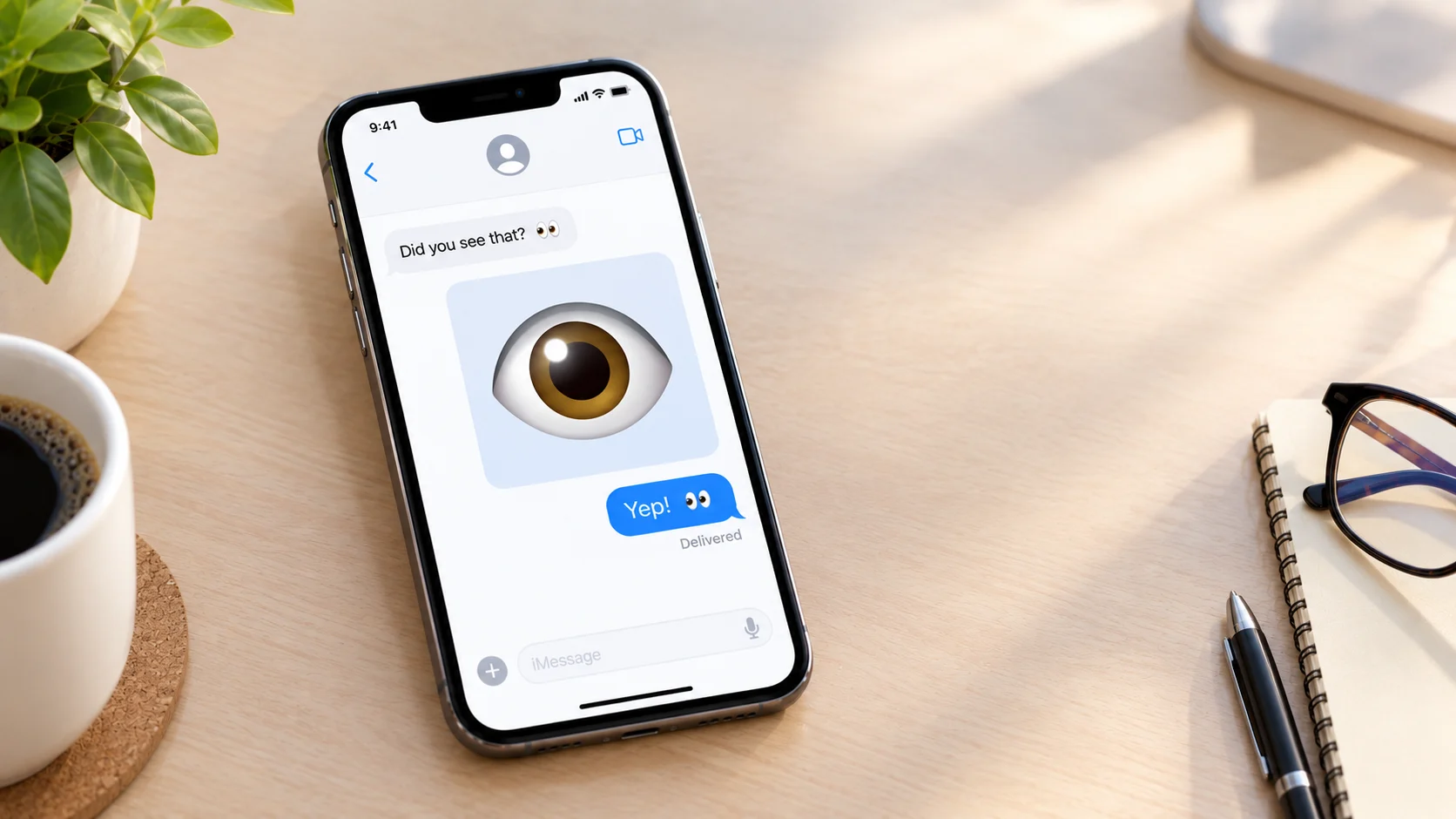
👁️ usually means seeing, looking, watching, or paying attention. It can be a simple visual reference or a playful way to show that someone noticed something. In a message, the same emoji may feel curious, observant, mysterious, or slightly dramatic depending on the words around it.
The 👁️ eyeball emoji is officially called Eye and usually represents seeing, looking, watching, or visual attention. In a text, it can suggest “I see,” “I’m looking,” or “I noticed that,” but the exact meaning depends on the surrounding message. It can also be used playfully, symbolically, or as part of an emoji combination.
One useful distinction: 👁️ is the single Eye emoji, while 👀 is the Eyes emoji. They look similar but can carry different conversational effects.
What Does the 👁️ Eyeball Emoji Mean?
The 👁️ emoji represents a single human eye looking forward. Its official Unicode name is Eye. Unicode identifies it with the code point U+1F441, and it belongs to the body-parts section of the emoji set.
In everyday texting, its meaning is usually connected to sight or attention.
For example:
- “I saw what you posted 👁️” can mean the sender noticed the post.
- “Interesting 👁️” may show curiosity or that the person is paying close attention.
- “Who told you that? 👁️” can give the message a playful or suspicious tone.
- “I’m watching 👁️” can make the idea of watching more visually obvious.
The emoji itself does not guarantee a particular emotion. The surrounding words and the relationship between the people sending the messages matter more.
👁️ Meaning in Text Messages
When someone sends 👁️ in a text, the most likely interpretation depends on what came before it.
1. “I see” or “I noticed”
The emoji can work almost like a visual version of “I see.”
Example:
“You changed your profile picture 👁️”
Likely meaning:
“I noticed that.”
Here, the emoji highlights observation rather than a strong emotion.
2. Curiosity or interest
The single eye can also suggest that someone wants to see what happens next.
Example:
“Okay, now tell me what happened 👁️”
Likely meaning:
“I’m listening. I want to know.”
The tone may be curious or playful.
3. Watching or paying attention
Sometimes 👁️ emphasizes that someone is keeping an eye on something.
Example:
“I’ll be watching the comments 👁️”
Likely meaning:
“I’m keeping track of what happens.”
This does not automatically mean anything threatening. It can simply be a playful way to emphasize attention.
4. A dramatic or mysterious reaction
Used by itself, the emoji can make a short reaction feel more dramatic.
Example:
“👁️”
Depending on the conversation, this might communicate “I see that,” “Interesting,” “I’m watching,” or “Tell me more.”
A one-emoji reply is especially dependent on context, so it should not be interpreted too literally.
Is 👁️ Friendly, Flirty, or Sarcastic?
The 👁️ emoji does not have one fixed relationship meaning.
It can appear in friendly conversations, joking exchanges, or conversations where someone is teasing another person. In some contexts, it may also contribute to a flirty tone, but the emoji by itself does not prove romantic interest.
For example:
“So you’re going to the party tonight? 👁️”
This could sound curious, teasing, or slightly playful. The surrounding conversation would tell you much more than the emoji alone.
Likewise:
“You really posted that 👁️”
could be amused, surprised, teasing, or simply observant.
If you’re trying to understand someone’s intent, look at the full message, previous conversation, timing, and their usual communication style instead of treating 👁️ as a definite signal.
👁️ vs. 👀: What’s the Difference?
This is one of the most useful distinctions when searching for the “eyeball emoji.”
👁️ is officially named Eye, while 👀 is officially named Eyes. Unicode lists them as separate characters: U+1F441 for Eye and U+1F440 for Eyes.
The single eye can feel more symbolic or deliberate. The pair of eyes often feels more like a direct reaction of watching, noticing, or looking.
For example:
- 👁️ — a single-eye symbol; can feel visual, symbolic, curious, or dramatic.
- 👀 — a pair of eyes; often feels more like “I’m looking,” “I noticed,” or “What’s going on?”
Emojipedia describes 👀 as a pair of eyes looking slightly to the side on most platforms and notes that it can sometimes be used for approval of an attractive image or to suggest “shifty eyes” in a deceptive context.
That does not mean 👀 always has those meanings. Like 👁️, its interpretation changes with context.
Other Eye Emojis Compared
| Emoji | Official Name | Common Meaning | Tone | Where or When It Is Used |
|---|---|---|---|---|
| 👁️ | Eye | Seeing, looking, noticing | Neutral, curious, symbolic | Texts, reactions, visual references |
| 👀 | Eyes | Watching, noticing, curiosity | Playful, curious, observant | Reactions, comments, conversations |
| 👁️🗨️ | Eye in Speech Bubble | An eye connected with speaking or witnessing | Serious, symbolic | Awareness or anti-bullying contexts |
| 😉 | Winking Face | Joke, playful hint, possible flirtation | Playful, teasing | Jokes, friendly messages, light teasing |
| 🙄 | Face with Rolling Eyes | Disapproval, boredom, frustration | Sarcastic, annoyed, playful | Reactions to something irritating or silly |
| 😳 | Flushed Face | Embarrassment, surprise, self-consciousness | Nervous, surprised | Awkward or unexpected moments |
| 🤨 | Face with Raised Eyebrow | Doubt, skepticism, questioning | Skeptical, questioning | When something seems questionable |
| 🧐 | Face with Monocle | Careful examination or scrutiny | Curious, analytical, playful | Inspecting details or jokingly examining something |
The biggest potential confusion is between 👁️ and 👀. The former shows one eye and can work well as a symbolic visual reference, while the latter presents a pair of eyes and often feels more directly focused on watching or noticing.
The 👁️🗨️ Eye in Speech Bubble is different again. It is a combined emoji sequence involving an eye, a zero-width joiner, and a speech bubble. Emojipedia notes that it was released in connection with the I Am A Witness anti-bullying campaign.
Meanwhile, 🙄 Face with Rolling Eyes is not simply another eye emoji. Its facial expression changes the message into one of annoyance, disbelief, boredom, or disapproval.
👁️ Eyeball Emoji Examples in Realistic Texts
Here are some hypothetical examples showing how the same emoji can change meaning.
Example 1
“I saw your comment 👁️”
Likely meaning:
The sender noticed the comment.
Why it matters:
The words already establish that the person saw something, so 👁️ mainly reinforces that idea.
Example 2
“Wait… you know them? 👁️”
Likely meaning:
Curiosity or interest.
Why it matters:
The question makes the eye feel more inquisitive than literal.
Example 3
“I’m keeping an eye on this 👁️”
Likely meaning:
Watching or paying attention.
Why it matters:
The wording gives the emoji a clear connection to observation.
Example 4
“That was an interesting choice 👁️”
Likely meaning:
Playful curiosity, surprise, or mild skepticism.
Why it matters:
The phrase “interesting choice” can carry different tones, so the emoji may make the statement feel more pointed or dramatic.
Example 5
“👁️👄👁️”
Likely meaning:
A stylized, dramatic, or stunned expression rather than a literal reference to an eye.
Why it matters:
Emoji combinations can create meanings that are different from the meaning of each individual character. The single Eye emoji is commonly used in this particular visual combination.
When Should You Use 👁️?
The emoji can work well when you want to add a visual sense of:
- Seeing something
- Noticing something
- Watching
- Curiosity
- Attention
- A slightly mysterious reaction
- Playful drama
- A visual reference to an eye
It can be especially useful when the surrounding words already make the intended meaning clear.
If you want a more obvious “I’m watching this” reaction, 👀 may feel more natural. If you want to show doubt or skepticism, 🤨 may communicate that idea more clearly. If you want annoyance or disbelief, 🙄 is more specific.
How to Respond When Someone Sends 👁️
There is no single required response. Match your reply to the conversation.
If they seem curious:
“Haha, what do you want to know?”
If they noticed something:
“Yep, you caught that.”
If the message feels playful:
“You saw that, huh? 😂”
If you’re unsure what they mean:
“What does that look mean? 😄”
A simple clarification is often better than guessing at a hidden meaning.
Common Misunderstandings About 👁️
Does 👁️ always mean “I’m watching you”?
No. It can suggest watching, but it can also simply represent seeing, looking, noticing, or visual attention.
Does 👁️ mean someone is flirting?
Not necessarily. It can appear in playful or flirty conversations, but the emoji alone is not enough to establish romantic interest.
Is 👁️ the same as 👀?
No. They are separate Unicode emoji characters. 👁️ is Eye, while 👀 is Eyes. Their visual form and conversational feel are different.
Can 👁️ be sarcastic?
Yes, depending on the message around it. The emoji itself does not have a fixed sarcastic meaning, but it can add a teasing, skeptical, or dramatic tone to a sentence.
What does 👁️ mean by itself?
When sent alone, 👁️ can mean something like “I see,” “I’m looking,” “I noticed,” or “Interesting.” Because there are no surrounding words, the intended meaning is more open to interpretation.
Official Details About the Eyeball Emoji
The official Unicode name for 👁️ is Eye. Its code point is U+1F441. Unicode lists it under facial parts within the body-parts section of the emoji set.
Emojipedia notes that the Eye emoji was approved as part of Unicode 7.0 in 2014 and added to Emoji 1.0 in 2015.
Its appearance can vary slightly between platforms and emoji designs. The core idea remains a single human eye facing forward.
FAQs 👁️
What does the 👁️ emoji mean in texting?
The 👁️ emoji usually means seeing, looking, noticing, or paying attention. In some messages, it can also add curiosity or a playful sense of mystery.
What does 👁️ mean from someone?
If someone sends 👁️, they may be saying “I see,” “I noticed that,” or “I’m paying attention.” The exact meaning depends on the message and conversation.
Is 👁️ a flirty emoji?
It can appear in a playful or flirty conversation, but 👁️ does not automatically mean flirting. The surrounding words and relationship context matter more.
What is the difference between 👁️ and 👀?
👁️ is officially Eye, while 👀 is officially Eyes. The single eye can feel more symbolic or dramatic, while 👀 often gives a clearer sense of watching, noticing, or looking.
What does 👁️ mean when sent alone?
By itself, 👁️ can suggest “I see,” “I’m watching,” “Interesting,” or “I noticed.” Because there are no words to provide context, its meaning can be open-ended.
Can 👁️ mean “I’m watching”?
Yes. In a message such as “I’m keeping an eye on this 👁️,” it can reinforce the idea of watching or monitoring something. However, it does not always carry that meaning.
Can 👁️ be sarcastic?
Yes, depending on the surrounding text. It can add a teasing, skeptical, or dramatic feel, but sarcasm comes from the overall message rather than the emoji alone.
What is the official name of 👁️?
The official Unicode name is Eye. Its Unicode code point is U+1F441.
Conclusion
The 👁️ eyeball emoji usually communicates seeing, looking, noticing, or paying attention. It can also add curiosity, mystery, humor, or dramatic emphasis to a message.
The safest way to understand it is to read the emoji together with the words around it. And if you’re comparing it with 👀, remember: 👁️ is the single Eye, while 👀 is the pair of Eyes.
See Also More:
- Hugging Emoji Meaning | From Warm Support to Playful Excitement In 2026
- Flex Emoji Meaning | What It Means in Text, Chats & Conversations In 2026
- Emoji Combo Meaning | How Two or More Emojis Create a New Message In 2026