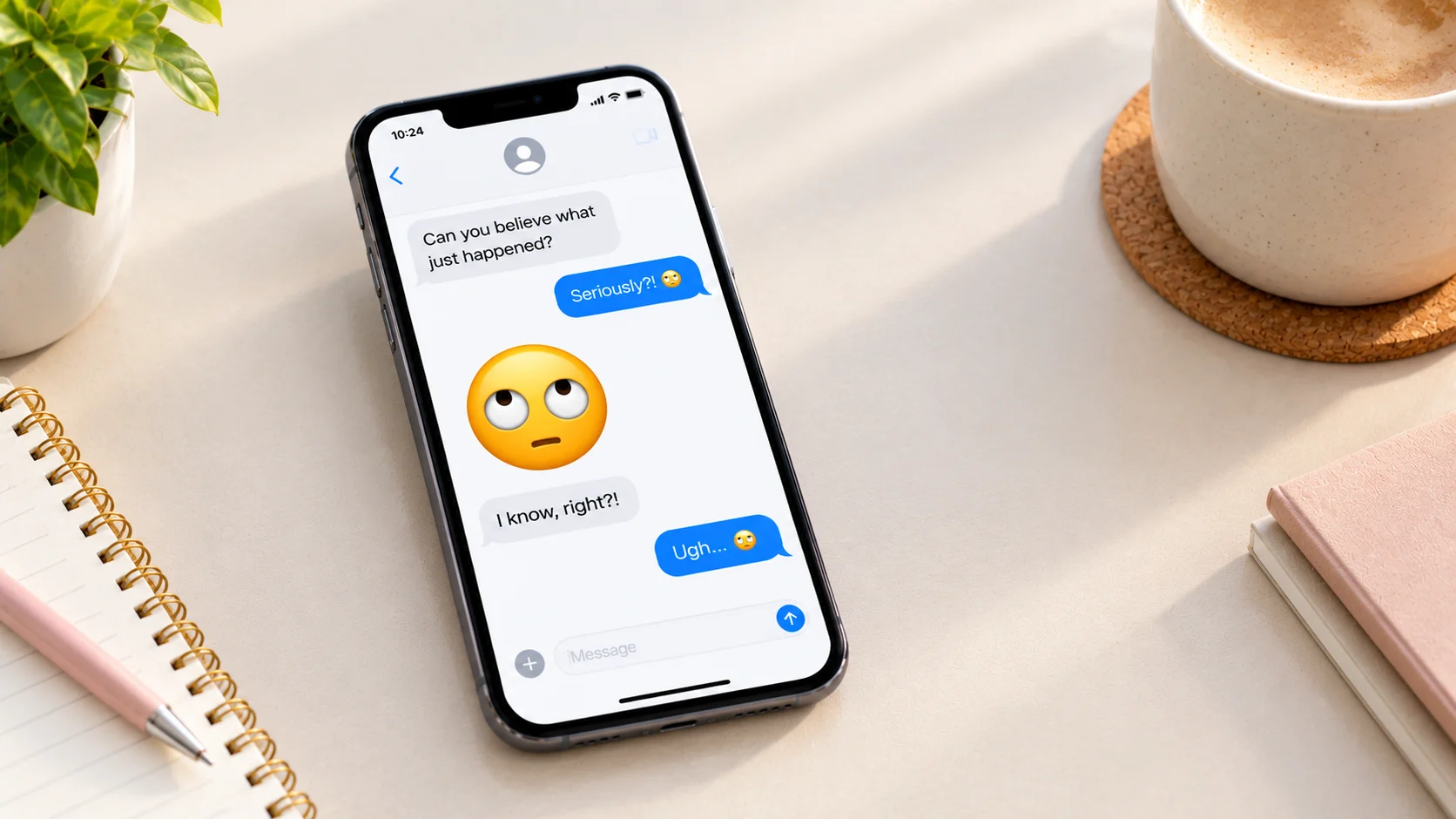
🙄 usually means “I’m annoyed,” “Seriously?” or “Yeah, whatever,” often showing mild frustration, disbelief, boredom, or disapproval. It can also be playful or sarcastic between friends, so the surrounding message matters more than the emoji by itself.
🙄 is the Face with Rolling Eyes emoji. The eyeroll emoji usually expresses annoyance, disbelief, boredom, impatience, or mild disapproval. Depending on the conversation, it can also make a comment feel playful, sarcastic, or teasing rather than genuinely angry.
If someone sends 🙄, the safest interpretation depends on the words around it, the relationship between you, and how that person normally communicates. The emoji can mean anything from “Seriously?” to a lighthearted “Oh, please.”
What Does the 🙄 Eyeroll Emoji Mean?
The official Unicode name for 🙄 is Face with Rolling Eyes. Unicode identifies it as U+1F644.
The visual is straightforward: a face looking upward with its eyes rolled back. That mirrors the familiar facial gesture people make when they feel unimpressed, irritated, or tired of something.
In everyday texting, 🙄 commonly communicates:
- Annoyance
- Disbelief
- Mild frustration
- Boredom
- Impatience
- Disapproval
- “Whatever”
- “Seriously?”
- Playful exasperation
- Sarcasm or teasing
The tone is often negative or dismissive, but it does not automatically mean the sender is seriously angry.
For example:
“You forgot your keys again 🙄”
This could be genuine frustration, but between close friends it might simply be playful teasing.
By contrast:
“You seriously said that? 🙄”
sounds more openly dismissive or disapproving.
🙄 Meaning in Text Messages
In texting, the eyeroll emoji often adds an emotional tone that plain words might not communicate clearly.
Compare:
“Okay.”
with:
“Okay 🙄”
The second version can sound impatient, doubtful, sarcastic, or unimpressed.
The emoji can also soften a criticism when the relationship is friendly. Someone might use it to joke about a small mistake rather than start an argument.
Common meanings in texts
“Seriously?”
The sender may think something is obvious, surprising, or hard to believe.
“I can’t believe this.”
The emoji can show frustration with a situation.
“Whatever.”
It may communicate dismissal or lack of interest.
“You’re being ridiculous.”
In a playful conversation, it can tease someone without serious hostility.
“Here we go again.”
It can signal that the sender has seen the same situation before and is mildly exasperated.
The exact meaning comes from the complete message, not 🙄 alone.
Is 🙄 a Negative Emoji?
Usually, yes. The emoji commonly carries some level of disapproval, annoyance, boredom, or disdain. Emojipedia describes its common uses in terms of moderate disdain, disapproval, frustration, and boredom, while also noting that its tone can be playful, sassy, resentful, or sarcastic.
However, “negative” does not always mean hostile.
A friend might write:
“You really watched that movie three times? 🙄😂”
Here, 🙄 is likely exaggerated for humor, especially because 😂 changes the overall tone.
But if someone sends:
“I already told you not to do that 🙄”
the emoji is more likely to reinforce genuine irritation.
Can 🙄 Be Sarcastic?
Yes. 🙄 can be used sarcastically, especially when the sender wants to exaggerate their reaction.
For example:
“Wow, you answered my text after five whole minutes 🙄”
The sender probably is not genuinely upset about the five-minute delay. The exaggerated reaction makes the message sarcastic or teasing.
Sarcasm becomes more likely when the words themselves are obviously exaggerated or humorous.
Still, 🙄 does not guarantee sarcasm. A serious complaint can use the same emoji.
Is 🙄 Flirty?
🙄 is not inherently a flirting emoji.
It can appear in playful conversations between people who are interested in each other, but the emoji itself does not prove romantic interest.
For example:
“You think you’re funny, don’t you? 🙄”
could be playful teasing, but it could also be genuine annoyance.
To understand the tone, consider the entire conversation rather than treating one emoji as proof of attraction.
What Does 🙄 Mean When Someone Sends It to You?
When someone sends 🙄 by itself, possible meanings include:
- “Seriously?”
- “Come on.”
- “I don’t believe you.”
- “That’s annoying.”
- “Whatever.”
- “I’m tired of this.”
- “You’re being silly.”
- “I’m teasing you.”
The surrounding conversation is especially important.
If you said:
“I forgot the homework again.”
and they replied:
“🙄”
they may be mildly frustrated or teasing you.
If you said:
“I can’t believe our team lost that game.”
and they replied:
“🙄”
the emoji could mean they are frustrated with the situation too.
If the conversation is already joking:
“I’m obviously the smartest person here 🙄”
the emoji may be deliberately sarcastic.
Don’t overread a single 🙄
One emoji cannot tell you exactly how someone feels.
The sender’s normal texting style, the words they used, your previous conversation, and they often joke with you can all change the interpretation.
Gender does not provide a reliable shortcut for understanding 🙄. The same emoji can have different meanings depending on the individual and situation.
Related Emojis: 🙄 Compared With Similar Reactions
| Emoji | Official Name | Common Meaning | Tone | Where or When It Is Used |
|---|---|---|---|---|
| 🙄 | Face with Rolling Eyes | Annoyance, disbelief, “whatever” | Dismissive, sarcastic, exasperated | Reactions to frustrating or ridiculous comments |
| 😒 | Unamused Face | Dissatisfaction, boredom, lack of enthusiasm | Unimpressed, irritated | When something is disappointing or uninteresting |
| 😑 | Expressionless Face | No strong reaction, awkwardness, “I have nothing to say” | Flat, dry, restrained | Deadpan responses and awkward situations |
| 🙃 | Upside-Down Face | Irony, silliness, awkward humor | Playful, ironic, resigned | Jokes, awkward moments, sarcastic comments |
| 🤨 | Face with Raised Eyebrow | Doubt, suspicion, questioning | Skeptical, curious | When questioning something is true |
| 😏 | Smirking Face | Smugness, slyness, or suggestive confidence | Sly, playful | Teasing, joking, or confident remarks |
| 🤦 | Person Facepalming | Frustration, embarrassment, disbelief | Exasperated, embarrassed | Reacting to a mistake or obviously bad decision |
| 😮💨 | Face Exhaling | Relief, exhaustion, frustration, or a sigh | Weary, relieved | After stressful, tiring, or frustrating moments |
The closest comparisons are 🙄 and 😒. Both can communicate annoyance or dissatisfaction, but 🙄 adds the visual idea of an eye roll, making it especially useful for “seriously?” or “whatever” reactions.
🙃 is different because its upside-down smile often signals irony, silliness, or awkward humor rather than direct disapproval.
🤨 is more about questioning or suspicion. If you want to communicate “Really?” without necessarily sounding annoyed, 🤨 may fit better.
🤦 usually focuses on a mistake or a “I can’t believe you did that” reaction, while 🙄 more directly resembles an eye-roll.
🙄 vs. 😒: What’s the Difference?
These two emojis are easy to confuse.
🙄 Face with Rolling Eyes often feels more reactive. It can communicate:
“Oh, come on.”
😒 Unamused Face tends to communicate:
“I’m not impressed.”
For example:
“You canceled again 🙄”
sounds like an irritated reaction to someone’s behavior.
“That was a pretty boring movie 😒”
sounds more like dissatisfaction or lack of enthusiasm.
The distinction is not absolute, but the visual difference can help you choose the better match.
🙄 vs. 🙃: What’s the Difference?
🙄 and 🙃 can both appear in sarcastic messages, but they usually create different impressions.
🙄 looks like an actual eye roll, so it more strongly suggests annoyance, disbelief, or dismissal.
🙃 turns a smiling face upside down and is commonly associated with irony, silliness, awkwardness, or a resigned “oh well” feeling.
Use 🙄 when you want the reaction to feel more unimpressed or exasperated.
Use 🙃 when you want it to feel more ironic, awkward, or silly.
Realistic Text Examples
1. Mild annoyance
Message:
“You left your backpack here again 🙄”
Likely meaning:
The sender is mildly annoyed about something that has happened before.
Why context matters:
The repeated behavior makes the eye roll feel more like genuine frustration.
2. Playful teasing
Message:
“You really think you can beat me at this game? 🙄”
Likely meaning:
The sender is teasing or pretending to be unimpressed.
Why context matters:
If the conversation is friendly and competitive, 🙄 may be playful rather than hostile.
3. Sarcasm
Message:
“Thanks for replying only three hours later 🙄”
Likely meaning:
The sender is exaggerating their annoyance.
Why context matters:
The wording suggests the reaction may be sarcastic rather than a serious complaint.
4. Disbelief
Message:
“He said he forgot the meeting was today 🙄”
Likely meaning:
The sender finds the excuse difficult to believe or frustrating.
Why context matters:
The emoji reacts to the situation being discussed rather than necessarily targeting the person receiving it.
5. Stronger frustration
Message:
“I asked you not to do that 🙄”
Likely meaning:
The sender may genuinely be irritated.
Why context matters:
The direct wording makes the emoji feel less playful.
How Should You Respond to 🙄?
Your best response depends on the person seems annoyed or joking.
If they’re genuinely frustrated
Try something simple:
“Yeah, that’s fair. My bad.”
or:
“I get why you’re annoyed.”
If they’re teasing
You can keep the tone light:
“Okay, okay 😂”
or:
“You know I’m right.”
If you’re unsure what they mean
A simple clarification works:
“Wait, are you serious or are you joking? 😅”
This is often better than guessing what the emoji means.
When Should You Use 🙄?
🙄 works well when you want to show a mild eye-roll reaction.
You might use it when:
- Someone makes an exaggerated claim
- A friend repeats an obvious mistake
- Something is mildly irritating
- You are joking about being unimpressed
- You want to emphasize sarcasm
- Someone says something you find hard to believe
- You are reacting to a repetitive situation
Because it can sound dismissive, be more careful using it in serious conversations, with unfamiliar people, or when the other person may already feel criticized.
A plain response may be clearer when you want to avoid sounding rude.
When Can 🙄 Be Misunderstood?
The biggest issue with 🙄 is that its tone can be stronger than the sender intended.
For example:
“Nice job 🙄”
could mean:
- genuine criticism,
- playful teasing,
- sarcasm,
- or disappointment.
Without hearing the person’s voice, the receiver may not know which one was intended.
This is especially true when the message is very short. Adding words or another emoji can make the intended tone clearer.
Compare:
“Nice job 🙄”
with:
“Nice job 😂🙄”
The second version gives more evidence that the reaction is playful.
Official Name and Unicode Details
The official Unicode name for 🙄 is Face with Rolling Eyes, and its code point is U+1F644. Unicode lists it among the face emojis in the Smileys & Emotion category.
The emoji was approved in Unicode 8.0 in 2015 and added to Emoji 1.0 in 2015.
Its appearance can vary somewhat between platforms. Emojipedia specifically notes that the emoji has historically had significant design differences across platforms, so the exact expression may look slightly different depending on the device or service.
These design differences do not create a separate official meaning. They simply affect how the emoji looks.
FAQs
What does the eyeroll emoji 🙄 mean?
🙄 usually expresses annoyance, disbelief, boredom, impatience, or disapproval. It can also be playful or sarcastic when used in a joking conversation.
Is 🙄 a rude emoji?
It can be. Because an eye roll is often associated with dismissiveness, 🙄 may sound rude or disrespectful in some situations. Between friends, however, it can be harmless teasing.
Does 🙄 mean sarcasm?
It can signal sarcasm, but sarcasm is not its only meaning. The words and conversation around the emoji help determine the sender is joking or genuinely annoyed.
What is the difference between 🙄 and 😒?
🙄 specifically resembles an eye roll and often communicates “seriously?” or “whatever.” 😒 is a more general expression of being unamused, dissatisfied, or unimpressed.
What is the difference between 🙄 and 🙃?
🙄 is more closely associated with annoyance, disbelief, and dismissal. 🙃 more often adds irony, silliness, awkward humor, or a resigned tone.
Can 🙄 mean “I don’t care”?
Sometimes. In a message such as “Whatever 🙄,” it can reinforce a dismissive “I don’t care” attitude. But the emoji alone does not always mean that.
Does 🙄 mean someone is angry?
Not necessarily. It can show mild irritation without indicating serious anger. In playful conversations, it may not represent genuine anger at all.
Is 🙄 a good emoji to use in a serious conversation?
Use it carefully. If the subject is sensitive, 🙄 may make your message sound dismissive or sarcastic even when that was not your intention.
Conclusion
🙄 Face with Rolling Eyes is mainly a reaction emoji for annoyance, disbelief, boredom, disapproval, or an exaggerated “seriously?” feeling. It can also be playful or sarcastic, especially between people who already have a joking communication style.
The most reliable way to understand an eyeroll emoji is to read it together with the surrounding words and the overall conversation. A single 🙄 can be a genuine complaint, a light tease, or simply a dramatic reaction.
See Also More:
- Hugging Emoji Meaning | From Warm Support to Playful Excitement In 2026
- Flex Emoji Meaning | What It Means in Text, Chats & Conversations In 2026
- Emoji Combo Meaning | How Two or More Emojis Create a New Message In 2026