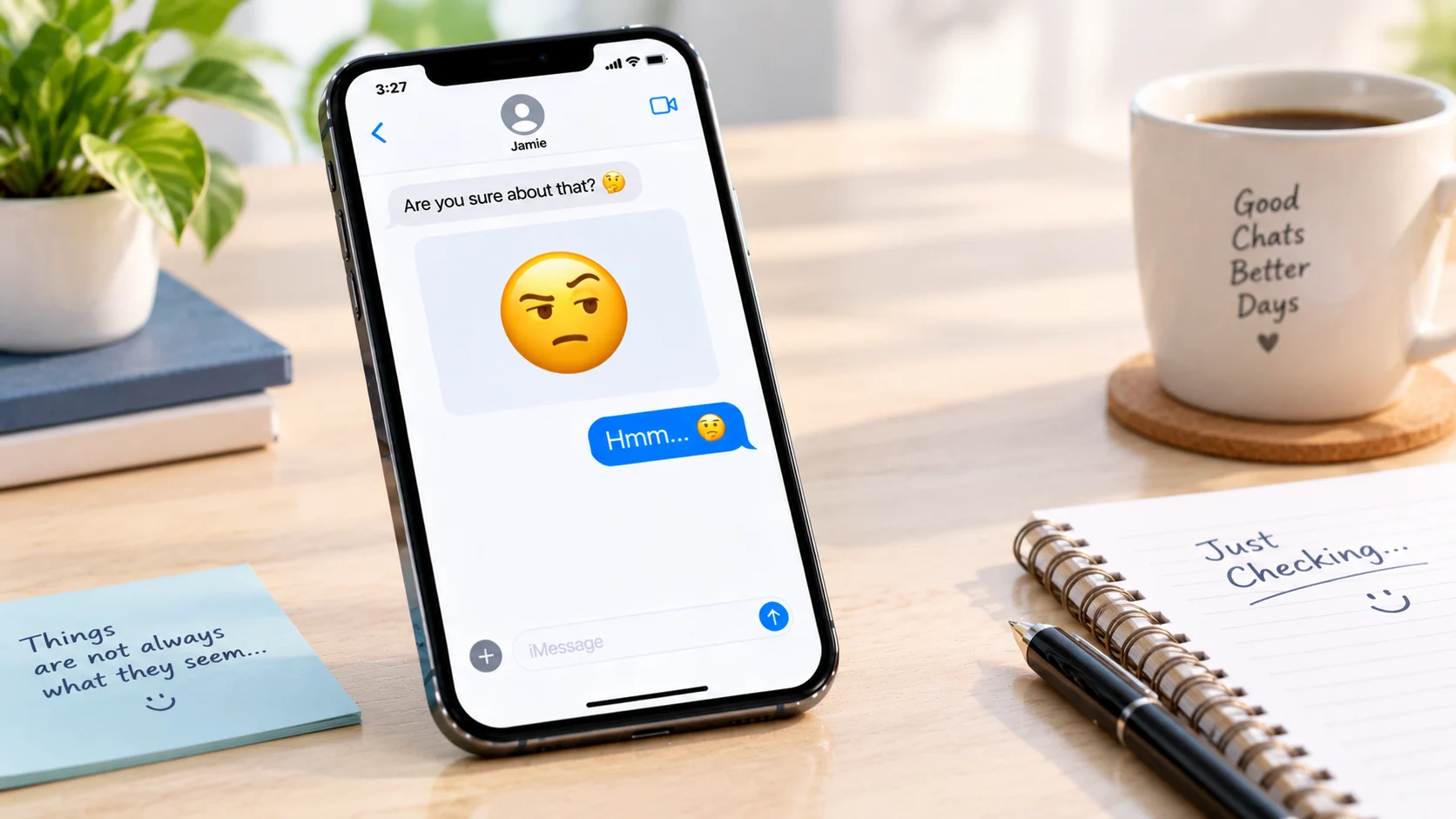
🤨 is commonly used as a suspicious or skeptical reaction, while 🧐 suggests closer examination and 🤔 usually expresses thought or uncertainty. The intended meaning depends on the message, the relationship between the people chatting, and the conversation’s tone.
The suspicious emoji 🤨 often expresses doubt, skepticism, disbelief, or the feeling that something does not seem right. People may use it when questioning a strange statement, reacting to a questionable excuse, or playfully suggesting that someone is hiding something.
Although these emojis can communicate suspicion, none automatically proves that someone is lying, angry, jealous, or hiding a secret.
What Does the Suspicious Emoji 🤨 Mean?
The 🤨 emoji is officially called Face with Raised Eyebrow. Its raised eyebrow and facial expression can suggest that someone is questioning what they have heard or is not entirely convinced.
In everyday texting, it can communicate several related feelings:
- Suspicion: Something seems unusual or questionable.
- Doubt: The sender is unsure a statement is believable.
- Skepticism: The sender wants more convincing information.
- Disbelief: A claim sounds surprising or hard to accept.
- Playful judgment: The sender is teasing someone about a questionable choice.
- Curiosity: The sender wants an explanation before accepting what happened.
The surrounding words help determine which meaning fits best.
For example, a friend might send 🤨 after hearing an unexpected excuse. In a serious discussion, the same emoji could express genuine doubt. Between close friends, it may simply be a humorous reaction.
The emoji itself does not establish the sender is truly suspicious or joking.
What Does 🤨 Mean in Text Messages?
In text messages, 🤨 often works as a short reaction to something that deserves a second look. Instead of typing a full question, someone can use it to signal that they are unconvinced or want clarification.
Here are a few hypothetical examples.
| Example message | Likely meaning | Why context matters |
|---|---|---|
| “You finished that entire project in five minutes? 🤨” | Doubt or disbelief | The claim sounds surprising. |
| “I was totally asleep when you called 🤨” | Possible suspicion | The sender may be questioning the explanation. |
| “You said you don’t like pizza, but you ate three slices 😂🤨” | Playful teasing | The laughing emoji makes the reaction less serious. |
| “Wait, that’s not what you told me yesterday 🤨” | Concern or skepticism | The sender has noticed conflicting information. |
| “I got us concert tickets for tonight 🤨” | Confusion or questioning | Without more context, the reaction could have several meanings. |
A single emoji may communicate a reaction, but it cannot fully explain the sender’s thoughts. If the message matters, consider the actual words and ask for clarification rather than assuming the worst.
Is 🤨 a Suspicious or Sarcastic Emoji?
It can be both, but suspicion and sarcasm are not the same thing.
- Suspicious: The sender thinks something may be wrong. Example: “Why did the plans suddenly change? 🤨”
- Sarcastic: The sender uses a questioning expression to tease or criticize. Example: “Oh, you definitely remembered to call me 🤨”
- Playful: The sender pretends to doubt a harmless statement. Example: “You ate the last cookie? 🤨”
- Genuinely confused: The sender wants an explanation. Example: “You booked the wrong date? 🤨”
The emoji can sound more confrontational when it follows a direct accusation. It usually feels lighter when paired with laughter, friendly wording, or an obviously playful situation.
What Does 🤨 Mean From Someone?
When someone sends 🤨 directly to you, they may be questioning something you said, reacting to an unexpected detail, or teasing you.
The exact interpretation depends on the conversation.
In a friendship: A friend might use it to joke about an unusual decision or challenge an excuse.
In a serious conversation: It may suggest doubt, concern, or a desire for more information.
In a romantic conversation: It might be playful teasing, curiosity about your intentions, or skepticism about a comment. However, 🤨 alone is not reliable evidence of attraction, jealousy, or distrust.
In a group chat: It can serve as a reaction to an unexpected announcement, questionable opinion, or surprising story.
Before interpreting the emoji personally, consider the sender normally uses expressive reactions. Some people use 🤨 jokingly, while others use it to communicate genuine skepticism.
🤨 vs. 🤔 vs. 🧐: Which Emoji Is More Suspicious?
These three expressions can overlap, but their typical emphasis differs.
- 🤨 Face with Raised Eyebrow: “Really? I’m not convinced.”
- 🤔 Thinking Face: “Hmm, let me think about that.”
- 🧐 Face with Monocle: “Let’s examine this more closely.”
If you want to question a claim, 🤨 is a direct choice. If you are still considering the possibilities, 🤔 may fit better. If you want to suggest careful inspection or scrutiny, 🧐 can communicate that idea.
Related Emojis and Their Meanings
The following emojis can express doubt, judgment, confusion, or suspicion, but each has a different emotional emphasis.
| Emoji | Official Name | Common Meaning | Tone | Where or When It Is Used |
|---|---|---|---|---|
| 🤨 | Face with Raised Eyebrow | Doubt, skepticism, suspicion | Questioning | Reacting to a questionable claim |
| 🧐 | Face with Monocle | Close examination, scrutiny | Analytical or curious | Inspecting details or questioning evidence |
| 🤔 | Thinking Face | Thinking, uncertainty, consideration | Reflective | Weighing an idea or asking a thoughtful question |
| 😒 | Unamused Face | Annoyance, dissatisfaction, skepticism | Irritated | Reacting to an excuse or frustrating comment |
| 🙄 | Face with Rolling Eyes | Exasperation, disbelief, impatience | Dismissive or sarcastic | Responding to a repetitive or irritating remark |
| 😏 | Smirking Face | Self-confidence, teasing, suggestiveness | Playful or smug | Making a teasing comment or hint |
| 😐 | Neutral Face | Little visible emotion, a restrained reaction | Neutral or deadpan | Responding without showing much emotion |
| 😬 | Grimacing Face | Awkwardness, tension, discomfort | Uneasy | Reacting to an uncomfortable situation |
The official names follow the Unicode emoji naming conventions.
The Most Important Differences
🤨 vs. 🧐: Both can suggest suspicion. However, 🤨 often questions something is believable, while 🧐 more strongly suggests examining information or looking for details.
🤨 vs. 🤔: The raised eyebrow in 🤨 can feel skeptical or judgmental. 🤔 usually puts more emphasis on thinking, though it can also express doubt.
🤨 vs. 🙄: The first often questions something, while the second more directly conveys annoyance or exasperation. Using 🙄 may sound more dismissive.
🤨 vs. 😏: The raised-eyebrow face questions a statement, while the smirking face can suggest teasing, smugness, or suggestiveness. Neither guarantees a particular intention.
🤨 vs. 😬: Choose 🤨 to question something and 😬 to show discomfort or awkwardness.
How to Respond to the Suspicious Emoji
If someone sends 🤨, your response should match the conversation rather than assuming they are accusing you of something.
Here are some natural options:
If they seem genuinely doubtful
“Wait, what seems off? I can explain.”
If they are joking with you
“LOL, why the suspicious face? 😂”
If they misunderstood your message
“I didn’t mean it that way. Let me explain.”
If you are also confused
“That’s the same reaction I had 🤨”
If you want a neutral reply
“What do you mean?”
You do not always need to respond to the emoji itself. If the person is reacting to a specific statement, answering the actual question may be more helpful.
Suspicious Emoji Copy and Paste
You can copy these emojis and use them in texts, captions, comments, or group chats.
🤨
Skepticism
Copy
🧐
Scrutiny
Copy
🤔
Thinking
Copy
😒
Unamused
Copy
🙄
Exasperation
Copy
😏
Smirking
Copy
Some example combinations include:
- 🤨❓ — questioning something
- 🤨😂 — playful disbelief
- 🤨👀 — suggesting that something deserves attention
- 🧐🤨 — examining something with skepticism
- 🤔🤨 — thinking while expressing doubt
These combinations have no fixed official meanings. The words around them help establish the intended tone.
Official Name and Unicode Details
The suspicious emoji most commonly associated with a raised eyebrow is 🤨, officially named Face with Raised Eyebrow.
- Emoji: 🤨
- Official name: Face with Raised Eyebrow
- Unicode code point: U+1F928
- Unicode release: Unicode 10.0 (2017)
- Emoji release: Emoji 5.0 (2017)
The appearance may vary slightly between Apple, Google, Samsung, and other platforms. Differences in eyebrow shape, mouth, and facial proportions can affect how an expression feels, even though the underlying emoji character remains the same.
FAQs
What is the suspicious emoji?
🤨 Face with Raised Eyebrow is the emoji most commonly associated with suspicion, skepticism, doubt, and disbelief. Its meaning depends on the message and situation.
What does 🤨 mean from a girl or a guy?
It can mean the same things regardless of the sender’s gender: doubt, curiosity, disbelief, or playful teasing. The surrounding conversation and the person’s usual texting style are better clues to their intention.
Does 🤨 mean someone thinks you are lying?
Not necessarily. It may suggest that someone is questioning your statement, but it can also be humorous or curious. The emoji alone cannot establish that someone believes you are lying.
Is 🤨 rude?
It can sound rude or judgmental if it follows a sensitive statement or an accusation. Among friends, it may be a harmless joke. If you want a softer reaction, 🤔 can communicate uncertainty without the same raised-eyebrow emphasis.
Is 🤨 a flirting emoji?
It can appear in playful or flirty conversations, especially when someone is teasing another person. However, it is not inherently romantic and does not prove that someone is flirting.
What is the difference between 🤨 and 🧐?
🤨 usually emphasizes doubt or skepticism, while 🧐 suggests closer inspection, curiosity, or careful examination. They can overlap when someone questions a statement or looks for more information.
What does 🤨 mean on social media?
In comments and posts, it can react to a surprising claim, questionable behavior, an unexpected reveal, or a statement that seems inconsistent. It may be serious or humorous depending on the caption and surrounding discussion.
Conclusion
🤨 Face with Raised Eyebrow is a useful way to express doubt, skepticism, disbelief, or playful suspicion without writing a full sentence. It can make a message funny, curious, or slightly confrontational depending on the context.
When interpreting it, pay attention to the words, the conversation, and the sender’s usual style. A raised eyebrow is a reaction, not proof of what someone thinks.
See Also More:
- Outlook Emojis Explained | Meanings, Shortcuts & Email Tips In 2026
- Train Emoji Meaning | Travel, Trains, & Texting Explained In 2026
- Soccer Emoji Meaning | What It Says in Texts, Sports Chats & More In 2026