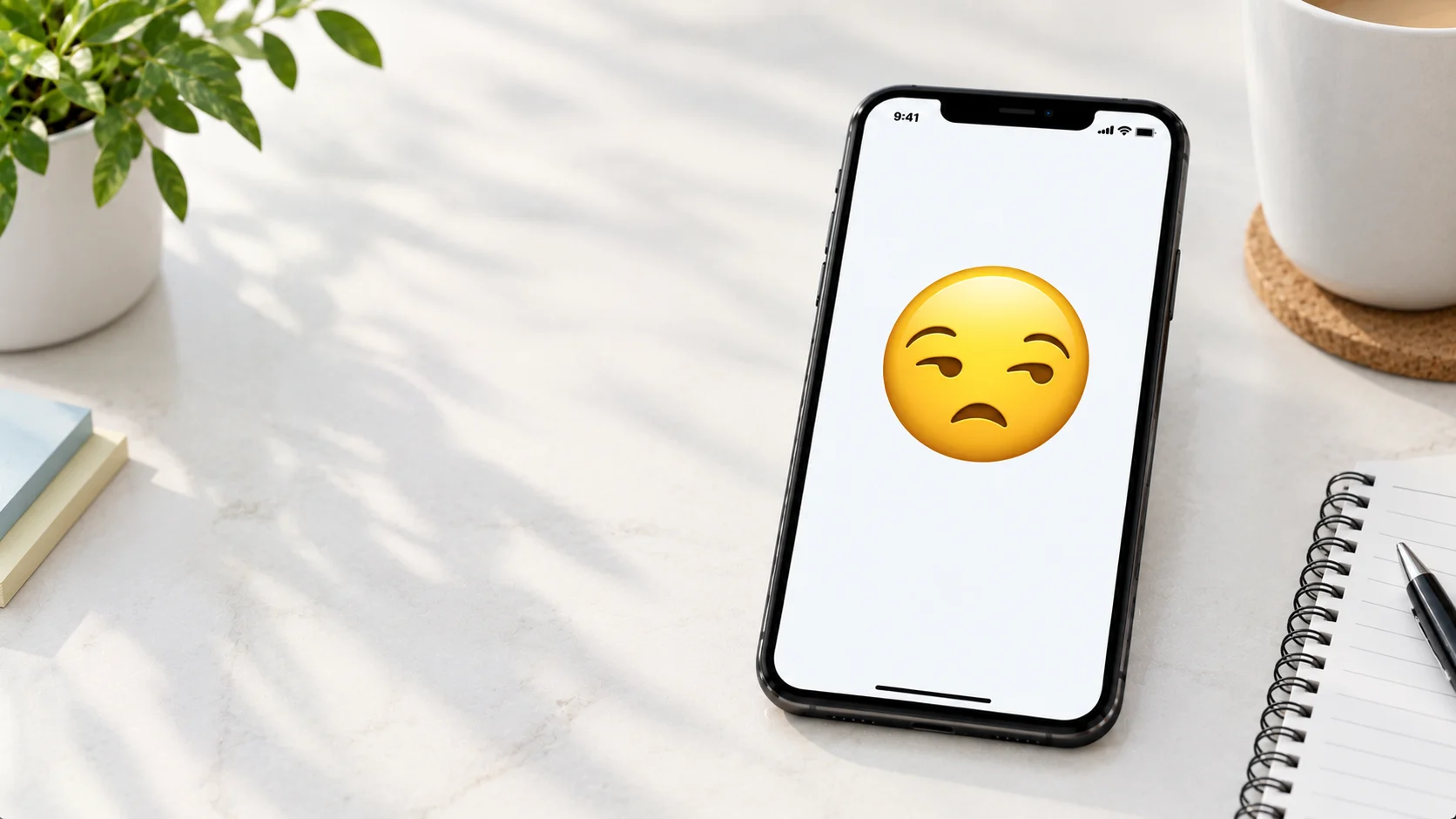
The 😒 emoji, often associated with a “meh” reaction, expresses displeasure, annoyance, boredom, or indifference. It can show that someone is unimpressed, frustrated, or not particularly interested in something.
The meh emoji 😒 is commonly used when something feels boring, disappointing, irritating, or simply not worth getting excited about. Its half-lidded eyes and sideways-looking expression give it an unimpressed appearance, making it useful for showing doubt, mild annoyance, or a lack of enthusiasm in text messages.
Although people often describe 😒 as a “meh” face, its official Unicode name is Unamused Face. The intended meaning depends on the conversation: it may express genuine frustration, playful disapproval, or a sarcastic reaction. Understanding the surrounding words helps you interpret the emoji without assuming too much.
What Does the Meh Emoji 😒 Mean?
The 😒 emoji usually communicates a negative or unimpressed reaction. It can suggest that someone is dissatisfied, irritated, skeptical, or not interested in what is happening.
Common meanings include:
- Indifference: Something does not seem interesting or exciting.
- Annoyance: A comment or situation is getting on someone’s nerves.
- Disappointment: Things did not turn out as expected.
- Disapproval: Someone does not like or agree with something.
- Skepticism: A person doubts what they have heard.
- Sarcasm: The emoji adds an unimpressed or mocking tone to a reply.
For example, “Another meeting today 😒” suggests frustration or a lack of enthusiasm. “You expect me to believe that? 😒” communicates doubt or disbelief.
Although these meanings overlap, the emoji does not always indicate anger. It often conveys mild irritation or an unimpressed attitude rather than intense emotion.
What Does 😒 Mean in Texting?
In text messages, 😒 can communicate feelings that might otherwise be difficult to recognize from words alone. It often changes the tone of a short reply, making it sound less enthusiastic or more critical.
| Example message | Likely meaning | Context clue |
|---|---|---|
| “We have homework again 😒” | Annoyance | The sender dislikes the situation. |
| “That movie was so boring 😒” | Disappointment | The sender was not impressed. |
| “Yeah, sure 😒” | Doubt or sarcasm | The response may show disbelief. |
| “You forgot again 😒” | Frustration | The sender is unhappy about a repeated mistake. |
| “Everyone else got invited except me 😒” | Disappointment | The sender feels left out. |
These examples are illustrative, not fixed definitions. A person’s usual texting style and the conversation’s history can change how the emoji comes across.
Is the Meh Emoji Negative or Neutral?
The 😒 emoji generally has a negative or unimpressed tone, but the intensity can range from mild disinterest to clear irritation.
- Mildly negative: “Not my favorite 😒” suggests that something is disappointing.
- Clearly annoyed: “You did that again? 😒” communicates frustration.
- Playfully unimpressed: “You call that a joke? 😒” may be teasing between friends.
- Skeptical: “And I’m supposed to believe that? 😒” suggests doubt.
It is not usually a neutral smile or a sign of happiness. However, a person may use it jokingly without feeling seriously upset.
What Does 😒 Mean From Someone?
When someone sends 😒, they may be unimpressed, annoyed, disappointed, or skeptical about something in the conversation. The emoji alone cannot tell you exactly which feeling they intend.
For example:
- “You are late again 😒” may express frustration.
- “You ate the last slice? 😒” could show playful annoyance.
- “Really? 😒” may communicate disbelief or disappointment.
Before assuming someone is angry with you, consider what they were responding to. They might be reacting to a situation, joking with you, or expressing an opinion rather than criticizing you personally.
Is 😒 Rude or Sarcastic?
The 😒 emoji can sound rude because it may make a message appear dismissive, judgmental, or impatient. However, it is not automatically insulting.
It may feel rude when:
- It follows an apology without any other response.
- It accompanies a dismissive comment.
- It appears after someone shares something important or personal.
It may feel playful when:
- Friends are teasing each other.
- The conversation is already humorous.
- The words clearly show that the sender is joking.
For instance, “Wow, you finished the snacks without me 😒” could be playful teasing. The same expression in a serious disagreement might communicate genuine frustration.
If you are unsure, pay more attention to the words and the relationship than to the emoji alone.
😒 Meh Emoji vs. Similar Emojis
Several emojis can express dissatisfaction or a lack of enthusiasm, but their facial expressions and typical uses differ.
| Emoji | Official Name | Common Meaning | Tone | Where or When It Is Used |
|---|---|---|---|---|
| 😒 | Unamused Face | Displeasure or disapproval | Unimpressed | Disappointing news or irritating situations |
| 😑 | Expressionless Face | No visible reaction or patience | Flat, restrained | Awkward moments or repetitive situations |
| 😐 | Neutral Face | Neutrality or uncertainty | Reserved | Plain replies or unclear reactions |
| 🙄 | Face with Rolling Eyes | Exasperation or disbelief | Sarcastic | Responding to an irritating comment |
| 😕 | Confused Face | Confusion or uncertainty | Hesitant | Unclear explanations or unexpected news |
| 😞 | Disappointed Face | Sadness or disappointment | Downcast | Bad news or unmet expectations |
| 😠 | Angry Face | Anger or strong displeasure | Intense | Clear frustration or anger |
| 😏 | Smirking Face | Self-confidence, suggestiveness, or smugness | Playful or knowing | Teasing or a knowing reaction |
What Is the Difference Between 😒, 😑, and 🙄?
These three emojis are especially easy to confuse.
- 😒 Unamused Face: Shows displeasure, dissatisfaction, or an unimpressed attitude.
- 😑 Expressionless Face: Suggests a blank reaction, emotional restraint, or having nothing to say.
- 🙄 Face with Rolling Eyes: Often communicates exasperation, disbelief, or irritation with something someone said.
For example, use 😒 when you are unimpressed, 😑 when you have no reaction, and 🙄 when you want to emphasize that something seems ridiculous or frustrating.
The distinctions are informal, so people may use them differently depending on their communication style.
How to Respond to the Meh Emoji 😒
The best response depends on the sender seems annoyed, disappointed, or playful.
- If someone seems disappointed: “Oh no, what happened?”
- If someone seems annoyed with you: “Did I do something that bothered you?”
- If a friend is joking: “Haha, okay, I get it 😂”
- If someone disagrees: “Fair enough. What would you prefer?”
- If the meaning is unclear: “What do you mean by that face?”
Avoid assuming the emoji is directed at you. If the conversation feels tense, a calm question is often more useful than responding with another negative emoji.
Does the Meh Emoji Look Different on Different Devices?
Yes. The 😒 emoji may look slightly different on Apple, Google, Samsung, and other platforms. Details such as the eye shape, eyebrows, mouth, and facial proportions can vary.
Its standard Unicode identity remains the same, even when the artwork differs. These visual differences do not establish separate official meanings for each device.
Official Name and Unicode Details
Although many people call 😒 the meh emoji, its official Unicode name is Unamused Face.
| Detail | Information |
|---|---|
| Emoji | 😒 |
| Official Unicode name | Unamused Face |
| Unicode code point | U+1F612 |
| Category | Smileys & Emotion |
| Unicode version | Unicode 6.0 |
| Approval year | 2010 |
“Meh” is an informal description of a reaction that communicates indifference or a lack of enthusiasm. It is not the official Unicode name of 😒.
Copy and Paste the Meh Emoji
😒
You can copy and paste the meh emoji into text messages, social media comments, captions, and chats whenever you want to express an unimpressed or dissatisfied reaction.
FAQs
What does 😒 mean from a girl or a guy?
The 😒 emoji can express annoyance, disappointment, skepticism, or disapproval regardless of the sender’s gender. The conversation and the person’s usual communication style are more useful clues than gender.
Does 😒 mean someone is mad at you?
Not necessarily. The person may be annoyed about something else, joking, or expressing general dissatisfaction. Look at the message they responded to before assuming their reaction is personal.
Is 😒 the same as saying “meh”?
They are related but not identical. “Meh” often expresses indifference or a lack of enthusiasm, while 😒 can communicate stronger displeasure, skepticism, or disapproval.
Can 😒 be used jokingly?
Yes. Friends may use it to tease each other or pretend to be unimpressed. The surrounding words and the relationship help distinguish playful teasing from genuine frustration.
What is the difference between 😒 and 🙄?
😒 usually shows an unimpressed or dissatisfied expression. 🙄 more directly suggests eye-rolling, often associated with exasperation, disbelief, or impatience.
Conclusion
The meh emoji 😒, officially known as Unamused Face, usually expresses displeasure, indifference, skepticism, or mild annoyance. It can make a message sound sarcastic or dismissive, but it may also be used playfully among friends. To understand its intended meaning, consider the surrounding words and the conversation rather than assuming the sender is angry.
See Also More:
- Palm Tree Emoji | What It Says About Summer, Travel & Relaxation In 2026
- Emoji Sad Meaning | How to Understand Sad Faces in Messages In 2026
- I Love You Emoji Meaning | How to Express Love, Care & Affection In 2026