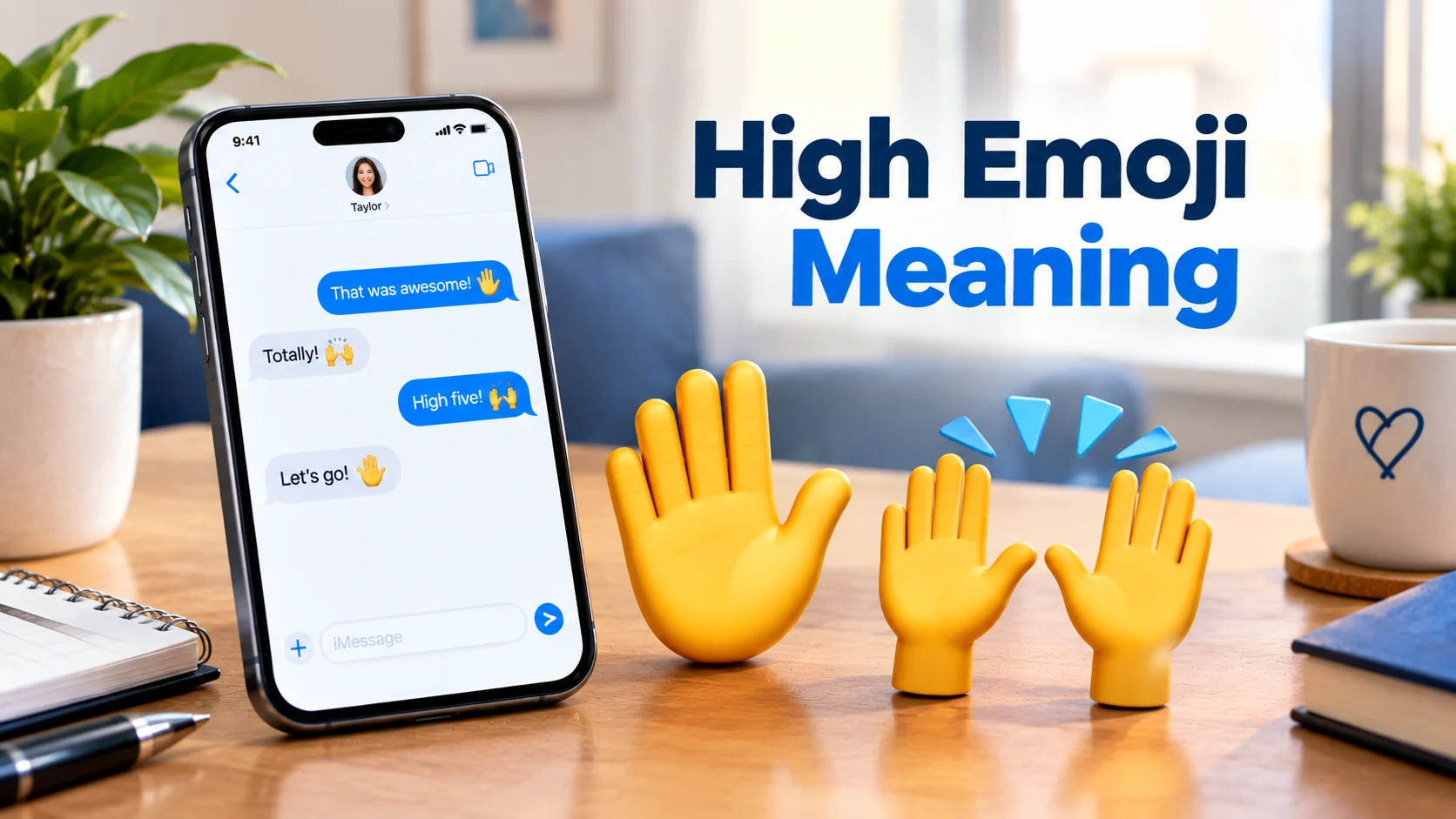
High emoji usually refers to a hand raised for a high five, celebration, agreement, or encouragement.
✋ Raised Hand | can mean a high five, “stop,” “wait,” or “I have something to say.
🙌 Raising Hands | usually gives a stronger feeling of celebration, excitement, praise, or success.
If someone sends one of these emojis by itself, look at the conversation before deciding what they mean.
The phrase “high emoji” can refer to more than one hand emoji, but there is no official Unicode emoji named simply “High Emoji.” The closest match is often ✋ Raised Hand, which can represent a high five, stop, or simply raising a hand.
🙌 Raising Hands is another common choice when someone wants to show celebration, excitement, praise, or shared success. Unicode officially names these emojis Raised Hand and Raising Hands, so the exact meaning depends on which character was sent and what the surrounding message says.
What Does the High Emoji Mean?
There isn’t a single official “high emoji.” The phrase is commonly used to describe hand emojis associated with a high five or raised hands.
The most useful distinction is between ✋ Raised Hand and 🙌 Raising Hands.
✋ Raised Hand shows one hand with the palm facing outward. It can represent a high five, but it can also mean “stop,” “hold on,” or “my hand is raised.” Emojipedia notes that it may be used to mean stop or as a high five.
🙌 Raising Hands shows two hands lifted in the air. Its main visual idea is celebration, and Unicode’s current emoji data associates it with words such as celebration, hooray, praise, and raised hands.
That difference matters because the two emojis can look similar in a quick message while creating different tones.
✋ High Five Emoji Meaning in Text
When ✋ appears in a friendly conversation, it can represent a high five.
For example:
“We finally finished the project ✋”
Here, ✋ can feel like a virtual high five: we did it.
It can also be used after good news:
“You got the part! ✋”
In this setting, the emoji adds congratulations and shared excitement.
But ✋ does not always mean “high five.” In a message such as:
“Hold up ✋ I need to check something.”
the same emoji feels more like stop, wait, or pause.
The surrounding words are what make the intended meaning clearer.
🙌 Raising Hands Meaning in Text
🙌 generally has a more celebratory tone than ✋.
It can express:
- Celebration
- Excitement
- Praise
- Relief after good news
- Encouragement
- Shared success
- “We did it!”
For example:
“The team won! 🙌”
The emoji reinforces the celebration.
Another example:
“I finally passed the test 🙌”
Here, 🙌 suggests happiness and relief about an achievement.
Because it shows both hands raised, 🙌 can feel more energetic and enthusiastic than a single raised hand.
Is the High Emoji a High Five?
It can be, but the answer depends on the emoji.
✋ is the clearer choice when you specifically want to suggest a high five. Unicode’s emoji annotations include “high 5” and “high five” among the keywords associated with Raised Hand.
🙌 is better when the meaning is celebration or excitement. Its official Unicode name is Raising Hands, and its associated annotations include celebration, hooray, and praise.
So, if your intended message is:
“High five!” → ✋
If your intended message is:
“We did it!” → 🙌
They can overlap, but they are not identical.
Does ✋ Mean Stop or High Five?
Both interpretations are possible.
The best clue is the wording around the emoji.
High-five meaning
“Nice job on that presentation! ✋”
The positive sentence makes the high-five interpretation more likely.
Stop or wait meaning
“Wait ✋ Don’t send that yet.”
Here, the emoji acts like a visual pause or stop signal.
This is a good example of why an emoji should not be interpreted in isolation.
Can 🙌 Be Used for Support?
Yes. 🙌 can communicate encouragement or shared excitement when someone reaches a goal.
For example:
“You worked really hard for this. 🙌”
The emoji can make the message feel warmer and more celebratory.
It does not automatically indicate romantic interest. A friend, teammate, classmate, family member, or another person could use it in a supportive conversation.
Is the High Emoji Flirty?
Usually, ✋ or 🙌 does not automatically indicate flirting.
These emojis are much more naturally connected with gestures, celebration, encouragement, congratulations, or a high five.
If someone uses one in a conversation that already has romantic or playful language, it may take on that tone. But the emoji itself is not proof of attraction or romantic interest.
For example:
“You actually did it 😂🙌”
This is naturally read as playful celebration.
By contrast, a message with romantic wording could make the same emoji feel more personal. The words and relationship between the people matter more than the emoji alone.
High Emoji vs. Similar Hand Emojis
| Emoji | Official Name | Common Meaning | Tone | Where or When It Is Used |
|---|---|---|---|---|
| ✋ | Raised Hand | High five, stop, wait, raised hand | Friendly or firm | High fives, pauses, reactions, asking someone to stop |
| 🙌 | Raising Hands | Celebration, success, praise | Excited and positive | Good news, achievements, congratulations |
| 👏 | Clapping Hands | Applause, approval, congratulations | Supportive and enthusiastic | Praising someone or reacting to an achievement |
| 🖐️ | Hand with Fingers Splayed | Raised hand, greeting, stop | Neutral or friendly | Gestures, greetings, or signaling stop |
| 🤚 | Raised Back of Hand | Raised hand or gesture for attention | Neutral | Reactions, gestures, or signaling |
| 🙏 | Folded Hands | Thanks, prayer, request, appreciation | Respectful or grateful | Thank-you messages, requests, prayers |
| 🫶 | Heart Hands | Love, affection, appreciation | Warm and affectionate | Support, appreciation, friendship, affection |
| ✊ | Raised Fist | Determination, solidarity, strength | Strong and assertive | Encouragement, solidarity, or showing resolve |
The biggest distinction is between ✋ and 🙌. ✋ can work as a literal virtual high five, while 🙌 is more strongly associated with celebration and shared success. 👏 is better when you want to communicate applause, while 🙏 has a more grateful or prayer-related meaning. Unicode lists these hand emojis separately, with different official names and annotations.
High Emoji Message Examples
1. “You crushed it! ✋”
Likely meaning: A virtual high five.
The phrase is clearly congratulatory, so ✋ works as a celebratory hand gesture.
2. “We passed! 🙌”
Likely meaning: Excitement and celebration.
The two raised hands make the achievement feel bigger and more energetic.
3. “Wait ✋”
Likely meaning: Stop or pause.
The short command changes the meaning of the raised hand completely.
4. “Great job 👏”
Likely meaning: Applause and approval.
👏 is more directly connected with clapping than either ✋ or 🙌.
5. “Thanks for helping me 🙏”
Likely meaning: Gratitude or appreciation.
Here, 🙏 is more suitable than a high-five-style hand emoji because the message is focused on thanks.
How to Respond to a High Emoji
Your response can match the tone of the original message.
If someone sends ✋ as a high five, you can respond with:
“High five! ✋”
For celebration:
“We did it! 🙌”
For a supportive conversation:
“Absolutely! 👏”
If you’re unsure what the person meant, simply respond to the words around the emoji rather than trying to decode the emoji by itself.
Common Misunderstandings
✋ does not always mean high five
The official name is Raised Hand, not “High Five.” A high five is one possible use, but stop or wait are also common interpretations.
🙌 is not officially called “High Five”
Its official name is Raising Hands. It is mainly associated with celebration and raised hands, although people may use it in a variety of expressive ways.
An emoji does not determine someone’s feelings
A single ✋ or 🙌 cannot reliably tell you someone is joking, flirting, annoyed, excited, or being serious. The surrounding message provides much more information.
Different devices can look slightly different
Emoji artwork can vary between platforms and operating systems. The underlying Unicode character remains the same even when its visual design changes. Emojipedia documents examples of platform-specific artwork for both Raised Hand and Raising Hands.
Official Names and Unicode Details
For accuracy, here are the two emojis most relevant to the phrase high emoji:
- ✋ Raised Hand — Unicode code point U+270B
- 🙌 Raising Hands — Unicode code point U+1F64C
Both were approved as part of Unicode 6.0 in 2010 and added to Emoji 1.0 in 2015.
Unicode’s current emoji charts list 🙌 as “raising hands” and ✋ as “raised hand.”
Copy and Paste
High five: ✋
Celebration: 🙌
Applause: 👏
Support: 🫶
FAQs
What is the high emoji?
There is no official Unicode emoji named simply “High Emoji.” People may use the phrase to refer to ✋ Raised Hand, especially when they mean a high five, or 🙌 Raising Hands when they mean celebration.
What emoji means high five?
✋ Raised Hand can represent a high five and is the closest single emoji for that gesture. 🙌 can also express shared celebration, but its official name is Raising Hands.
What does ✋ mean in texting?
✋ can mean a high five, stop, wait, or simply a raised hand. The message around it determines which interpretation makes the most sense.
What does 🙌 mean in texting?
🙌 usually expresses celebration, excitement, praise, or shared success. It often appears when someone is happy about good news or an achievement.
Is ✋ a positive emoji?
It can be positive when used as a high five or friendly gesture. However, it can also communicate “stop” or “wait,” so its tone depends on context.
Is 🙌 a high-five emoji?
Not officially. 🙌 is Raising Hands, while ✋ is Raised Hand. 🙌 is more strongly associated with celebration, while ✋ can directly represent a high five.
Conclusion
The high emoji is not one official Unicode character. If you mean a virtual high five, ✋ Raised Hand is usually the closest choice. If you want to show celebration, excitement, or shared success, 🙌 Raising Hands is a better fit. The most accurate interpretation still depends on the words, situation, and tone of the conversation.
See Also More:
- Sleepy Emoji | Meaning, Uses & What It Says in Texts In 2026
- Orange Emoji Meaning | What It Means in Text & Messages In 2026
- Exclamation Point Emoji | Meaning in Text, Tone & Uses In 2026