What does the TikTok happy emoji [happy] mean?
It usually expresses strong happiness, joy, excitement, or a very positive reaction.
How do you use it?
Type [happy] with the square brackets in a TikTok area that supports hidden emojis. TikTok may convert the shortcode into its custom happy face.
The TikTok happy emoji [happy] is a hidden TikTok emoji that expresses strong happiness, joy, delight, or excitement. Unlike regular Unicode emojis such as 😀 or 😄, it is entered through a square-bracket shortcode rather than the standard phone emoji keyboard.
Its exact feeling depends on the message around it. A comment such as “This made my day [happy]” sounds genuinely cheerful, while the same emoji can feel playful or exaggerated in a humorous TikTok conversation.
What Is the TikTok Happy Emoji?
The TikTok happy emoji is one of TikTok’s hidden custom emoji-style expressions. It is commonly identified by the shortcode [happy].
Unlike standard Unicode characters, hidden TikTok emojis are entered through special bracketed codes. Emojipedia describes these as hidden emojis, emotes, stickers, or emoticons rather than ordinary Unicode emojis.
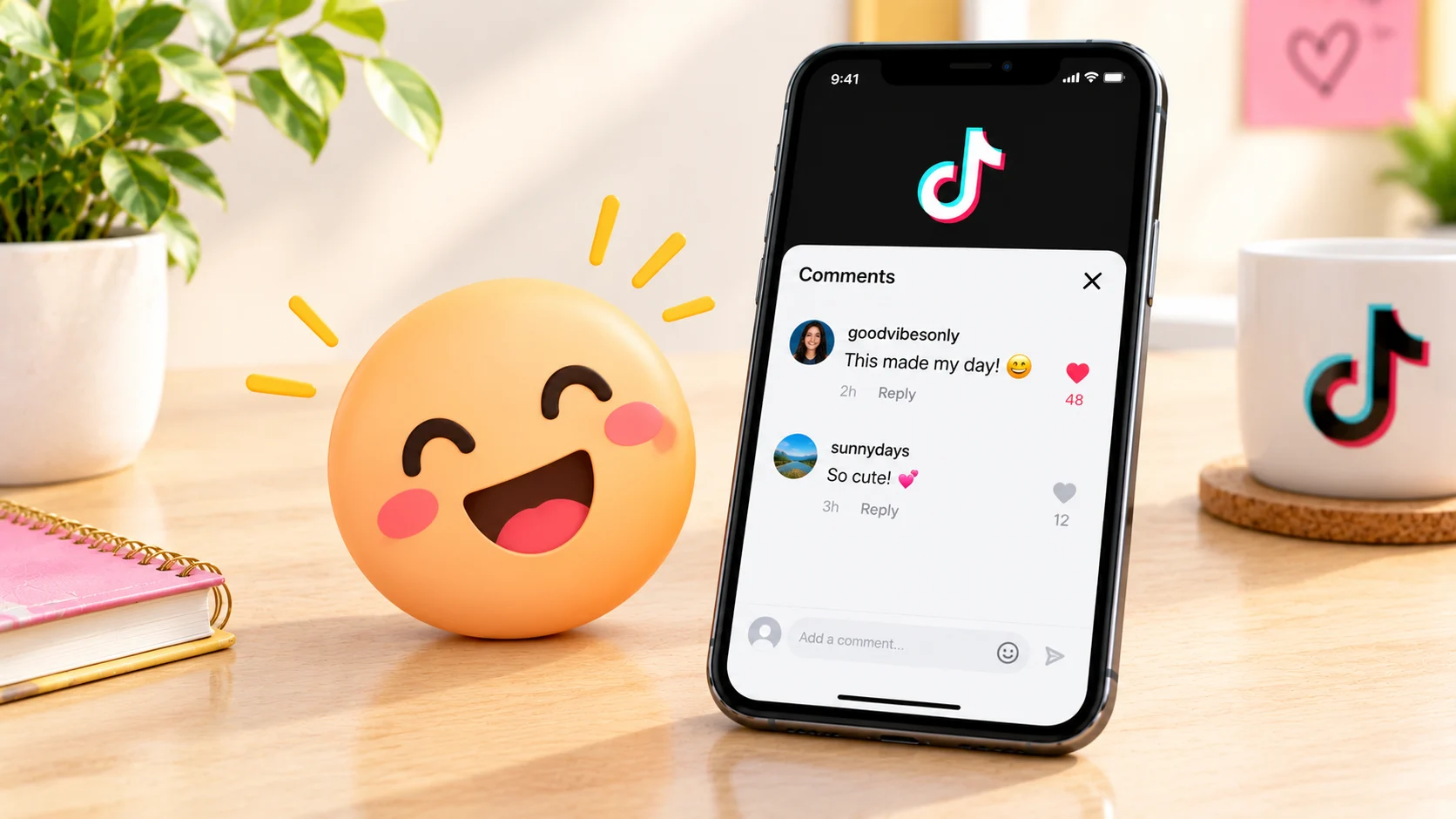
The [happy] design has a cheerful facial expression with a broad smile and tightly narrowed or closed-looking eyes. Its appearance is different from the standard 😀, 😄, or 😊 emojis you may find on a phone keyboard.
What Does [happy] Mean on TikTok?
The most common meaning is genuine happiness or an enthusiastic positive reaction.
Someone might use [happy] when:
- Celebrating good news
- Reacting to a wholesome video
- Showing excitement about an achievement
- Supporting a creator
- Responding to something funny or uplifting
- Adding extra energy to a positive comment
The emotional level can be stronger than a simple polite smile. For example:
“You finally did it [happy]”
This could communicate genuine excitement and congratulations.
By comparison, a simple 🙂 may feel calmer or more restrained.
The context still matters
There is no single guaranteed interpretation for every use. The words around the emoji, the video being discussed, and the overall tone of the conversation can change how [happy] feels.
For example:
“That ending was unexpected [happy]”
could show amused excitement.
But:
“Sure, that’s exactly what I wanted [happy]”
could be playful or ironic depending on the surrounding conversation.
The emoji alone does not prove that someone is being sarcastic.
How to Type the TikTok Happy Emoji
The commonly documented shortcode is:
[happy]
The important part is the complete code, including both square brackets.
If TikTok supports the shortcode in the part of the app where you are typing, it can turn into the custom emoji after you enter or post it. Hidden TikTok emojis are separate from the regular emoji keyboard.
If [happy] remains plain text, that does not necessarily mean you typed it incorrectly. Support or rendering can vary with the current TikTok app experience, so it is worth checking the code is supported where you are using it.
What Does [happy] Mean in a TikTok Comment?
In comments, [happy] can work as a quick emotional reaction.
For example:
Comment:
“Your reaction at the end 😂 [happy]”
Likely meaning:
The commenter is showing that they found the video or reaction enjoyable.
Comment:
“Congratulations on 1 million! [happy]”
Likely meaning:
The sender is celebrating the creator’s achievement.
Comment:
“This is honestly so wholesome [happy]”
Likely meaning:
The emoji adds warmth and reinforces the positive reaction.
These examples are hypothetical. The same code can communicate something slightly different depending on the content and wording.
Is the TikTok Happy Emoji Flirty?
Not by itself.
Because [happy] communicates positive emotion, someone might use it in a friendly, affectionate, or playful conversation. But it does not automatically mean romantic interest.
For example:
“You made it! [happy]”
is easily read as friendly encouragement.
A better way to interpret a potentially personal message is to consider the whole conversation, not one emoji. Look at the words, previous messages, and the relationship between the people involved.
Can [happy] Be Sarcastic?
Yes, it can be used in a playful or ironic way, but sarcasm comes from context rather than from the shortcode itself.
For example:
“Another three-hour homework assignment [happy]”
could be a joking way to express the opposite of excitement.
If the surrounding text clearly signals a joke, [happy] can add to the exaggeration. Without that context, it is safer to read it as a positive expression.
TikTok Happy Emoji vs. Regular Happy Emojis
The biggest difference is that [happy] is a TikTok hidden emoji shortcode, while emojis such as 😀, 😄, and 😊 are standard Unicode emoji characters.
Unicode lists 😀 as Grinning Face, 😄 as Grinning Face with Smiling Eyes, and 😊 as Smiling Face with Smiling Eyes.
Related Happy Emojis and Their Meanings
| Emoji | Official Name | Common Meaning | Tone | Where or When It Is Used |
|---|---|---|---|---|
| [happy] | TikTok hidden happy emoji | Strong happiness or excitement | Cheerful, energetic | TikTok comments, captions, and other supported TikTok text areas |
| 😀 | Grinning Face | Open, straightforward happiness | Bright, upbeat | General texts, comments, reactions |
| 😄 | Grinning Face with Smiling Eyes | Happy excitement or friendly joy | Warm, enthusiastic | Celebrations, jokes, positive replies |
| 😁 | Beaming Face with Smiling Eyes | Big grin, strong happiness | Energetic, confident | Exciting news, achievements, playful reactions |
| 😊 | Smiling Face with Smiling Eyes | Warm, gentle happiness | Soft, friendly | Appreciation, kindness, pleasant replies |
| 🙂 | Slightly Smiling Face | Mild happiness or a simple smile | Calm, restrained | Casual replies and low-key positive reactions |
| 😂 | Face with Tears of Joy | Finding something extremely funny | Playful, humorous | Jokes, funny videos, laughter |
| 🤩 | Star-Struck | Amazement or excited admiration | Excited, impressed | Amazing performances, achievements, impressive content |
The Unicode names and classifications for the standard emojis in this table come from Unicode’s current emoji charts.
The most important differences
[happy] vs. 😄:
Both can communicate strong happiness, but [happy] is a TikTok hidden custom emoji, while 😄 is a standard Unicode emoji.
[happy] vs. 😊:
😊 usually feels softer and warmer. [happy] can feel more energetic and expressive.
[happy] vs. 🙂:
🙂 is much more restrained. If you want a simple smile rather than an excited reaction, 🙂 may fit better.
[happy] vs. 😂:
😂 focuses on laughter and humor. [happy] is broader and can express happiness even when nothing is funny.
[happy] vs. 🤩:
🤩 suggests amazement or admiration. [happy] is more directly about feeling happy or excited.
When Should You Use [happy]?
The hidden happy emoji works well when you want your reaction to feel noticeably positive.
Examples include:
Celebrating:
“Passed my driving test [happy]”
Supporting someone:
“You deserve this! [happy]”
Reacting to wholesome content:
“This is so sweet [happy]”
Showing excitement:
“Can’t wait for the concert [happy]”
Reacting to good news:
“That is amazing news [happy]”
The key is matching the emotional strength of the emoji to the message.
When Might Another Emoji Be Better?
A different emoji may communicate your intention more clearly.
Use 😊 when you want warmth without making the reaction feel highly energetic.
Use 😂 when the main point is that something is funny.
Use 🤩 when you are impressed or amazed.
Use 🙂 when you want a mild, simple smile.
Use 😀 or 😄 when you want a standard Unicode happy face that works across many apps and platforms.
This distinction matters because TikTok’s hidden emojis are not the same type of character as ordinary Unicode emojis.
Common Misunderstandings About [happy]
One common mistake is assuming that every smiling emoji has exactly the same meaning.
They do not.
A smile can be enthusiastic, gentle, playful, amused, supportive, or simply friendly. The visual design helps set the tone, but the surrounding message usually provides the missing context.
Another mistake is treating [happy] as proof that someone is flirting. A positive emoji can appear in romantic conversations, but it can also be completely friendly.
It is also easy to confuse [happy] with a standard Unicode smiley because both communicate positive emotion. The important difference is that [happy] belongs to TikTok’s hidden shortcode system rather than the standard Unicode emoji set.
How to Respond to the TikTok Happy Emoji
Your response should match the conversation.
If someone celebrates your achievement:
“Thank you! I’m so excited!”
If someone reacts positively to your video:
“Glad you enjoyed it!”
If they are joking:
“Haha, exactly 😂”
If you’re unsure what they mean:
“Haha, what do you mean?”
There is no special response that works every time. Treat [happy] as a positive emotional signal, then use the surrounding conversation to decide how much meaning to attach to it.
FAQs
What is the code for the TikTok happy emoji?
The commonly documented code is [happy]. It is one of TikTok’s hidden emoji-style shortcodes.
Is [happy] a normal Unicode emoji?
No. [happy] is a hidden TikTok shortcode rather than a standard Unicode emoji character. Standard characters such as 😀 and 😄 are part of the Unicode emoji system.
What does the happy emoji mean on TikTok?
It generally expresses happiness, joy, excitement, or a strongly positive reaction. The exact tone can change with the message and video context.
Is [happy] the same as 😄?
No. They communicate similar positive feelings, but they are different emoji assets. 😄 is Grinning Face with Smiling Eyes, a standard Unicode emoji, while [happy] is a TikTok hidden shortcode.
Can [happy] mean sarcasm?
It can be used in a sarcastic or joking message, but the shortcode itself does not automatically mean sarcasm. The surrounding words and situation determine the reaction is sincere or ironic.
Why does [happy] sometimes appear as text?
Hidden emoji shortcodes depend on TikTok’s support and rendering behavior. If the code does not convert, it may simply remain as [happy] instead of becoming the custom emoji.
Conclusion
The TikTok happy emoji [happy] is best understood as a cheerful, expressive reaction that can communicate happiness, joy, excitement, or positive support. It is different from standard Unicode emojis such as 😀, 😄, and 😊 because it uses TikTok’s hidden shortcode system.
Its meaning becomes clearer when you read the words around it. In most positive conversations, it simply adds extra energy to an already happy message.
See Also More:
- Family Emoji Meaning | What It Means in Text & Messages In 2026
- Foot Emoji | Walking, Feet, Movement & Everyday Chats In 2026
- Emoji Keyboard Shortcut on Mac | The Fastest Way to Open Emojis In 2026