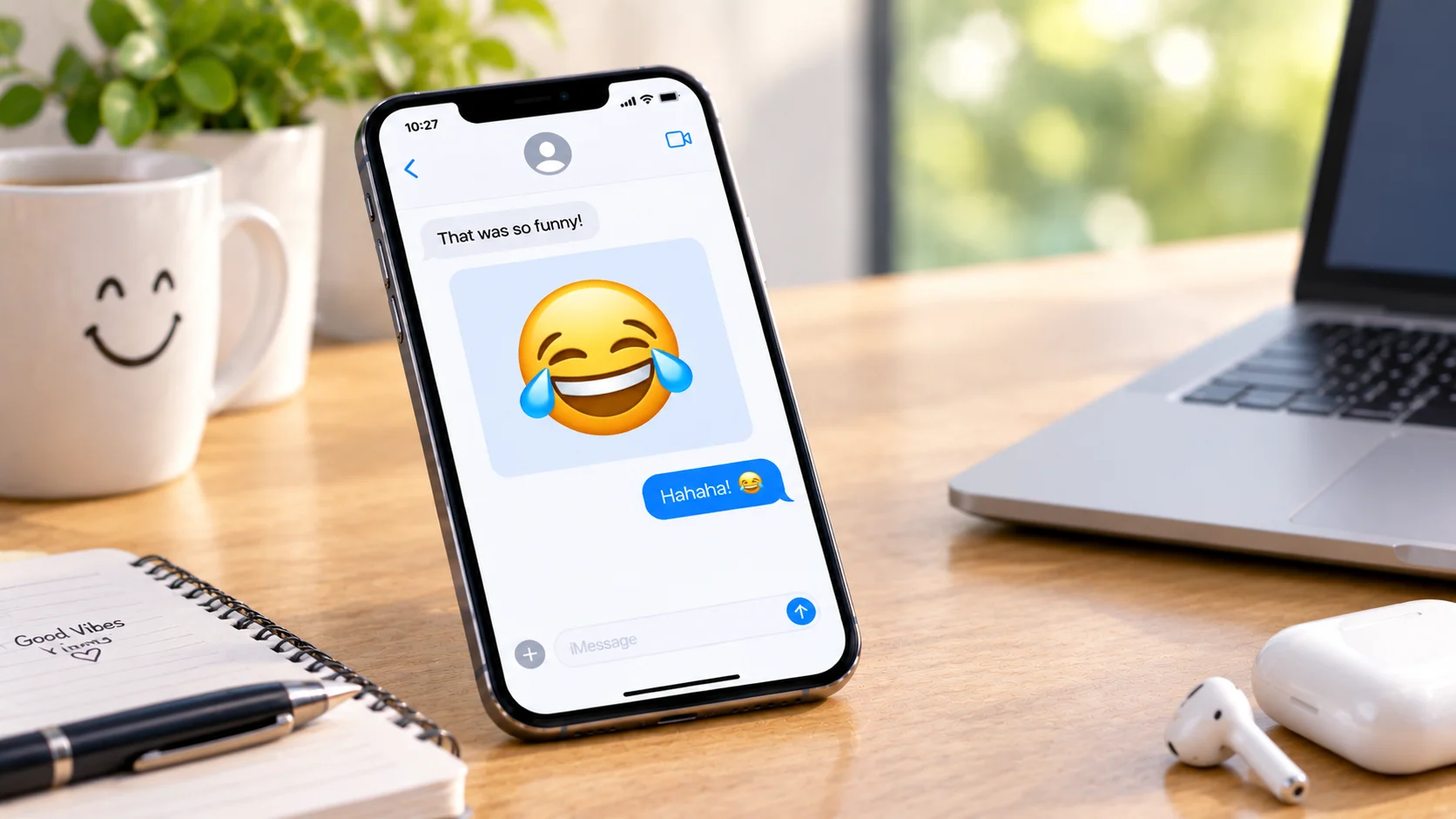
😂 Laugh Cry Emoji: Usually means “I’m laughing so hard” or “That is really funny.”
Tone: Happy, playful, amused, and sometimes exaggerated; the exact feeling depends on the conversation.
😂 usually means strong laughter, amusement, or “that’s really funny.” Its official Unicode name is Face with Tears of Joy, and the tears represent laughter rather than sadness.
People use it in texts, comments, reactions, and casual conversations to show that something made them laugh. Depending on the surrounding message, 😂 can also make teasing feel lighter or signal playful irony.
What Does the Laugh Cry Emoji 😂 Mean?
The laugh cry emoji 😂 shows a face laughing with tears coming from its eyes. The official Unicode name is Face with Tears of Joy, and its code point is U+1F602. Unicode lists keywords connected with the emoji such as “funny,” “happy,” “joy,” “laugh,” and “tear.”
In everyday texting, 😂 is most often a reaction to something funny. Someone might send it after a joke, a ridiculous story, an unexpected comment, or an embarrassing moment that is safe to laugh about.
The important distinction is that the tears normally represent tears of joy, not sadness. Emojipedia describes it as a laughing face with tears and notes that it is used to show something funny or pleasing.
The emoji can also be flexible. A message such as “I forgot my own password again 😂” is not necessarily saying that the person finds the situation hilarious. It can simply make the admission sound lighthearted.
😂 Meaning in Text Messages
In a text, 😂 commonly communicates one of these ideas:
- “That is so funny.”
- “I’m laughing.”
- “You made me laugh.”
- “I can’t believe you said that.”
- “That situation is ridiculous.”
- “I’m joking around.”
- “I know this sounds embarrassing, but it’s funny.”
The surrounding words matter. A standalone 😂 after a joke is usually a straightforward laughing reaction. The same emoji after an ironic statement can make the message feel sarcastic or playful.
For example:
“I definitely planned to start my homework early 😂”
If the person sends this after starting homework at the last minute, 😂 can signal that they are joking about their own behavior.
When 😂 Means Something Is Really Funny
This is the clearest use of the emoji.
Example:
“My dog stole the sandwich and then acted like nothing happened 😂”
Here, 😂 simply shows strong amusement.
It can work as a response by itself, too:
Friend: “I accidentally called my teacher ‘Mom.’”
You: “😂”
In this situation, the emoji acts like a short visual version of “That is hilarious.”
Can 😂 Be Playful or Sarcastic?
Yes. 😂 can sometimes support sarcasm, irony, or playful teasing, but the emoji itself does not automatically mean sarcasm.
Consider:
“Sure, I love waking up at 5 a.m. 😂”
The words sound exaggerated. The emoji reinforces the idea that the statement is not meant literally.
Now compare that with:
“I finally finished the project 😂”
That is more likely to be a genuine happy or relieved reaction.
When deciding 😂 is sarcastic, look at the words around it, the conversation history, and the sender’s usual style rather than assuming the emoji has a hidden meaning.
Does 😂 Mean Someone Is Actually Crying?
Usually, no.
The tears in 😂 are part of the visual idea of laughing so hard that tears appear. Unicode officially calls it Face with Tears of Joy, which makes the intended connection between tears and happiness clear.
If someone is talking about genuine sadness and adds 😂, the emoji may create confusion. In that situation, the surrounding message becomes especially important.
For example:
“I just watched the ending and I’m actually upset 😂”
The words and emoji point in different directions. The sender may be using humor to soften the situation, but you cannot know that from the emoji alone.
😂 From Someone: What Does It Mean?
When someone sends 😂 to you, the safest interpretation is usually that they found something funny or are responding in a playful way.
It does not automatically prove that they are flirting, interested in you, annoyed with you, or making fun of you.
For example:
“You really sent that message to the whole group 😂”
Depending on the conversation, this could be friendly teasing, genuine amusement, or mild disbelief.
If the meaning matters, pay attention to the rest of the message. A single emoji rarely provides enough information to determine someone’s exact intention.
Is 😂 a Flirty Emoji?
😂 can appear in a playful or flirty conversation, but it is not specifically a flirting emoji.
Someone might use it while joking with a person they like, but the same emoji is also completely normal between friends, classmates, relatives, coworkers in casual settings, and other people having a light conversation.
For example:
“You really think you can beat me at trivia? 😂”
This could be friendly competition, teasing, or flirting depending on the larger conversation. The emoji alone does not establish romantic interest.
When 😂 Can Feel Rude
😂 is usually lighthearted, but context can change how it feels.
It may seem dismissive if someone uses it while you are discussing something serious.
For example:
“I worked really hard on this and I’m disappointed with the result.”
A reply containing only:
“😂”
could easily feel insensitive because there is no clear funny part of the conversation.
The same emoji can be harmless when reacting to a funny story but poorly timed in a serious discussion.
Common Uses of 😂
Reacting to a joke
“Why did I think I could finish all of that in ten minutes? 😂”
Likely meaning: The speaker is laughing at the situation.
Laughing at an unexpected comment
“He answered the question before the teacher even finished asking it 😂”
Likely meaning: The situation was unexpectedly funny.
Making a confession feel lighter
“I waved at someone who wasn’t waving at me 😂”
Likely meaning: The person is embarrassed but choosing to laugh about it.
Playful teasing
“You actually wore that? 😂”
Likely meaning: The sender is teasing. it is friendly or rude depends on the relationship and tone.
Sarcastic humor
“Perfect. Another assignment. Exactly what I needed 😂”
Likely meaning: The sender is joking about the situation rather than celebrating it.
Laugh Cry Emoji Examples in Realistic Texts
These are hypothetical examples designed to show how context can change the tone.
| Message | Likely Meaning | Why Context Matters |
|---|---|---|
| “That joke was actually hilarious 😂” | Genuine laughter | The words directly describe something funny. |
| “I forgot where I parked again 😂” | Laughing at a mistake | The emoji makes the confession feel less serious. |
| “You really thought that would work? 😂” | Teasing or disbelief | The wording may sound playful or mocking depending on the relationship. |
| “Yeah, waking up early is my favorite thing 😂” | Sarcasm | The exaggerated statement suggests the opposite. |
| “I finally submitted it 😂” | Relief mixed with amusement | The laughter may be about getting through a stressful task. |
These examples show why an emoji should be read together with the message rather than treated like a fixed code.
😂 vs. 🤣: What’s the Difference?
The closest comparison is 😂 Face with Tears of Joy and 🤣 Rolling on the Floor Laughing.
😂 generally communicates strong laughter with tears of joy. 🤣 presents an even more exaggerated image of laughter. Unicode officially names 🤣 Rolling on the Floor Laughing.
In casual texting, the two can overlap heavily. There is no universal rule saying that one must always mean “funny” while the other means “extremely funny.”
A simple way to think about them is:
- 😂 — “That is really funny.”
- 🤣 — “I’m absolutely losing it.”
The choice often comes down to personal style and how intense the reaction feels.
Related Laughing and Emotional Reaction Emojis
| Emoji | Official Name | Common Meaning | Tone | Where or When It Is Used |
|---|---|---|---|---|
| 😂 | Face with Tears of Joy | Strong laughter or amusement | Joyful, playful | Jokes, funny stories, reactions |
| 🤣 | Rolling on the Floor Laughing | Very intense laughter | Exaggerated, energetic | Extremely funny moments and reactions |
| 😆 | Grinning Squinting Face | Big laugh or cheerful amusement | Energetic, happy | Casual jokes and excited reactions |
| 😅 | Grinning Face with Sweat | Nervous, awkward, or relieved laughter | Awkward, relieved | Mistakes, close calls, uncomfortable humor |
| 😄 | Grinning Face with Smiling Eyes | Happy, cheerful smile | Warm, positive | Friendly messages and cheerful reactions |
| 😹 | Cat with Tears of Joy | Laughing in a playful cat form | Silly, playful | Cat-related humor or playful reactions |
| 🤭 | Face with Hand Over Mouth | Suppressed laughter or amused surprise | Playful, coy | Trying not to laugh or reacting to something amusing |
| 😭 | Loudly Crying Face | Intense crying or exaggerated emotion | Dramatic, emotional | Sadness, overwhelm, or humorous exaggeration |
| 🥲 | Smiling Face with Tear | Bittersweet or emotional smile | Tender, mixed | Gratitude, bittersweet moments, or smiling through difficulty |
The biggest potential confusion is between 😂 and 🤣. Both can express intense laughter, but 🤣 has a more exaggerated visual idea.
😅 is different because its sweat can suggest nervousness, awkwardness, or relief rather than pure amusement.
😭 can sometimes be used online as an exaggerated reaction to something funny, but its official name is Loudly Crying Face, and it can also represent genuine sadness or distress.
🥲 is another important contrast. Its single tear and small smile can express mixed or bittersweet feelings, making it quite different from the wide laughing expression of 😂.
😂 vs. 😭: Why Do People Confuse Them?
😂 has tears, but its large grin clearly connects those tears with laughter.
😭 has heavy streams of tears and is officially called Loudly Crying Face. It can represent genuine sadness, but it is also used in exaggerated or humorous ways for reactions such as excitement, affection, disbelief, or laughter.
So, if you want the clearest visual signal for “That is funny,” 😂 is usually more direct.
If you want a dramatic reaction that could mean “I can’t handle this,” “I’m overwhelmed,” or even “this is so funny,” 😭 can be more flexible.
How to Respond to 😂
Your response can match the tone of the original message.
If they are joking
“😂 I know, that was ridiculous.”
If they are teasing you
“Okay, okay, you got me 😂”
If they shared something genuinely funny
“That actually made me laugh 😂”
If you’re unsure what they mean
Ask about the message itself rather than trying to decode the emoji alone:
“Wait, are you serious? 😂”
This gives the other person a chance to clarify without turning a simple emoji into a bigger issue.
Is 😂 the Same as LOL?
Not exactly, but they often perform a similar job.
“LOL” is text shorthand for laughing, while 😂 gives the message a visual emotional reaction. People can also combine them:
“LOL 😂”
The combination generally strengthens the impression that something is funny.
Still, neither “LOL” nor 😂 guarantees that someone is literally laughing. People use both as casual reactions, and the strength of the reaction depends on the conversation.
Official Name and Technical Details
The official Unicode name for 😂 is Face with Tears of Joy.
- Emoji: 😂
- Unicode code point: U+1F602
- Unicode name: FACE WITH TEARS OF JOY
- Unicode approval: Unicode 6.0, 2010
- Emoji 1.0: Added in 2015
Unicode’s current emoji data also associates 😂 with concepts including funny, happy, hilarious, joy, laugh, and tears.
Different platforms may draw the face slightly differently. The basic concept remains the same: a broad laughing expression with tears of joy.
Copy and Paste
😂
Use it when you want a simple, familiar way to show laughter or amusement.
FAQs
What does the laugh cry emoji 😂 mean?
😂 usually means strong laughter, amusement, or that something is very funny. It can also make teasing, embarrassment, irony, or playful comments feel lighter.
What is the official name of 😂?
The official Unicode name is Face with Tears of Joy. Its Unicode code point is U+1F602.
Does 😂 mean happy crying?
Usually, yes, in the sense of laughing so hard that tears appear. It is not normally a sadness emoji.
What is the difference between 😂 and 🤣?
😂 is Face with Tears of Joy, while 🤣 is Rolling on the Floor Laughing. Both express laughter, but 🤣 often gives a more exaggerated impression.
Can 😂 be sarcastic?
Yes. 😂 can reinforce an ironic or sarcastic statement, but sarcasm comes from the wording and context rather than from the emoji alone.
Can 😂 mean someone is embarrassed?
It can. A person may add 😂 after describing an embarrassing mistake to show that they are laughing at themselves and keeping the mood light.
Is 😂 a rude emoji?
Not by itself. It is normally playful or humorous, but it can feel rude or dismissive if used in response to a serious or sensitive message.
Does 😂 mean flirting?
Not necessarily. It can appear in a flirty conversation, but it is also common in ordinary friendly conversations. The surrounding words and relationship matter more than the emoji itself.
What should I use instead of 😂 when something is bittersweet?
🥲 Smiling Face with Tear may be a better choice when you want to express mixed feelings, tender happiness, or a bittersweet reaction rather than straightforward laughter.
Conclusion
The laugh cry emoji 😂 usually means strong amusement: “That is so funny,” “I’m laughing,” or “I can’t believe that happened.” Its official name, Face with Tears of Joy, reflects the idea of laughing so hard that tears appear.
Its tone can shift from genuine laughter to playful teasing, embarrassment, irony, or sarcasm depending on the words around it. When the context is unclear, read the full message instead of assuming the emoji has a hidden meaning.
See Also More:
- Hugging Emoji Meaning | From Warm Support to Playful Excitement In 2026
- Flex Emoji Meaning | What It Means in Text, Chats & Conversations In 2026
- Emoji Combo Meaning | How Two or More Emojis Create a New Message In 2026