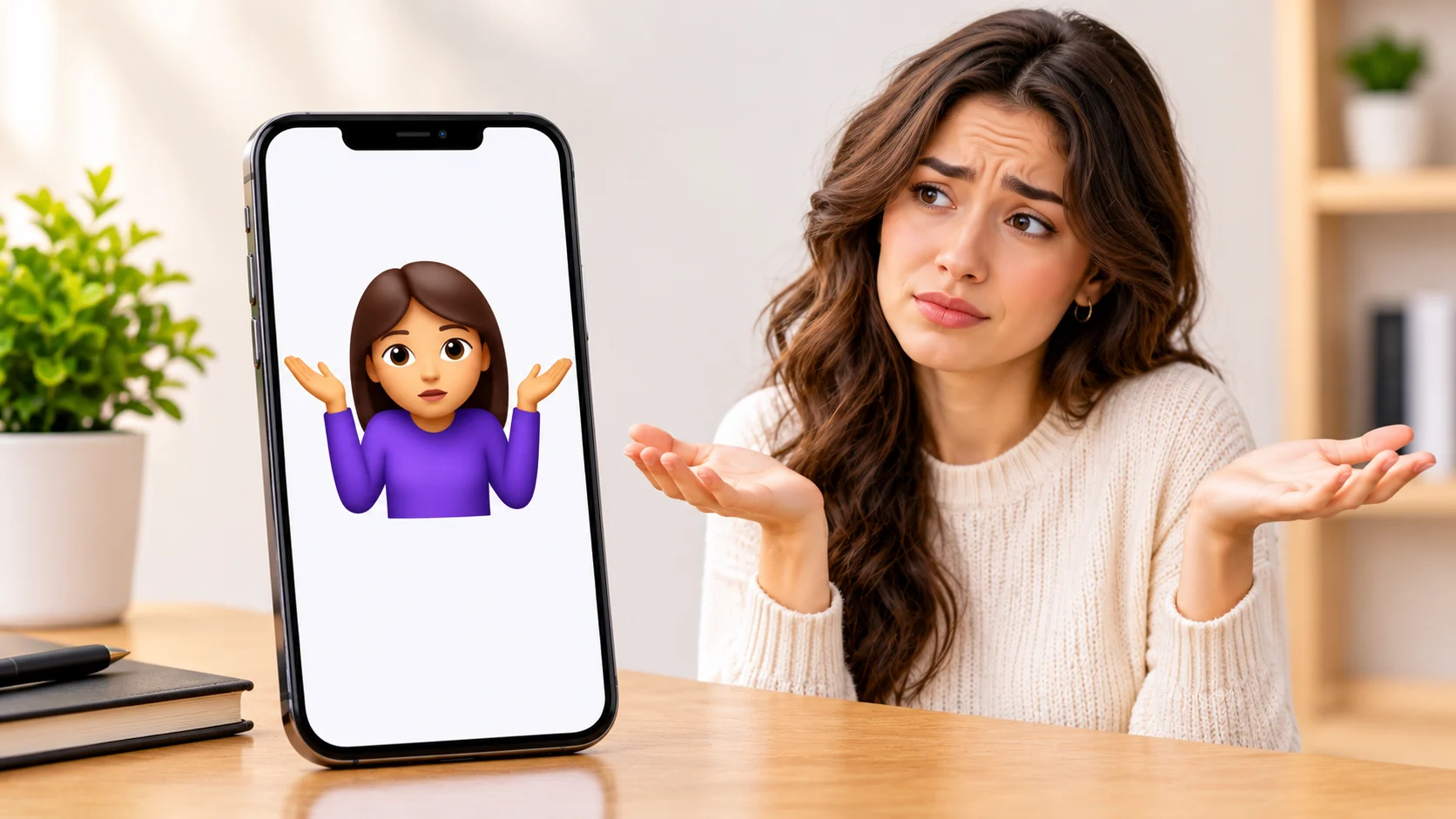
The 🤷 emoji is commonly used to mean “I don’t know,” “I’m not sure,” or “What can I say?” It expresses uncertainty, confusion, or a relaxed, sometimes humorous attitude toward a situation.
The IDK emoji 🤷 is commonly used when someone does not know an answer, feels uncertain, or has no clear explanation for something. It is officially called Person Shrugging and visually represents a person raising their shoulders in a shrug. In texting, it often replaces the phrase “I don’t know” or adds a casual tone to an uncertain response.
Depending on the conversation, it can also express confusion, indifference, helplessness, or playful uncertainty. However, it does not always mean that someone does not care. The surrounding words and situation help reveal the intended message.
What Does the IDK Emoji 🤷 Mean?
The 🤷 emoji usually communicates uncertainty or a lack of knowledge. It visually represents the familiar shrug gesture people use when they do not have an answer or cannot explain something.
People commonly use it to express:
- Not knowing: They genuinely do not have an answer.
- Uncertainty: They are unsure what will happen or what to choose.
- Confusion: They cannot understand a situation.
- Indifference: They do not have a strong opinion or preference.
- Helplessness: They cannot control or change something.
- Playful humor: They are responding casually to an unexpected situation.
For example, “What time does the movie start? 🤷” suggests that the sender does not know. Meanwhile, “Well, that’s life 🤷” can communicate acceptance or a relaxed attitude toward something unexpected.
The exact meaning depends on the message. A shrug can show genuine uncertainty, but it can also make a response sound casual, humorous, or slightly dismissive.
Why Do People Use 🤷 Instead of Writing “I Don’t Know”?
The shrugging emoji can communicate a complete reaction without requiring a long explanation. It is especially useful when someone wants to keep a conversation casual.
For example:
- To save time: Instead of typing “I don’t know,” someone sends 🤷.
- To show uncertainty: It communicates that the person has no definite answer.
- To avoid choosing: It can suggest that either option is fine.
- To make a situation humorous: It adds a playful reaction to something unexpected.
- To express acceptance: It can suggest that a situation is outside someone’s control.
For example, if someone asks, “Which restaurant should we visit?” replying “Either one 🤷” may mean that both choices are acceptable.
What Does 🤷 Mean When Someone Sends It to You?
When someone sends 🤷 in a private message, they are often expressing uncertainty or showing that they do not have an answer.
However, the tone can change depending on the conversation.
| Message | Possible meaning |
|---|---|
| “I have no idea 🤷” | Genuine uncertainty |
| “Whatever happens, happens 🤷” | Acceptance |
| “You tell me 🤷” | Asking you to decide |
| “That’s not my problem 🤷” | Possible indifference |
| “I guess we’ll see 🤷” | Uncertainty about the future |
A single shrug does not necessarily mean the sender is annoyed or uninterested. Some people use it as a normal, casual reaction. If the response seems unclear, consider the surrounding messages before making assumptions.
Does the IDK Emoji Mean Someone Doesn’t Care?
Not always. This is one of the most common misunderstandings about 🤷.
The emoji can communicate different levels of interest:
- Uncertainty: “I genuinely don’t know.”
- Acceptance: “There isn’t much I can do about it.”
- Indifference: “I don’t have a preference.”
- Dismissiveness: “I don’t want to discuss this.”
Compare these messages:
- “What should we watch? 🤷” — The sender may be open to suggestions.
- “I don’t know what happened 🤷” — The sender may genuinely lack information.
- “Not my problem 🤷” — The sender may be dismissing the issue.
The words surrounding the emoji are more useful than the shrug alone when deciding someone is being helpful, indifferent, or dismissive.
Is 🤷 Rude, Sarcastic or Dismissive?
The 🤷 emoji is not automatically rude. It usually has a casual, neutral, or playful tone.
However, it can feel dismissive when someone uses it to avoid answering an important question or ignores another person’s concerns.
For example:
- “Sorry, I don’t know 🤷” — Usually a casual admission of uncertainty.
- “What do you expect me to do? 🤷” — May sound defensive or dismissive.
- “Well, that’s life 🤷” — Often communicates acceptance, possibly with humor.
If you are discussing something serious, a shrug without an explanation may feel less thoughtful than a complete response. In those situations, adding a few words can make your intention clearer.
🤷 vs. 🤦 vs. 😕: What’s the Difference?
These emojis can all appear in conversations about confusion or unexpected situations, but they express different reactions.
- 🤷 Person Shrugging: Shows uncertainty, not knowing, or having no clear answer.
- 🤦 Person Facepalming: Expresses disbelief, embarrassment, frustration, or disappointment.
- 😕 Confused Face: Shows confusion or uncertainty about something.
The difference is mainly in the gesture and emotional tone. A shrug communicates “I don’t know,” a facepalm suggests “I can’t believe this,” and a confused face communicates “I don’t understand.”
Emojis Similar to 🤷 and Their Meanings
| Emoji | Official Name | Common Meaning | Tone | Where or When It Is Used |
|---|---|---|---|---|
| 🤷 | Person Shrugging | I don’t know or I’m unsure | Casual, uncertain | Unknown answers and unclear situations |
| 🤷♂️ | Man Shrugging | Uncertainty or indifference | Casual | Informal conversations |
| 🤷♀️ | Woman Shrugging | Not knowing or having no preference | Casual | Everyday text replies |
| 😕 | Confused Face | Confusion or uncertainty | Puzzled | Asking for clarification |
| 🤔 | Thinking Face | Thinking or considering something | Curious | Decisions and questions |
| 🤦 | Person Facepalming | Disbelief or frustration | Exasperated | Mistakes and awkward situations |
| 😐 | Neutral Face | Little or no visible emotion | Neutral | Flat or restrained reactions |
| 😬 | Grimacing Face | Awkwardness or nervousness | Uncomfortable | Embarrassing situations |
The most important difference is that 🤷 represents a shrug, while 🤔 shows someone thinking and 😕 communicates confusion. The gendered versions, 🤷♂️ and 🤷♀️, represent the same basic shrugging gesture with different depicted genders.
Choose 🤷 when you have no answer, 🤔 when you are considering something, and 😕 when you do not understand what is happening.
How to Respond to the 🤷 Emoji
Your response depends on why the person sent the shrug. Here are some natural replies for different situations:
- When someone doesn’t know: “No worries, I’ll figure it out.”
- When someone has no preference: “Let’s go with the first option.”
- When someone seems confused: “Let me explain what I mean.”
- When someone is being playful: “Haha, fair enough!”
- When you need a clear answer: “Can you give me your best guess?”
If the topic is important, ask a direct question instead of trying to guess the meaning of the emoji.
Does the IDK Emoji Look Different on iPhone and Android?
Yes. The appearance of 🤷 can vary across Apple, Google, Samsung, and other platforms.
Some versions may show different clothing, hairstyles, facial expressions, or hand positions. However, the main gesture remains the same: a person raising their shoulders and hands to communicate uncertainty or a lack of knowledge.
These design differences do not create separate official meanings. The emoji represents the same basic shrugging gesture across platforms.
Official Name and Unicode Details
The emoji commonly called the IDK emoji has an official Unicode name: Person Shrugging.
Here are its identification details:
| Detail | Information |
|---|---|
| Emoji | 🤷 |
| Official Unicode name | Person Shrugging |
| Unicode code point | U+1F937 |
| Category | People & Body |
| Subcategory | Person Gesture |
| Unicode version | Unicode 9.0 |
| Approval year | 2016 |
Unicode also includes gender-specific versions and skin-tone variations. These are different visual forms of the same basic shrugging gesture. Unicode+2
Copy and Paste the IDK Emoji
🤷
Person Shrugging Copy 🤷
You can copy and paste 🤷 into text messages, social media captions, comments, and everyday conversations whenever you want to express uncertainty or say “I don’t know.”
FAQs
Is 🤷 officially called the IDK emoji?
No. Its official Unicode name is Person Shrugging. People informally call it the IDK emoji because the shrugging gesture commonly communicates “I don’t know.”
What does 🤷 mean from a girl or a guy?
The basic meaning does not change based on the sender’s gender. It usually expresses uncertainty, indifference, acceptance, or a lack of information. The conversation provides more useful clues than gender.
Does 🤷 mean whatever?
It can. In some conversations, the shrug suggests “whatever,” especially when someone has no preference or does not want to make a decision. However, it can also simply mean that they do not know.
Is 🤷 a negative emoji?
Not necessarily. It can be neutral, playful, or mildly dismissive depending on the message. Its usual purpose is to communicate uncertainty or a shrugging reaction.
What is the difference between IDK and 🤷?
IDK is an abbreviation for “I don’t know,” while 🤷 is a visual gesture that can communicate the same idea. The emoji can also express indifference, acceptance, or uncertainty without using those exact words.
Can I use 🤷 in professional messages?
It depends on the situation. It may be acceptable in casual workplace conversations, but a direct written response is usually clearer in formal emails, important discussions, or professional communication.
Conclusion
The 🤷 IDK emoji is a simple way to express uncertainty, confusion, or a lack of information. Its official name, Person Shrugging, reflects the familiar gesture of raising your shoulders when you do not have an answer. It can also suggest acceptance, indifference, or playful humor depending on the conversation. When interpreting this emoji, pay attention to the surrounding words rather than assuming that every shrug means the sender does not care.
See Also More:
- Beggar Emoji Meaning | What It Means in Text and How to Use It In 2026
- Sexy Emoji Meaning | What These Emojis Really Mean In 2026
- Fist Emoji | What It Means in Text, Support, Solidarity & More In 2026