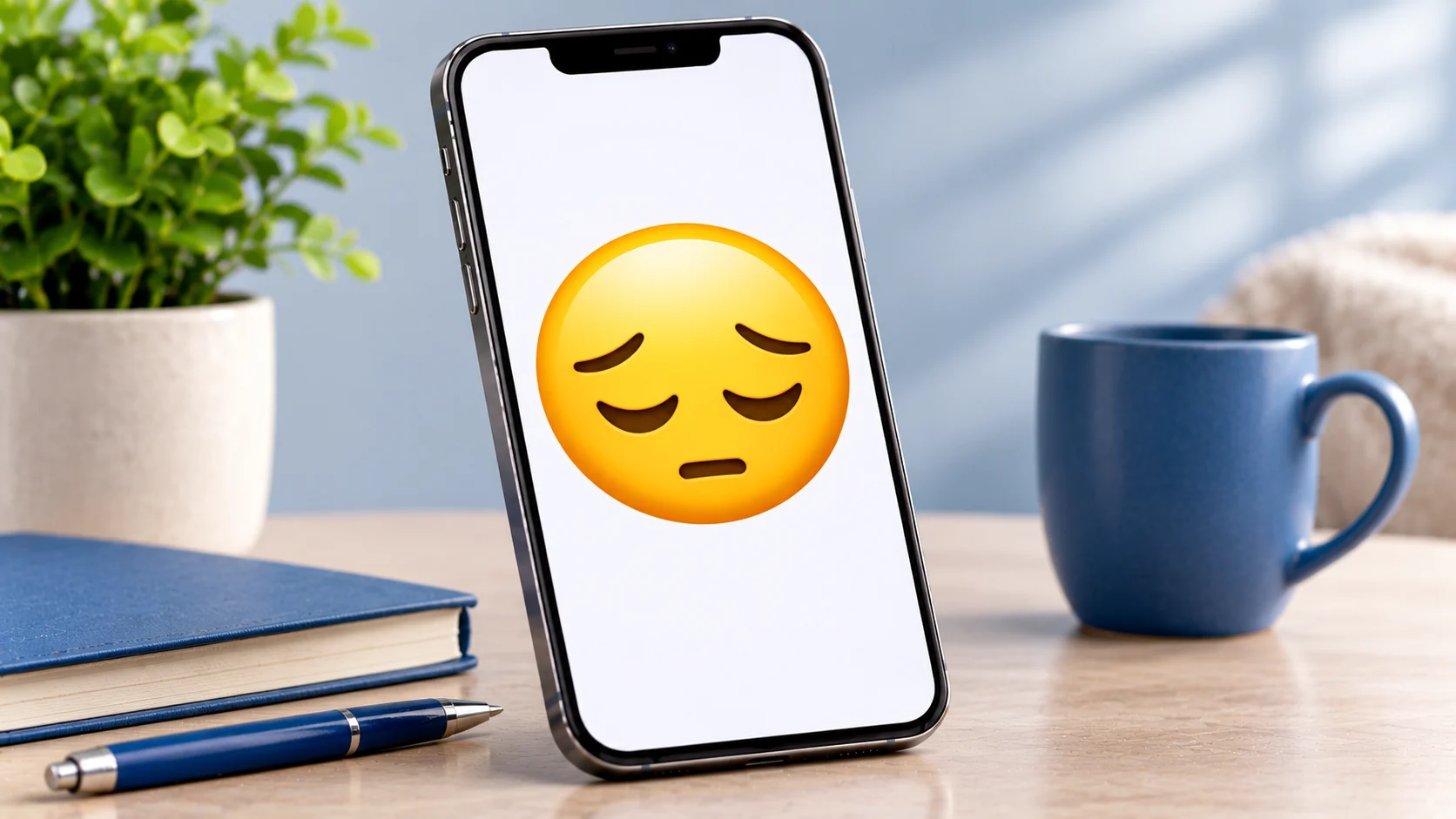
The 😔 pensive emoji usually expresses sadness, disappointment, regret, or quiet reflection. It can show that someone feels down, misses something, or is thinking seriously about a situation. Its exact meaning depends on the conversation and the emotions behind the message.
The pensive emoji 😔 shows a face with lowered eyes, slightly raised inner eyebrows, and a small, downturned mouth. Its official Unicode name is Pensive Face. People commonly use it to express sadness, disappointment, regret, sympathy, or thoughtful feelings. Unlike crying emojis, it often communicates a quieter kind of sadness without showing tears.
In text messages, it can suggest that someone is feeling low, remembering something emotional, or reflecting on an uncomfortable situation. However, the emoji does not always indicate serious sadness. The surrounding words and conversation help reveal its intended meaning.
What Does 😔 Mean in Text Messages?
In texting, the 😔 emoji often communicates feelings that are difficult to express with words. It can make a message sound more emotional, personal, or thoughtful.
Here are some common interpretations:
- Sadness: Showing that something has made you unhappy.
- Disappointment: Reacting to an outcome that did not meet expectations.
- Regret: Expressing that you wish something had happened differently.
- Loneliness: Suggesting that you miss someone or feel emotionally distant.
- Reflection: Showing that you are thinking seriously about something.
- Sympathy: Acknowledging another person’s difficult experience.
For example, someone might write, “I really wanted to see you today 😔.” This suggests disappointment or sadness because the meeting did not happen.
The emoji can also soften an emotional message. Instead of directly explaining every feeling, someone may add 😔 to show that their words come from a sad or thoughtful place.
Different Emotional Meanings of the Pensive Emoji
Although sadness is its main interpretation, 😔 can communicate several related emotions.
1. Sadness and Feeling Down
The emoji can express a low mood or disappointment about something unpleasant.
Example: “Today wasn’t a good day 😔”
The message suggests that the person is feeling down and may not want to explain everything.
2. Disappointment
People may use 😔 when plans fail, expectations are not met, or something does not go as hoped.
Example: “The event got canceled 😔”
Here, the emoji emphasizes disappointment rather than intense sadness.
3. Regret and Remorse
Sometimes, 😔 accompanies an apology or a message about a past mistake.
Example: “I wish I had handled that differently 😔”
It adds a thoughtful, regretful tone to the statement.
4. Missing Someone
In personal conversations, the emoji can suggest that someone misses a friend, family member, or someone important to them.
Example: “I miss our old conversations 😔”
The message expresses nostalgia or sadness about something that has changed.
5. Quiet Reflection
Not every use of 😔 means someone is deeply upset. It can also represent serious thought, reflection, or a moment of disappointment.
Example: “Sometimes things don’t happen the way we expect 😔”
In this context, the emoji adds a reflective and slightly sad feeling.
What Does 😔 Mean From Someone?
When someone sends you 😔, they may be expressing sadness, disappointment, regret, or sympathy.
The surrounding message can help you understand their intention.
| Example message | Possible interpretation |
|---|---|
| “I had a difficult day 😔” | They may be feeling down. |
| “I wish you were here 😔” | They may miss your company. |
| “I’m sorry about yesterday 😔” | They may feel regretful. |
| “That’s really unfortunate 😔” | They are showing sympathy. |
| “I didn’t get the result I wanted 😔” | They are disappointed. |
If someone sends only 😔 without words, it is difficult to know exactly what they mean. They might be sad, disappointed, or simply looking for a little understanding.
A gentle question is usually better than making assumptions.
Is 😔 a Sad or Depressed Emoji?
The 😔 emoji is commonly associated with sadness and disappointment, but it is not a diagnosis or a reliable way to determine someone’s mental health.
It often represents a temporary emotional reaction, such as feeling disappointed about canceled plans or remembering an unpleasant experience.
For example:
- “I forgot my friend’s birthday 😔” — Regret.
- “My favorite team lost 😔” — Disappointment.
- “I miss those summer days 😔” — Nostalgia.
The emoji can communicate a serious or emotional mood, but its use alone does not tell you how someone is feeling overall.
Is the Pensive Emoji Romantic or Flirty?
The 😔 emoji is not primarily a flirting emoji. Its usual meaning is sadness, disappointment, or reflection.
In a personal conversation, it may appear when someone misses another person or feels disappointed about not spending time together.
For example:
- “I wish we could meet this weekend 😔” — Disappointment about not meeting.
- “I miss talking to you 😔” — Missing someone’s company.
- “It’s been a while since we last met 😔” — Nostalgia or sadness about the distance.
These messages may occur in romantic or friendly relationships. The emoji itself does not prove attraction or romantic interest.
😔 vs. 😞 vs. 😢: What’s the Difference?
These three emojis are closely related because they can all communicate sadness. However, their expressions and common interpretations are slightly different.
- 😔 Pensive Face: Often expresses quiet sadness, regret, disappointment, or reflection.
- 😞 Disappointed Face: More directly communicates dissatisfaction or disappointment.
- 😢 Crying Face: Shows sadness with a visible tear, making the emotional expression more obvious.
The difference is mainly in the emotional emphasis. Use 😔 for a thoughtful or quietly sad message, 😞 for disappointment, and 😢 when you want to make sadness more visible.
Related Sad and Thoughtful Emojis and Their Meanings
Several emojis can express sadness, disappointment, or reflection. The following comparison helps explain how 😔 differs from other emotional faces.
| Emoji | Official Name | Common Meaning | Tone | Where or When It Is Used |
|---|---|---|---|---|
| 😔 | Pensive Face | Sadness, regret, or reflection | Thoughtful, somber | Disappointing news and emotional messages |
| 😞 | Disappointed Face | Dissatisfaction or disappointment | Sad, discouraged | Unsuccessful plans or unwanted results |
| 😢 | Crying Face | Sadness or emotional pain | Emotional, sorrowful | Upsetting news and sympathy |
| 😭 | Loudly Crying Face | Intense crying or overwhelming emotion | Dramatic, emotional | Strong reactions and exaggerated sadness |
| 😥 | Sad but Relieved Face | Disappointment mixed with relief | Worried, relieved | Difficult situations that turn out okay |
| 😟 | Worried Face | Concern or anxiety | Uneasy, concerned | Uncertain situations and worries |
| 😕 | Confused Face | Uncertainty or confusion | Puzzled, unsure | Unexpected information and misunderstandings |
| 🥺 | Pleading Face | Asking for kindness or showing vulnerability | Gentle, emotional | Requests, apologies, and affectionate messages |
| 😌 | Relieved Face | Peace, calmness, or relief | Relaxed, peaceful | Reassuring news and stressful situations ending |
Which Sad Emoji Should You Choose?
The best choice depends on the emotion you want to communicate:
- Choose 😔 when you feel quietly sad, disappointed, or thoughtful.
- Choose 😞 when something has not gone as expected.
- Choose 😢 when you want to express visible sadness.
- Choose 😭 when the reaction is much more intense or exaggerated.
- Choose 😟 when you are worried about something.
- Choose 🥺 when you want to express vulnerability or make a gentle request.
- Choose 😌 when you feel calm or relieved rather than sad.
One important distinction is between 😔 and 😌. Their closed eyes may look similar, but their expressions communicate different moods. 😔 usually suggests sadness or reflection, while 😌 generally represents relief or contentment.
How to Respond to the 😔 Emoji
If someone sends you 😔, consider the conversation before replying. A supportive response can help acknowledge their feelings without making assumptions.
Here are some natural responses for different situations:
| Situation | Possible Response |
|---|---|
| Someone feels disappointed | “I’m sorry things didn’t work out.” |
| Someone misses you | “I miss those moments too.” |
| Someone had a difficult day | “Hope tomorrow goes better.” |
| Someone expresses regret | “It’s okay. We all make mistakes.” |
| Someone shares upsetting news | “That’s really unfortunate. Are you okay?” |
| You don’t understand the emoji | “Is everything alright?” |
You can also respond with a simple supportive emoji, such as ❤️ or 🫂, if it feels appropriate for your relationship and the conversation.
The goal is to acknowledge the message rather than assume you know exactly what the other person is experiencing.
Does the Pensive Emoji Look Different on Different Platforms?
Yes. The appearance of 😔 can vary slightly across Apple, Google, Samsung, Microsoft, and other platforms.
😔 – Cara pensativa Significado del emoji, copiar y pegar
😔 Pensive Face Emoji: Meaning & Usage
😔 Pensive Face on Facebook 15.0
4
Some versions may have slightly different eye shapes, eyebrows, mouth positions, or facial details. These visual changes can affect how expressive the emoji looks.
However, the underlying Unicode character remains the same. The official name and basic emotional association do not change simply because someone uses a different device.
Official Name and Unicode Details of 😔
The Unicode Consortium identifies 😔 as Pensive Face. It belongs to the Smileys and Emotion emoji category.
Here are its basic technical details:
| Detail | Information |
|---|---|
| Emoji | 😔 |
| Official Unicode name | Pensive Face |
| Unicode code point | U+1F614 |
| Unicode version | Unicode 6.0 |
| Approval year | 2010 |
| Emoji version | Emoji 1.0 |
| Category | Smileys & Emotion |
| General interpretation | Sadness, disappointment, reflection |
The emoji was approved in Unicode 6.0 in 2010 and included in Emoji 1.0 in 2015. Its official name identifies the expression, while meanings such as regret, loneliness, and disappointment come from common conversational use. Unicode+1
Copy and Paste the Pensive Emoji
Want to use the pensive emoji in a message, caption, or comment? You can copy it here:
😔
Pensive Face
Unicode: U+1F614 Copy 😔 Emoji
You can paste 😔 into text messages, social media captions, comments, and other conversations whenever you want to express a thoughtful or sad feeling.
FAQs
What does 😔 mean from a girl or a boy?
The 😔 emoji generally expresses sadness, disappointment, regret, or reflection regardless of who sends it. The sender’s gender does not determine its meaning. The surrounding conversation is more useful for understanding the message.
Does 😔 mean someone is upset?
It can suggest that someone is upset, disappointed, or feeling down. However, it may also represent quiet reflection or regret. A single emoji cannot tell you exactly how someone feels.
Is 😔 the same as 😢?
No. 😔 usually communicates quiet sadness or thoughtful disappointment, while 😢 includes a visible tear and expresses sadness more directly.
What is the difference between 😔 and 😞?
😔 is commonly associated with reflection, regret, and quiet sadness. 😞 more directly communicates disappointment or dissatisfaction with a situation.
Can 😔 mean missing someone?
Yes. In personal conversations, it can suggest that someone misses another person or feels sad about being apart. The words accompanying it help clarify the intended meaning.
Is 😔 a negative emoji?
It generally has a sad or somber tone rather than a positive one. However, it can also communicate empathy, reflection, or a thoughtful reaction without suggesting intense sadness.
What does 😔 mean when someone sends it alone?
When sent without words, it may indicate sadness, disappointment, regret, or a thoughtful mood. If you are unsure, asking everything is okay is a natural response.
Conclusion
The 😔 pensive emoji usually represents quiet sadness, disappointment, regret, or thoughtful reflection. It is useful when someone wants to express an emotional reaction without using a crying face or explaining everything in words. Although it can also suggest missing someone or feeling sympathetic, its meaning depends on the conversation. Understanding the surrounding message helps you interpret the emoji more accurately.
See Also More:
- Beggar Emoji Meaning | What It Means in Text and How to Use It In 2026
- Sexy Emoji Meaning | What These Emojis Really Mean In 2026
- Fist Emoji | What It Means in Text, Support, Solidarity & More In 2026