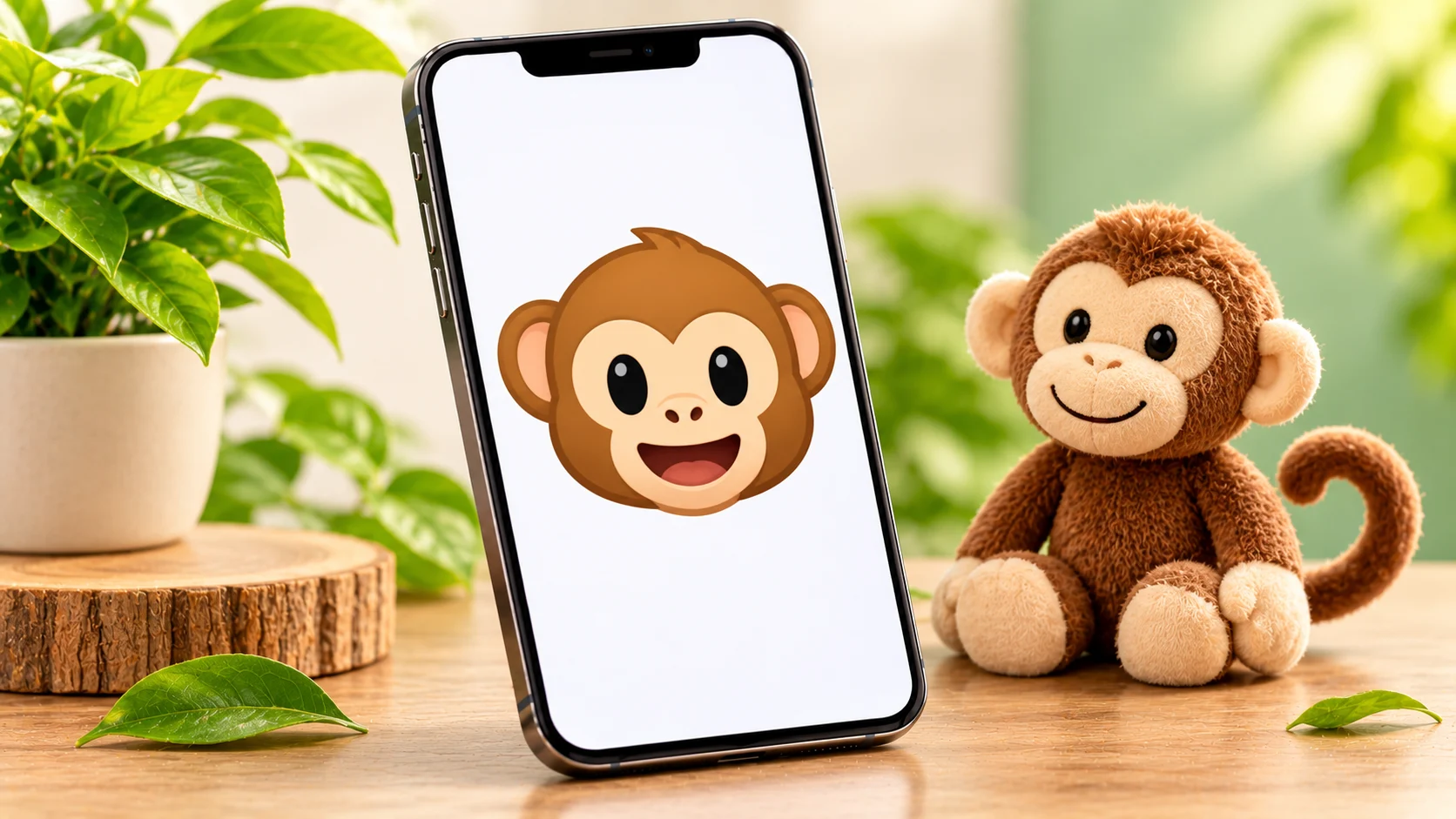
The 🐒 monkey emoji usually represents monkeys, playful behavior, curiosity, or mischief. It can also refer to jokes, silly moments, and animal-related conversations. The three related emojis 🙈, 🙉, and 🙊 have different meanings, commonly expressing embarrassment, not hearing something, or keeping a secret.
The monkey emoji 🐒 is commonly used to represent monkeys, playful behavior, curiosity, and silly moments. In text messages, it can add a funny or mischievous tone to a conversation. However, the monkey emoji family includes several different expressions, especially the famous three wise monkeys: 🙈 See-No-Evil Monkey, 🙉 Hear-No-Evil Monkey, and 🙊 Speak-No-Evil Monkey.
Each has its own visual meaning and common use. Understanding the differences helps you choose the right emoji for jokes, awkward situations, playful reactions, and everyday conversations without confusing one expression with another.
What Does the 🐒 Monkey Emoji Mean?
The 🐒 monkey emoji usually represents a real monkey, playful behavior, curiosity, or mischief. It can also add a silly or humorous feeling to everyday messages.
People use it in several ways:
- Animals and wildlife: Talking about monkeys, zoos, nature, or animal videos.
- Playfulness: Showing a silly mood or joking around.
- Mischief: Suggesting someone is being cheeky or doing something playful.
- Curiosity: Reacting to something unusual or interesting.
- Humor: Making a message feel less serious.
For example:
- “Look at this cute monkey! 🐒” — Refers to an actual animal.
- “I’m feeling silly today 🐒” — Expresses a playful mood.
- “You are such a little troublemaker 🐒” — Adds a teasing, humorous tone.
The emoji does not have one fixed emotional meaning. A conversation about wildlife gives it a literal meaning, while a playful exchange may use it as a funny reaction.
🐵 Monkey Face vs. 🐒 Monkey: What’s the Difference?
These two emojis are closely related, but their designs are different.
- 🐵 Monkey Face: Shows a monkey’s face without its full body. It is useful for expressing monkey-related reactions, silliness, or playful behavior.
- 🐒 Monkey: Shows a full monkey, making it a natural choice for animal-related conversations, wildlife, and playful references.
For example, “Look at this monkey 🐒” sounds like a reference to the animal, while “I’m acting silly today 🐵” gives the message a playful feel.
Neither emoji has a guaranteed emotional meaning. The surrounding words help explain the intended message.
What Do the Three Wise Monkey Emojis Mean?
🙈
See-No-EvilCovering the eyes
🙉
Hear-No-EvilCovering the ears
🙊
Speak-No-EvilCovering the mouth
The three wise monkey emojis come from the traditional idea of seeing no evil, hearing no evil, and speaking no evil. In modern texting, people often use them to express embarrassment, avoiding something, or keeping a secret.
🙈 See-No-Evil Monkey
The 🙈 emoji usually expresses embarrassment, shyness, awkwardness, or playful avoidance.
People may use it when:
- They feel embarrassed about something.
- They see something surprising or awkward.
- They want to avoid looking at an uncomfortable situation.
- They are joking about a mistake.
Example: “I accidentally waved at the wrong person 🙈”
The emoji makes the situation sound lighthearted rather than overly serious.
🙉 Hear-No-Evil Monkey
The 🙉 emoji commonly represents not wanting to hear something, ignoring unwanted information, or playfully avoiding a conversation.
It can be used when:
- Someone does not want to hear a spoiler.
- A conversation includes unwanted information.
- Someone is joking about ignoring advice.
- A person wants to avoid hearing gossip.
Example: “Please don’t tell me how the movie ends 🙉”
Here, the emoji suggests that the person would rather not hear the information.
🙊 Speak-No-Evil Monkey
The 🙊 emoji usually suggests keeping quiet, holding back a comment, or keeping something secret.
People may use it when:
- They accidentally reveal something.
- They want to keep a secret.
- They are trying not to say something.
- They have something to share but are holding back.
Example: “I know what the surprise is, but I won’t tell anyone 🙊”
The covered mouth makes it a natural visual choice for playful secrecy.
What Does the Monkey Emoji Mean in Texting?
In text messages, monkey emojis can make conversations more expressive, funny, or playful.
Their meanings depend on which monkey emoji appears and what the sender is discussing.
| Example message | Likely meaning | Context |
|---|---|---|
| “That monkey is adorable 🐒” | Talking about an animal | Wildlife or animal conversation |
| “I’m being silly today 🐵” | Playful behavior | Casual conversation |
| “I can’t believe I did that 🙈” | Embarrassment | An awkward moment |
| “Don’t tell me the ending 🙉” | Avoiding information | Spoiler-related conversation |
| “It’s a secret 🙊” | Keeping something private | Playful secrecy |
These examples show why it is helpful to distinguish the regular monkey emojis from the three wise monkeys.
Does the Monkey Emoji Have a Flirty Meaning?
The 🐒 emoji is not automatically romantic or flirty. Its usual meaning is connected with animals, humor, playfulness, and mischief.
However, someone might use it in a playful conversation to make a message feel less serious.
For example:
- “You’re so silly 🐒” — Friendly teasing.
- “Stop making me laugh 🙈” — Playful embarrassment.
- “I have a little surprise for you 🙊” — Keeping something secret.
These messages may feel affectionate depending on the relationship, but the emojis alone do not prove romantic interest.
Emojis Similar to the Monkey Emoji and Their Meanings
| Emoji | Official Name | Common Meaning | Tone | Where or When It Is Used |
|---|---|---|---|---|
| 🐒 | Monkey | Monkey or playful behavior | Playful | Animal conversations and jokes |
| 🐵 | Monkey Face | Monkey face or silliness | Funny | Casual reactions and animal references |
| 🙈 | See-No-Evil Monkey | Embarrassment or avoidance | Shy, playful | Awkward moments |
| 🙉 | Hear-No-Evil Monkey | Not wanting to hear something | Humorous | Spoilers and unwanted information |
| 🙊 | Speak-No-Evil Monkey | Keeping quiet or a secret | Mischievous | Secrets and accidental comments |
| 🦍 | Gorilla | Gorilla or wildlife | Strong, animal-related | Animal discussions |
| 🦧 | Orangutan | Orangutan or wildlife | Neutral, animal-related | Nature and animal conversations |
| 🐵 | Monkey Face | Monkey-related expression | Lighthearted | Funny messages and reactions |
Understanding the differences: 🐒 and 🐵 are the most closely related regular monkey emojis. The first shows a full monkey, while the second shows only its face. The three wise monkey emojis have more specific expressions: 🙈 for not seeing, 🙉 for not hearing, and 🙊 for not speaking. Gorilla and orangutan emojis represent different animals rather than variations of the monkey expression.
How to Respond to a Monkey Emoji
Your response can depend on the sender is talking about an animal, making a joke, or using one of the three wise monkeys.
Here are some natural responses:
- When someone sends 🐒: “Haha, that’s a funny little monkey!”
- When someone sends 🐵: “You’re in a silly mood today!”
- When someone sends 🙈: “Don’t be embarrassed! It happens.”
- When someone sends 🙉: “Okay, I won’t spoil it!”
- When someone sends 🙊: “Now I’m curious. What’s the secret?”
If the meaning is unclear, you can simply ask what they mean.
Does the Monkey Emoji Look Different on iPhone and Android?
Yes. The appearance of the monkey emoji may vary across Apple, Google, Samsung, and other platforms.
Differences may include:
- Fur color and shading.
- Facial expression.
- Eye and mouth details.
- Shape and position of the body.
- Overall illustration style.
These are visual differences rather than separate meanings. The Unicode character remains the same across supported devices, even when the artwork looks slightly different.
Official Name and Unicode Details
The Unicode Consortium lists the monkey emojis as separate characters with their own names and code points.
| Detail | 🐒 Monkey | 🐵 Monkey Face |
|---|---|---|
| Official name | Monkey | Monkey Face |
| Unicode code point | U+1F412 | U+1F435 |
| Category | Animals & Nature | Animals & Nature |
| Subcategory | Animal-Mammal | Animal-Mammal |
| Unicode version | Unicode 6.0 | Unicode 6.0 |
| Approval year | 2010 | 2010 |
The three wise monkey emojis also have individual Unicode identities:
| Emoji | Official Name | Unicode Code Point |
|---|---|---|
| 🙈 | See-No-Evil Monkey | U+1F648 |
| 🙉 | Hear-No-Evil Monkey | U+1F649 |
| 🙊 | Speak-No-Evil Monkey | U+1F64A |
These names identify the emoji characters. Their meanings in texting can be broader and depend on context. Unicode+1
Copy and Paste Monkey Emojis
You can copy any of these monkey emojis for messages, captions, comments, and social media posts.
🐒
MonkeyCopy
🐵
Monkey FaceCopy
🙈
See-No-EvilCopy
🙉
Hear-No-EvilCopy
🙊
Speak-No-EvilCopy
🦍
GorillaCopy
FAQs
What does 🐒 mean from someone?
The 🐒 emoji usually represents playfulness, humor, mischief, or an actual monkey. The intended meaning depends on the conversation and the sender’s communication style.
What is the difference between 🐒 and 🐵?
🐒 shows a full monkey, while 🐵 displays only a monkey’s face. Both can represent monkeys, but 🐵 may feel more expressive in playful conversations.
What does 🙈 mean in texting?
🙈 usually expresses embarrassment, shyness, or playful avoidance. Someone might use it after making an awkward mistake or receiving an unexpected compliment.
What do the three wise monkey emojis mean?
The three wise monkey emojis represent three different actions:
- 🙈 See-No-Evil: Avoiding seeing something.
- 🙉 Hear-No-Evil: Avoiding hearing something.
- 🙊 Speak-No-Evil: Keeping quiet or not revealing information.
Is 🐒 a positive emoji?
Generally, yes. It often creates a playful, funny, or friendly tone. However, its meaning depends on the message and situation.
Does 🙊 mean someone is keeping a secret?
It can. 🙊 commonly represents keeping quiet, holding back information, or joking about revealing a secret. It does not necessarily mean the sender is hiding something serious.
Can 🙈 mean embarrassment?
Yes. 🙈 is commonly used to express embarrassment, shyness, or an awkward reaction. It can also make a playful situation feel less serious.
Conclusion
The monkey emoji 🐒 represents monkeys, playful behavior, humor, and mischief. Its related emojis add more specific expressions: 🙈 suggests embarrassment, 🙉 represents avoiding something you hear, and 🙊 often means keeping quiet or protecting a secret. Understanding these differences makes it easier to choose the right monkey emoji for texts, social media captions, and everyday conversations.
See Also More:
- Beggar Emoji Meaning | What It Means in Text and How to Use It In 2026
- Sexy Emoji Meaning | What These Emojis Really Mean In 2026
- Fist Emoji | What It Means in Text, Support, Solidarity & More In 2026