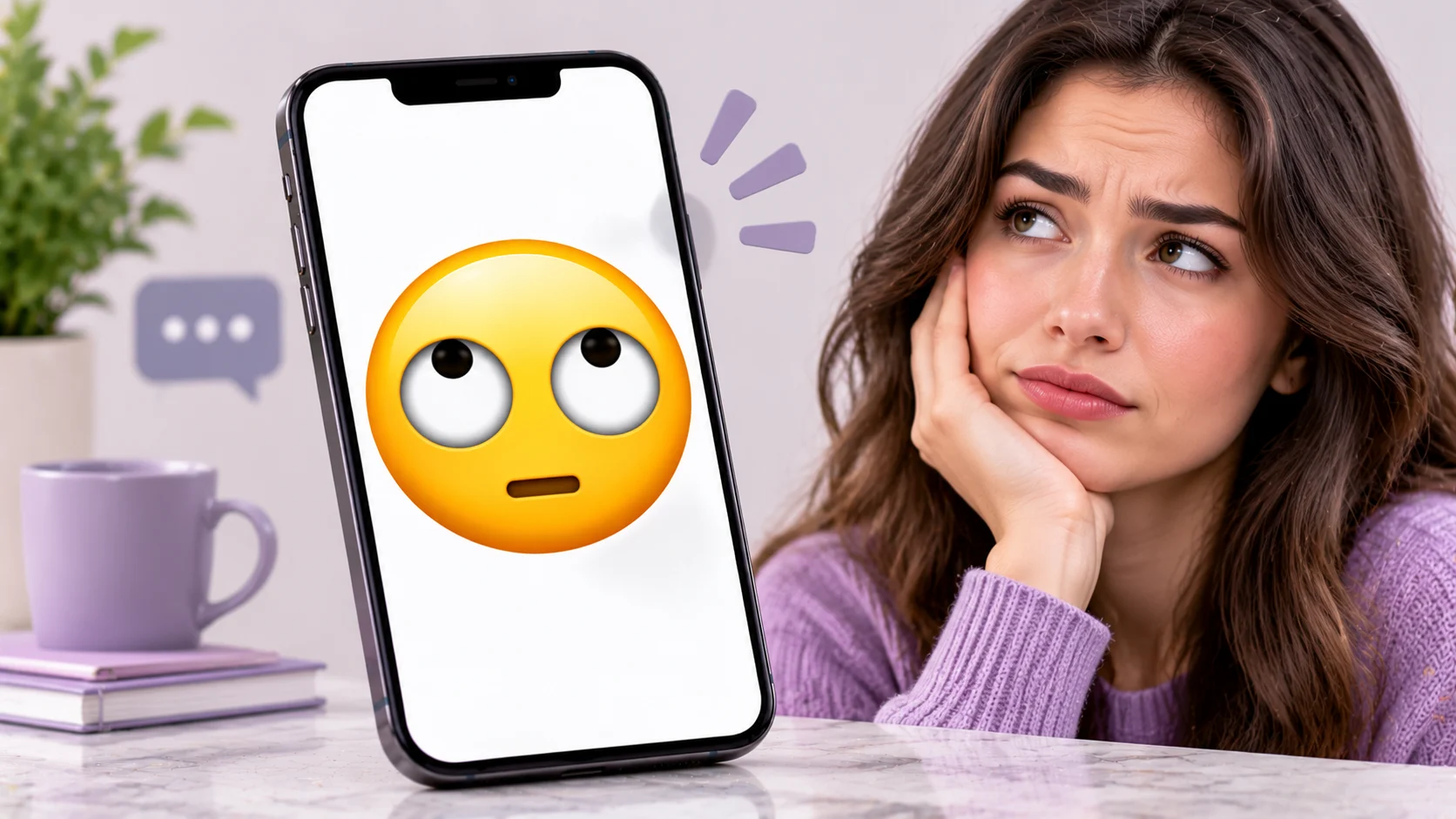
🙄 usually means “Seriously?”, “Whatever,” or “I can’t believe this.” It often communicates sarcasm or annoyance, but depending on the conversation, it can also be playful teasing.
The eye roll emoji 🙄 is commonly used in text messages and social media conversations to show an exaggerated reaction. People often send it when they are frustrated by something, disagree with a statement, or find a situation unnecessarily dramatic. It can also express playful sarcasm between people who know each other well. Its official Unicode name is Face with Rolling Eyes.
However, the emoji does not always indicate genuine anger or disrespect. The surrounding words, relationship, and tone of the conversation help determine the sender is joking, irritated, or simply expressing disbelief.
What Does the 🙄 Eye Roll Emoji Mean?
The 🙄 emoji represents a facial expression in which the eyes look upward. In everyday communication, this gesture is often associated with annoyance, disbelief, or an exaggerated reaction.
Common interpretations include:
- Annoyance: Showing irritation about something frustrating.
- Sarcasm: Reacting to a statement that seems silly or unbelievable.
- Disbelief: Expressing doubt about what someone has said.
- Impatience: Showing that someone is tired of waiting or repeating something.
- Playful teasing: Making a dramatic reaction during a friendly conversation.
- Dismissiveness: Suggesting that a comment is not worth taking seriously.
For example, someone might reply “Not this again 🙄” when a familiar problem comes up. The emoji adds an irritated or sarcastic tone to the message.
However, it does not always mean that someone is angry. Friends may use it jokingly when teasing each other about harmless situations.
What Does 🙄 Mean From Someone?
When someone sends 🙄, they may be expressing annoyance, disbelief, impatience, or playful sarcasm. The intended meaning depends on what happened before the message.
Here are a few examples:
- “You forgot again 🙄” — Expresses frustration about something repeated.
- “Sure, whatever you say 🙄” — May suggest disbelief or dismissiveness.
- “You’re so dramatic 🙄😂” — Likely playful teasing between friends.
- “I have to do all this work again 🙄” — Shows annoyance or frustration.
The emoji does not automatically mean someone is angry with you. Sometimes it is simply an exaggerated reaction to a joke or an everyday situation.
Is the Eye Roll Emoji Rude?
The 🙄 emoji can sound rude or dismissive, especially when someone uses it as a response to a serious message.
For example:
- “I already told you 🙄” may sound impatient.
- “That’s not what I meant 🙄” may come across as dismissive.
- “Oh, really? 🙄” may suggest disbelief or sarcasm.
However, close friends may use it without intending to offend anyone. If you are discussing something serious, a direct response with words is usually clearer than relying on an eye-roll emoji.
Does 🙄 Mean Sarcasm?
Yes. The eye roll emoji is often used to communicate sarcasm or an exaggerated reaction.
For example:
“Oh, great. Another meeting 🙄”
The words sound positive, but the emoji suggests that the person may actually be unhappy about the meeting.
Another example:
“Yeah, because that makes perfect sense 🙄”
Here, the emoji reinforces the sarcastic tone and suggests that the speaker does not agree.
Still, sarcasm is not guaranteed. The sender’s usual communication style and the conversation itself matter.
Related Emojis Similar to 🙄 and Their Meanings
Several facial emojis can express annoyance, disbelief, or frustration. However, each has a slightly different expression and conversational tone.
| Emoji | Official Name | Common Meaning | Tone | Where or When It Is Used |
|---|---|---|---|---|
| 🙄 | Face with Rolling Eyes | Annoyance or disbelief | Sarcastic, dismissive | Frustrating comments and exaggerated reactions |
| 😒 | Unamused Face | Dissatisfaction or disapproval | Unimpressed | Disappointing situations and unwanted comments |
| 😑 | Expressionless Face | No reaction or being fed up | Deadpan | Awkward conversations and repetitive situations |
| 😐 | Neutral Face | Neutral or uncertain feelings | Calm, restrained | When someone has little to say |
| 🤨 | Face with Raised Eyebrow | Doubt or suspicion | Skeptical | Questioning a statement or explanation |
| 😏 | Smirking Face | Self-confidence or playful teasing | Sly, cheeky | Jokes and suggestive comments |
| 😬 | Grimacing Face | Awkwardness or discomfort | Uneasy | Embarrassing moments and uncomfortable situations |
| 🤦 | Person Facepalming | Frustration or disbelief | Exasperated | Mistakes and disappointing decisions |
🙄 vs. 😒 vs. 😑: What’s the Difference?
These three emojis are easy to confuse because all can communicate negative or unimpressed reactions.
- 🙄 Eye Roll: Suggests annoyance, sarcasm, or disbelief. It often feels like an exaggerated reaction.
- 😒 Unamused Face: Shows dissatisfaction or disappointment without the upward eye movement.
- 😑 Expressionless Face: Communicates a blank, deadpan reaction, often suggesting that someone has nothing more to say.
If you want to express obvious annoyance, 🙄 is a natural choice. Use 😒 for an unimpressed reaction and 😑 when you want to communicate silence or a lack of enthusiasm.
How to Respond to the 🙄 Emoji
Your response depends on the sender is joking, annoyed, or expressing disbelief.
Here are some natural replies:
- Playful response: “Haha, what did I do now? 😂”
- Friendly response: “Come on, don’t be like that!”
- When someone seems annoyed: “Is something bothering you?”
- When someone disagrees: “Okay, tell me what you think.”
- When someone is being sarcastic: “I can tell you’re not impressed 😂”
If the conversation is serious, avoid responding with another sarcastic emoji. A simple question can help prevent a misunderstanding.
Does 🙄 Look Different on iPhone and Android?
Yes. The appearance of 🙄 can vary across Apple, Google, Samsung, and other platforms.
Some versions show a face with eyes looking directly upward and a flat mouth, while older designs on certain platforms used slightly different eye directions or facial expressions.
These visual differences do not change its official Unicode identity. However, they may affect how expressive or sarcastic the emoji looks on different devices. Meaning, Copy And Paste+1
Official Name and Unicode Details
The Unicode Consortium identifies 🙄 with the following details:
| Detail | Information |
|---|---|
| Emoji | 🙄 |
| Official Unicode name | Face with Rolling Eyes |
| Unicode code point | U+1F644 |
| Category | Smileys & Emotion |
| Unicode version | Unicode 8.0 |
| Approval year | 2015 |
| Emoji version | Emoji 1.0 |
The official name describes the facial expression rather than assigning one fixed emotional meaning. Annoyance, sarcasm, disbelief, and impatience are common interpretations based on everyday communication. Meaning, Copy And Paste+1
Copy and Paste the Eye Roll Emoji
🙄
Face with Rolling Eyes Copy 🙄
You can use 🙄 in text messages, social media captions, comments, and casual conversations whenever you want to express annoyance, disbelief, or playful sarcasm.
FAQs
What does 🙄 mean from a girl or boy?
The emoji generally communicates annoyance, disbelief, sarcasm, or playful frustration regardless of the sender’s gender. The conversation and relationship provide better clues about its meaning.
Does 🙄 mean someone is angry?
Not necessarily. It can express mild irritation, boredom, disbelief, or playful teasing. One emoji is not enough to determine someone is genuinely angry.
Is 🙄 a negative emoji?
Usually, it has a negative or unimpressed tone. However, friends sometimes use it humorously to exaggerate their reactions to harmless situations.
What does 🙄 mean when someone replies with only this emoji?
A reply containing only 🙄 may suggest that the person is unimpressed, annoyed, skeptical, or jokingly frustrated. The previous message is important for understanding the reaction.
Is 🙄 different from 🤨?
Yes. 🙄 usually communicates annoyance or disbelief through an eye roll. 🤨 suggests questioning, suspicion, or doubt through a raised eyebrow.
Can I use 🙄 with friends?
Yes. It can work well in casual conversations, especially when friends understand each other’s humor. However, it may sound dismissive in serious discussions or unfamiliar conversations.
Conclusion
The 🙄 eye roll emoji usually expresses annoyance, sarcasm, disbelief, or impatience. It is often used when someone finds a comment frustrating, a situation ridiculous, or a conversation repetitive. Among similar emojis, 😒 communicates dissatisfaction, while 😑 gives a more emotionless reaction. Remember that context matters: an eye roll can be genuinely dismissive or simply playful between friends.
See Also More:
- Beggar Emoji Meaning | What It Means in Text and How to Use It In 2026
- Sexy Emoji Meaning | What These Emojis Really Mean In 2026
- Fist Emoji | What It Means in Text, Support, Solidarity & More In 2026